Tawney
Down to the lowest pit with rank, and gifts that all admire;
Hurl virtue headlong from the steep, burn pedigrees with fire;
On valour let the bolt descend: for wealth alone we pray,
Without which noble qualities are vile as mouldy hay.
Telang
all
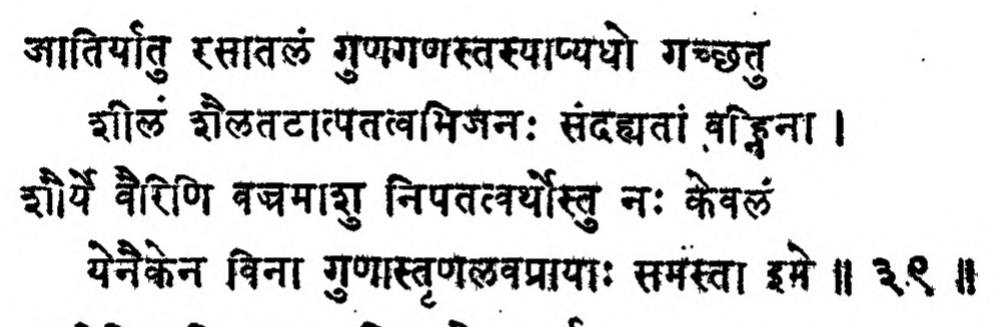
जातिर्यातु रसातलं गुणगणस्तस्याप्यधो गच्छतु
शीलं शैलतटात्पतत्वभिजनः संदह्यतां वह्निना ।
शौर्ये वैरिणि वज्रमाशु निपतत्वर्थोस्तु नः केवलं
येनैकेन विना गुणास्तृणलवप्रायाः समस्ता इमे ॥ ३९ ॥
Notes
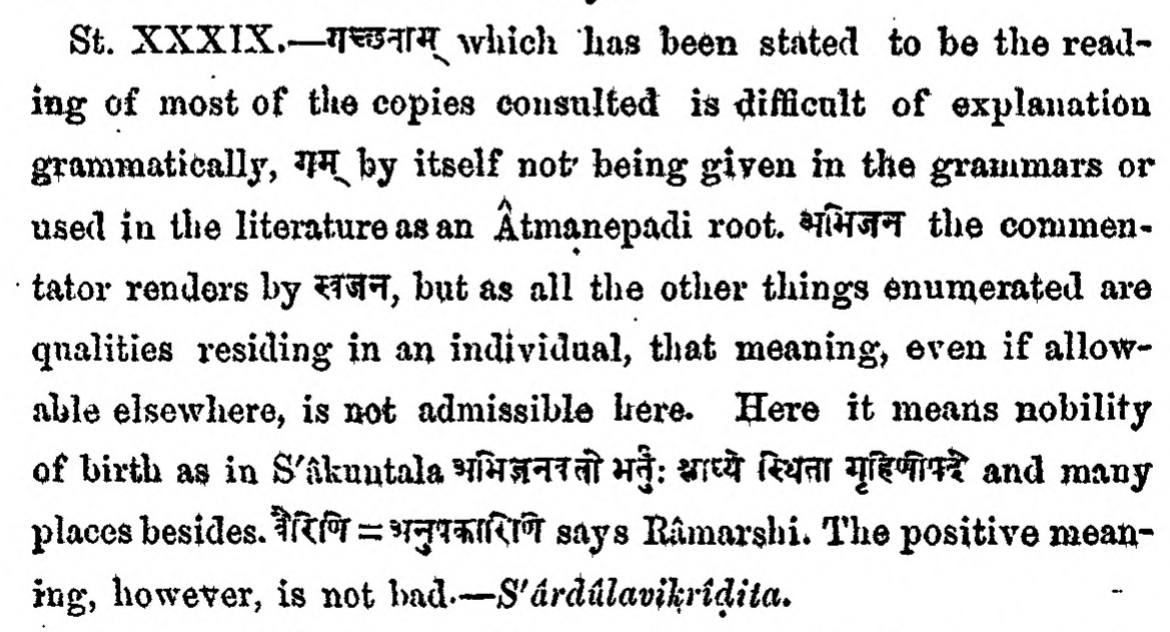
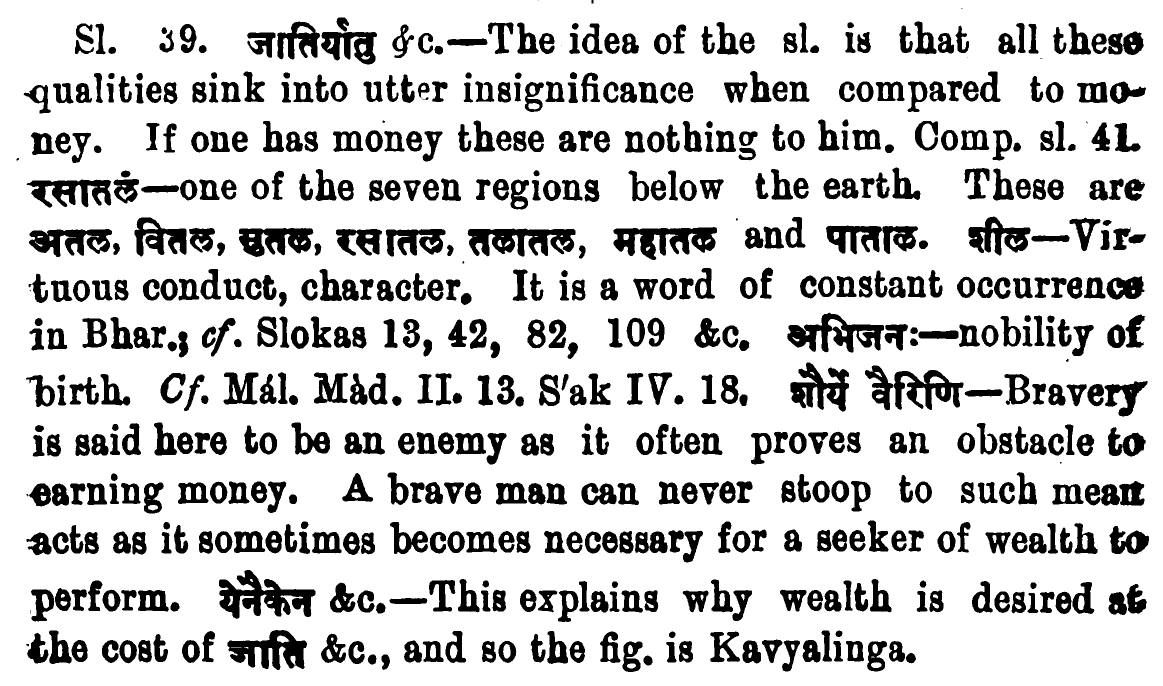
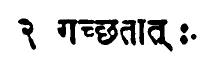
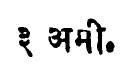
St. XXXIX.—गच्छताम् which has been stated to be the reading of most of the copies consulted is difficult of explanation grammatically, गम् by itself not being given in the grammars or used in the literature as an Âtmaṇepadi root. अभिजन the commentator renders by स्वजन, but as all the other things enumerated are qualities residing in an individual, that meaning, even if allowable elsewhere, is not admissible here. Here it means nobility of birth as in S'âkuntala अभिजनवतो भर्तुः श्लाघ्ये स्थिता गृहिणीपदे and many places besides. वैरिणि = अनुपकारिणि says Râmarshi. The positive meaning, however, is not bad.—S'ârdûlavikrîḍita.

Kale
all

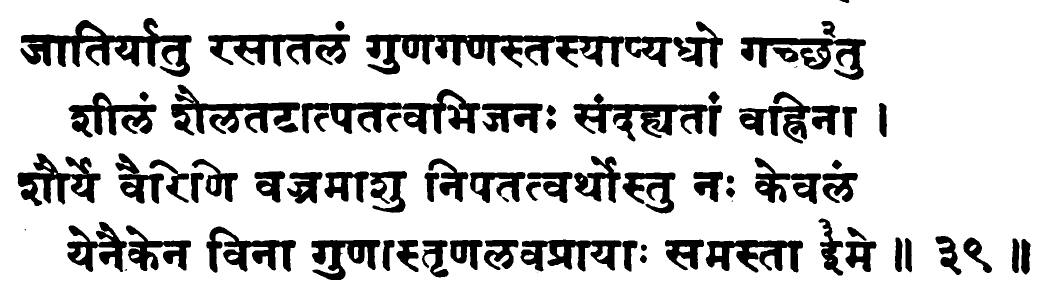
जातिर्यातु रसातलं गुणगणस्तस्याप्यधो गच्छतु
शीलं शैलतटात्पतत्वभिजनः संदह्यतां वह्निना ।
शौर्ये वैरिणि वज्रमाशु निपतत्वर्थोस्तु नः केवलं
येनैकेन विना गुणास्तृणलवप्रायाः समस्ता इमे ॥ ३९ ॥
Translation
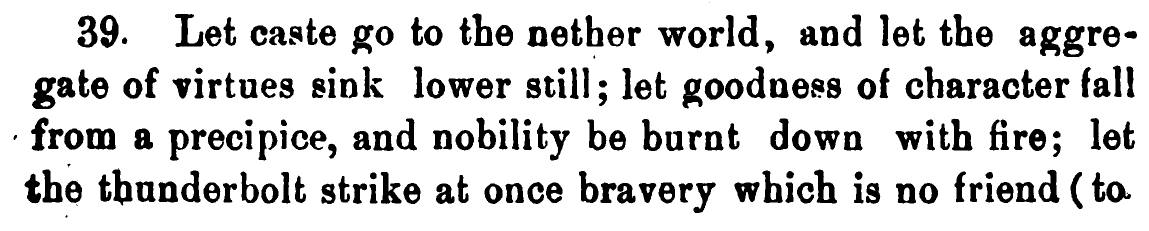
39. Let caste go to the nether world, and let the aggregate of virtues sink lower still; let goodness of character fall from a precipice, and nobility be burnt down with fire; let the thunderbolt strike at once bravery which is no friend ( to us ); wealth alone be ours, without which all these virtues are like ( of as little worth as ) a piece of straw.

Notes
Sl. 39. जातिर्यातु &c.—The idea of the sl. is that all these qualities sink into utter insignificance when compared to money. If one has money these are nothing to him. Comp. sl. 41. रसातलं—one of the seven regions below the earth. These are अतल, वितल, सुतल, रसातल, तलातल, महातल and पाताल. शील—Virtuous conduct, character. It is a word of constant occurrence in Bhar.; cf. Slokas 13, 42, 82, 109 &c. अभिजनः—nobility of birth. Cf. Mál. Mâd. II. 13. S'ak IV. 18. शौर्ये वैरिणि—Bravery is said here to be an enemy as it often proves an obstacle to earning money. A brave man can never stoop to such mean acts as it sometimes becomes necessary for a seeker of wealth to perform. येनैकेन &c.—This explains why wealth is desired at the cost of जाति &c., and so the fig. is Kavyalinga.
Gopinath1914
all
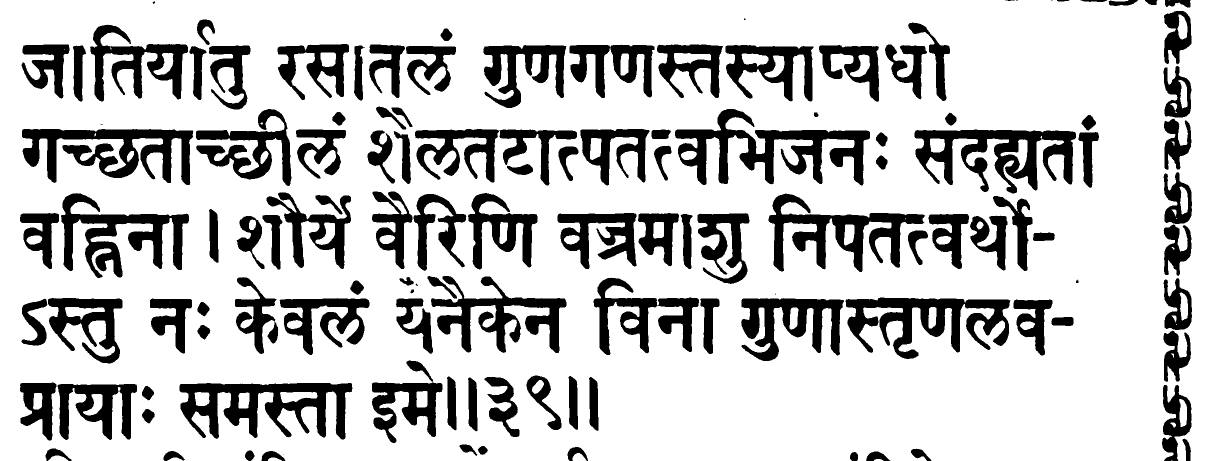
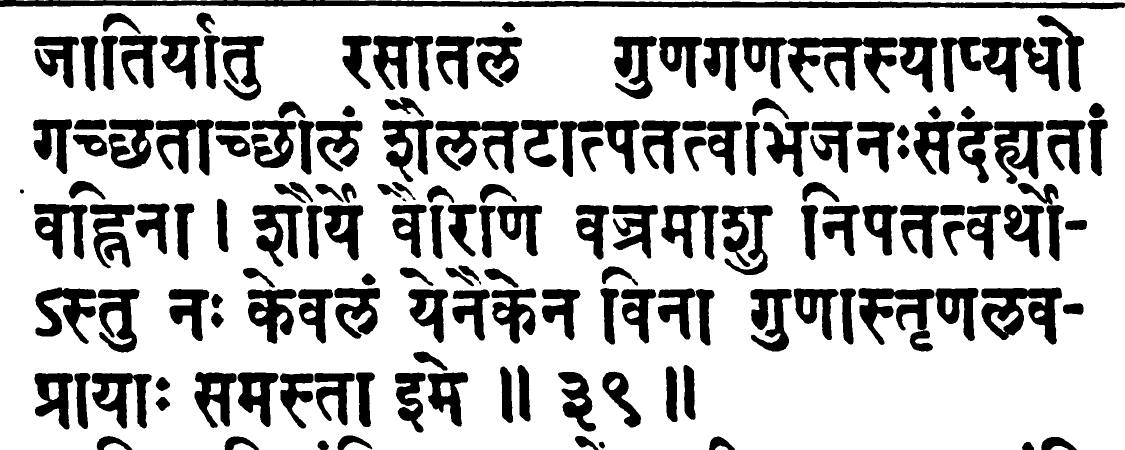
जातिर्यातु रसातलं गुणगणस्तस्याप्यधो
गच्छताच्छीलं शैलतटात्पतत्वभिजनः संदह्यतां
वह्निना । शौर्ये वैरिणि वज्रमाशु निपतत्वर्थो-
ऽस्तु नः केवलं येनैकेन विना गुणास्तृणलव-
प्रायाः समस्ता इमे॥३९॥
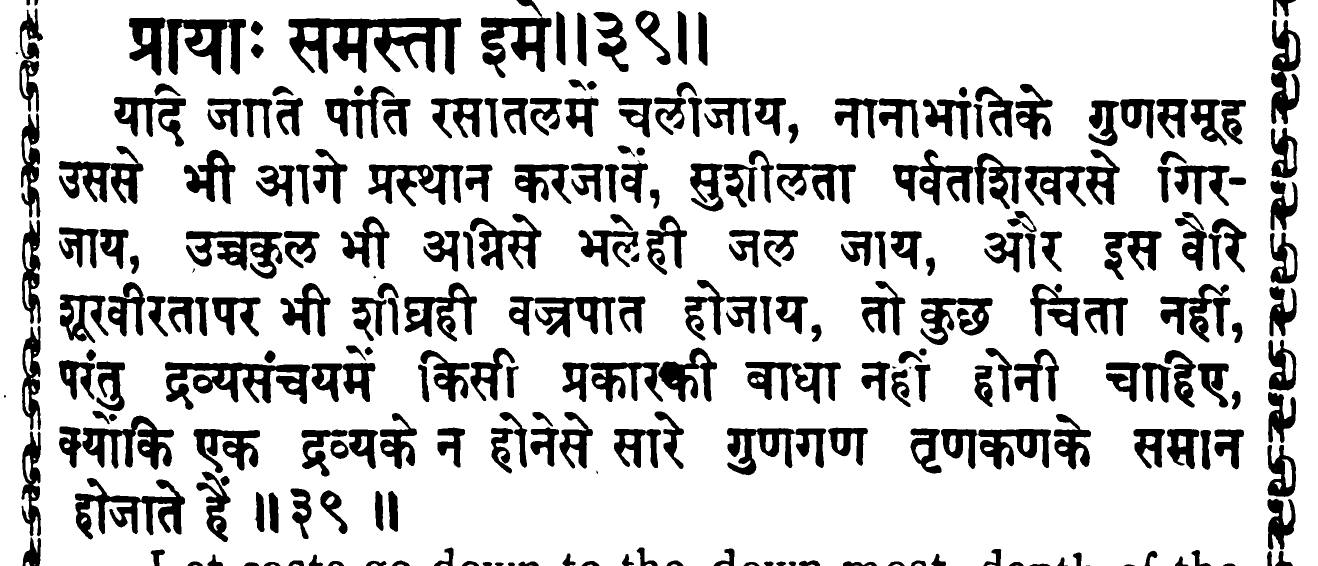
यदि जाति पांति रसातलमें चलीजाय, नानाभांतिके गुणसमूह उससे भी आगे प्रस्थान करजावें, सुशीलता पर्वतशिखरसे गिरजाय, उच्चकुल भी अग्निसे भलेही जल जाय, और इस वैरि शूरवीरतापर भी शीघ्रही वज्रपात होजाय, तो कुछ चिंता नहीं, परंतु द्रव्यसंचयमें किसी प्रकारकी बाधा नहीं होनी चाहिए, क्योंकि एक द्रव्यके न होनेसे सारे गुणगण तृणकणके समान होजाते हैं ॥३९ ॥
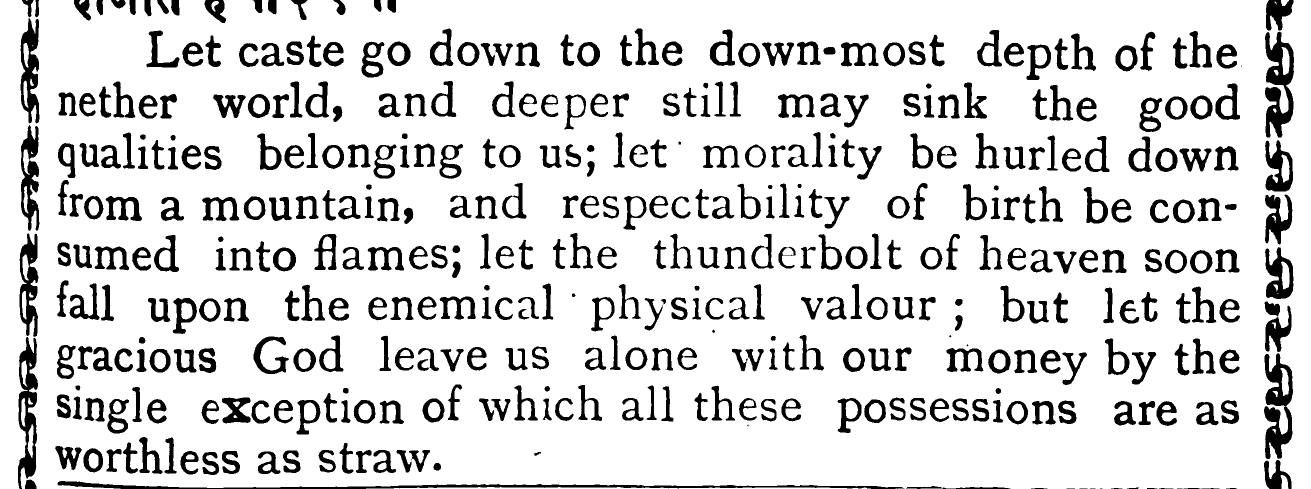
Let caste go down to the down-most depth of the nether world, and deeper still may sink the good qualities belonging to us; let morality be hurled down from a mountain, and respectability of birth be consumed into flames; let the thunderbolt of heaven soon fall upon the enemical physical valour; but let the gracious God leave us alone with our money by the single exception of which all these possessions are as worthless as straw.
Footnote
Ballabhadeva in his Subhâshitâvali ( सुभाषितावलि ) quotes it at No. 3073 under Mâgha ( माघ ), but the sloka is not to be found in the Siśupâlubadha ( शिशुपालवधं ).


Footnote
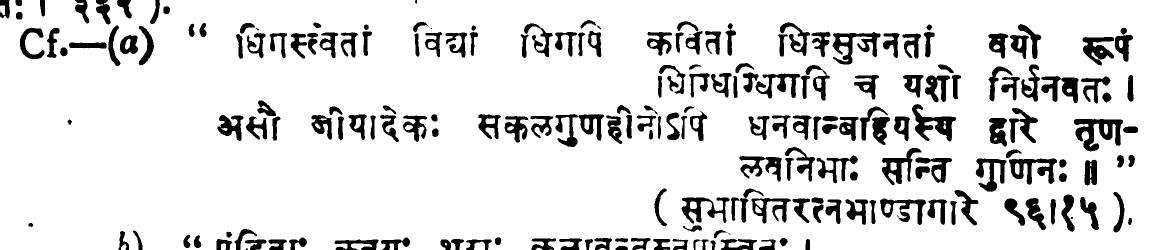
Cf.—(a) “ धिगस्त्वेतां विद्यां धिगपि कवितां धिक्सुजनतां वयो रूपं धिग्धिग्धिगपि च यशो निर्धनवतः । असौ जीयादेकः सकलगुणहीनोऽपि धनवान्बाह्यस्य द्वारे तृणलवनिभाः सन्ति गुणिनः ॥ ” ( सुभाषितरत्नभाण्डागारे ९६।१५ ).

Gopinath1896
all
जातिर्यातु रसातलं गुणगणस्तस्याप्यधो
गच्छताच्छीलं शैलतटात्पतत्वभिजनः संदह्यतां
वह्निना । शौर्ये वैरिणि वज्रमाशु निपतत्वर्थो-
ऽस्तु नः केवलं येनैकेन विना गुणास्तृणलव-
प्रायाः समस्ता इमे ॥ ३९ ॥
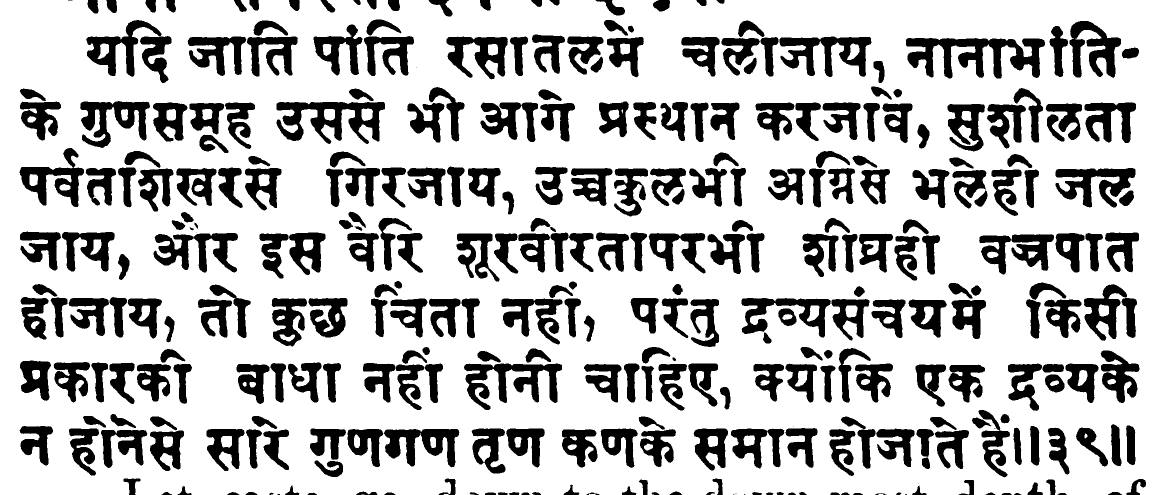
यदि जाति पांति रसातलमें चलीजाय, नानाभांतिके गुणसमूह उससे भी आगे प्रस्थान करजावें, सुशीलता पर्वतशिखरसे गिरजाय, उच्चकुलभी अग्निसे भलेही जल जाय, और इस वैरि शूरवीरतापरभी शीघ्रही वज्रपात होजाय, तो कुछ चिंता नहीं, परंतु द्रव्यसंचयमें किसी प्रकारकी बाधा नहीं होनी चाहिए, क्योंकि एक द्रव्यके न होनेसे सारे गुणगण तृण कणके समान होजाते हैं॥३९॥
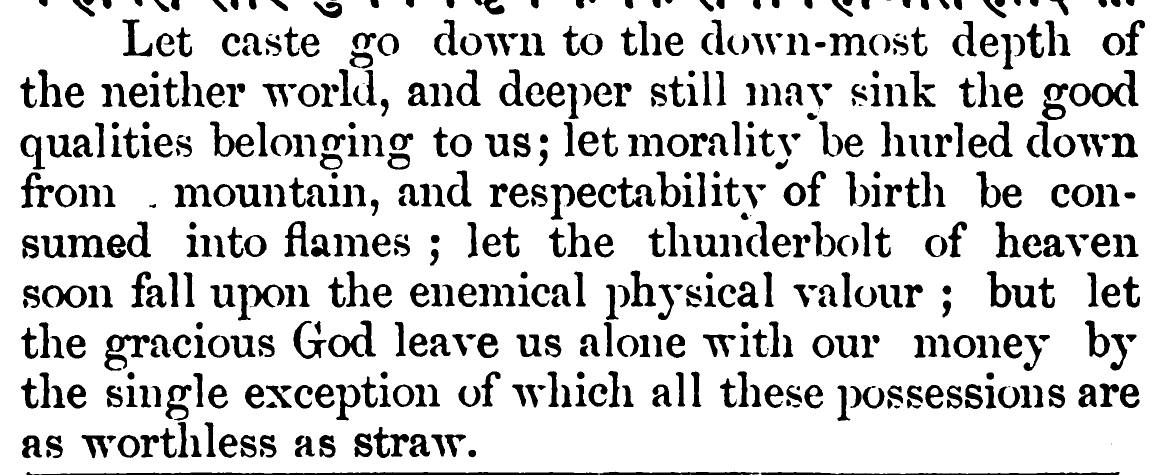
Let caste go down to the down-most depth of the neither world, and deeper still may sink the good qualities belonging to us; let morality be hurled down from mountain, and respectability of birth be consumed into flames ; let the thunderbolt of heaven soon fall upon the enemical physical valour ; but let the gracious God leave us alone with our money by the single exception of which all these possessions are as worthless as straw.
Footnote
Ballabhadeva in his Subhâshitâvali (सुभाषितावलि) quotes it at No. 3073 under Mâgha (माघ), but the sloka is not to be found in the Śiśupâlabadha (शिशुपालवधं).


Footnote
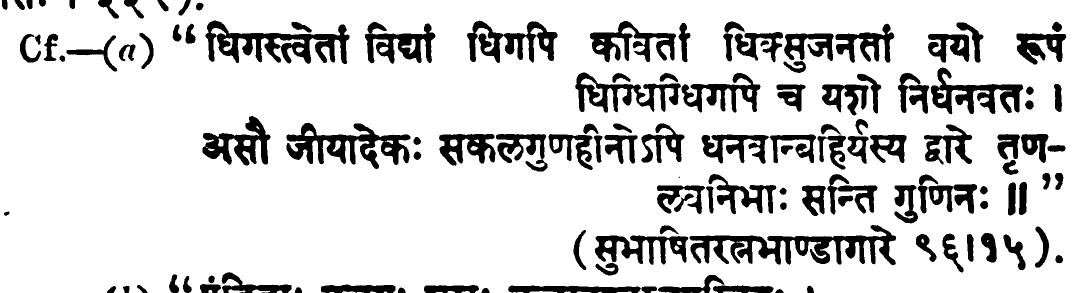
Cf.—(a) “ धिगस्त्वेतां विद्यां धिगपि कवितां धिक्सुजनतां वयो रूपं धिग्धिग्धिगपि च यशो निर्धनवतः । असौ जीयादेकः सकलगुणहीनोऽपि धनवान्वहिर्यस्य द्वारे तृणलवनिभाः सन्ति गुणिनः ॥ ” (सुभाषितरत्नभाण्डागारे ९६।१५).
Kosambi
all
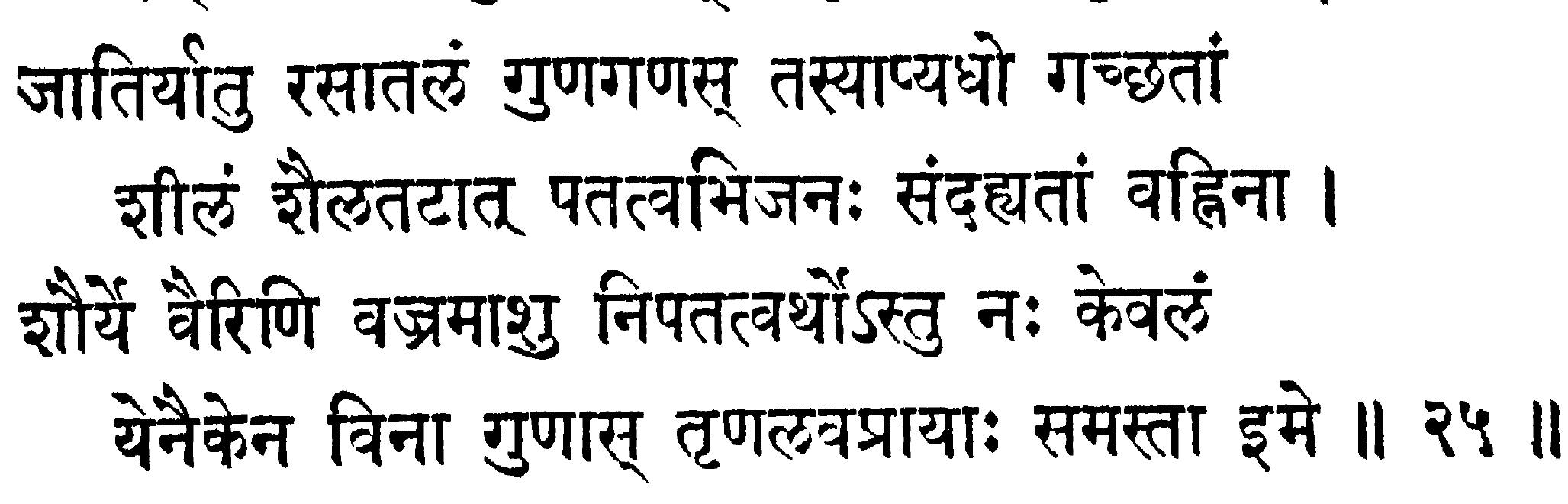
जातिर्यातु रसातलं गुणगणस् तस्याप्यधो गच्छतां
शीलं शैलतटात् पतत्वभिजनः संदह्यतां वह्निना ।
शौर्य वैरिणि वज्रमाशु निपतत्वर्थोऽस्तु नः केवलं
येनैकेन विना गुणास् तृणलवप्रायाः समस्ता इमे ॥ २५ ॥
Footnote
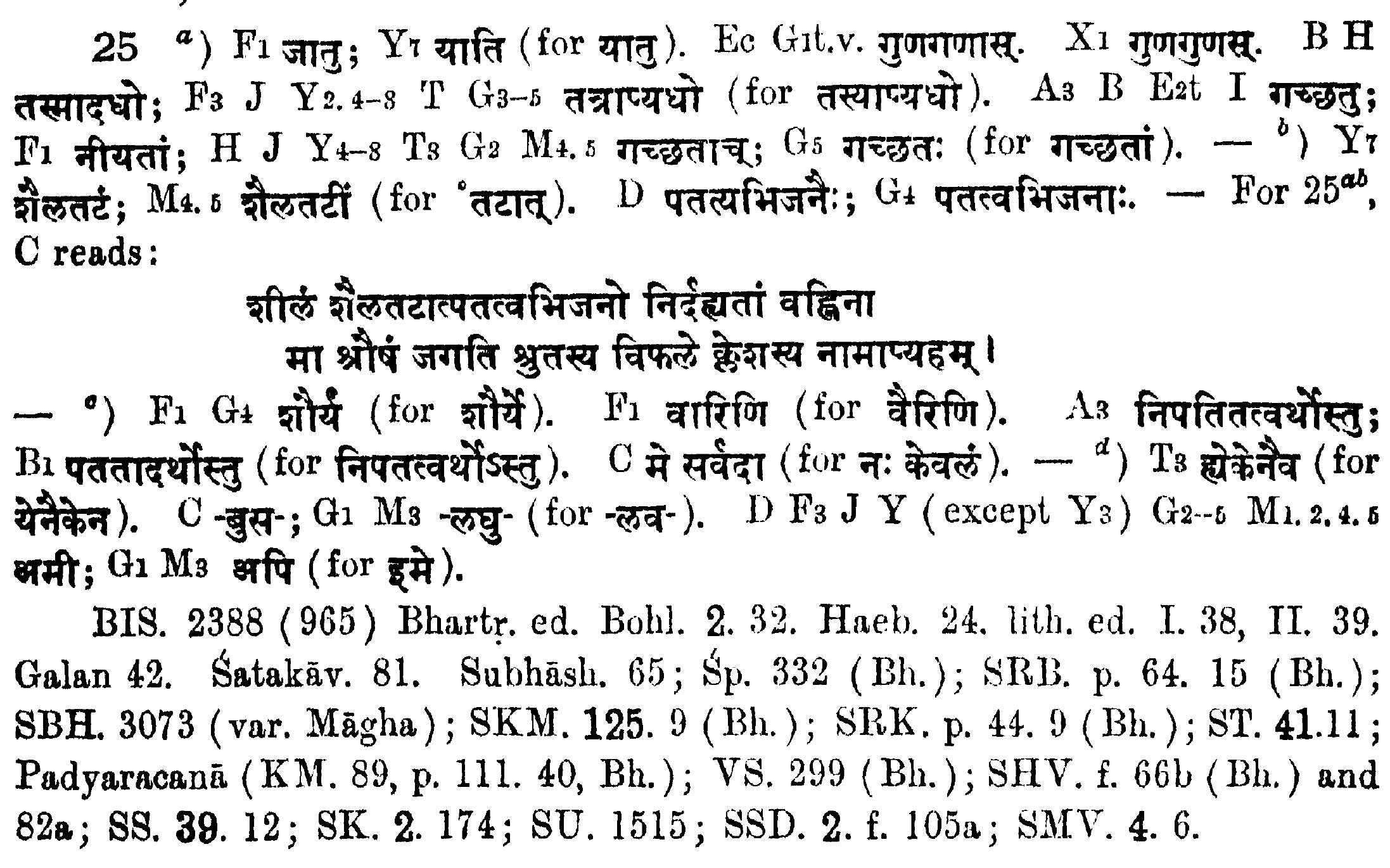
25 ) F1 जातु ; Yr याति ( for यातु ) . Ec Git.v. गुणगणास् . X1 गुणगुणस् . BH
तस्मादधो ; F3 J Y 2. 4 - 8 T G 3 - 5 तत्राप्यधो ( for तस्याप्यधो ) . A3 B Eat I गच्छतु ;
F1 नीयतां ; H J_Y 4 – 8 T3 G2 M4.5 गच्छताच् ; 5 गच्छतः ( for गच्छतां ) . 4 ) Y7
शैलतर्ट ; M4.6 शैलतीं ( for ' तटात् ) . D पतत्यभिजनैः ; G + पतत्व भिजनाः For 25a4 ,
C reads :
शील शैलतटात्पतत्वभिजनो निर्दयतां वह्निना
मा श्रौषं जगति श्रुतस्य विफले क्लेशस्य नामाप्यहम् ।
- 0 ) F1 G + शौर्य ( for शौर्ये ) . F1 वारिणि ( for वैरिणि ) . A3 निपतितत्वर्थोस्तु ;
B1 पततादर्थोस्तु ( for निपतत्वर्थोऽस्तु ) . C मे सर्वदा ( for नः केवलं ) . - ) a Ts ह्येकेनैव ( for
येनैकेन ) . C -बुस ; G 1 M3 लघु- ( for - लव- ) . D F3 J Y ( except Y 3 ) ( 32 - - 6 M1.24.6
अमी ; G1 M3 अपि ( for इमे ) .
BIS . 2388 ( 965 ) Bhartr ed . Bohl . 2. 32. Haeb . 24 , lith ed . I. 38 , II . 39 .
Galan 42. Śatakāv . 81. Subhāsh . 65 ; Sp . 332 ( Bh . ) ; SRB . p . 64. 15 ( Bh . ) ;
SBH . 3073 ( var Māgha ) ; SKM . 125 9 ( Bh . ) ; SRK . p . 44. 9 9 ( Bh . ) ; ST . 41.11 ;
Padyaracanã ( KM . 89 , p . 111 40 , Bh . ) ; VS. 299 ( Bh . ) ; SHVf 66b ( Bh . ) and
82 & ; SS . 39.12 ; SK . 2. 174 ; SU . 1515 ; SSD . 2. f . 105 & ; SMV . 4. 6 .
Commentary