Tawney
The modest man's accounted dull, the pure a prudish knave,
Th' austere a sour-faced hypocrite, the meek a heartless slave,
The orator is tedious, the ascetic but a fool,
The dignified is haughty, stolid and obtuse the cool,
The hero savage; thus the bad do all things good despise,
Each virtue with its kindred vice is tainted in their eyes.
Telang
all
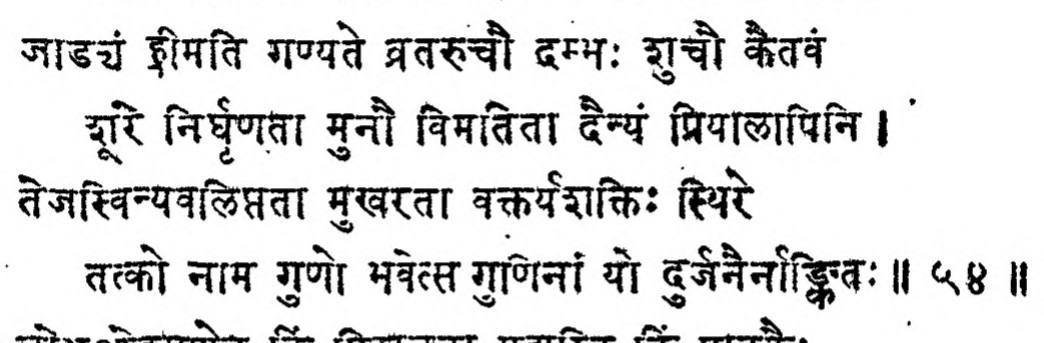
जाड्यं ह्रीमति गण्यते व्रतरुचौ दम्भः शुचौ कैतवं
शूरे निर्घृणता मुनौ विमतिता दैन्यं प्रियालापिनि ।
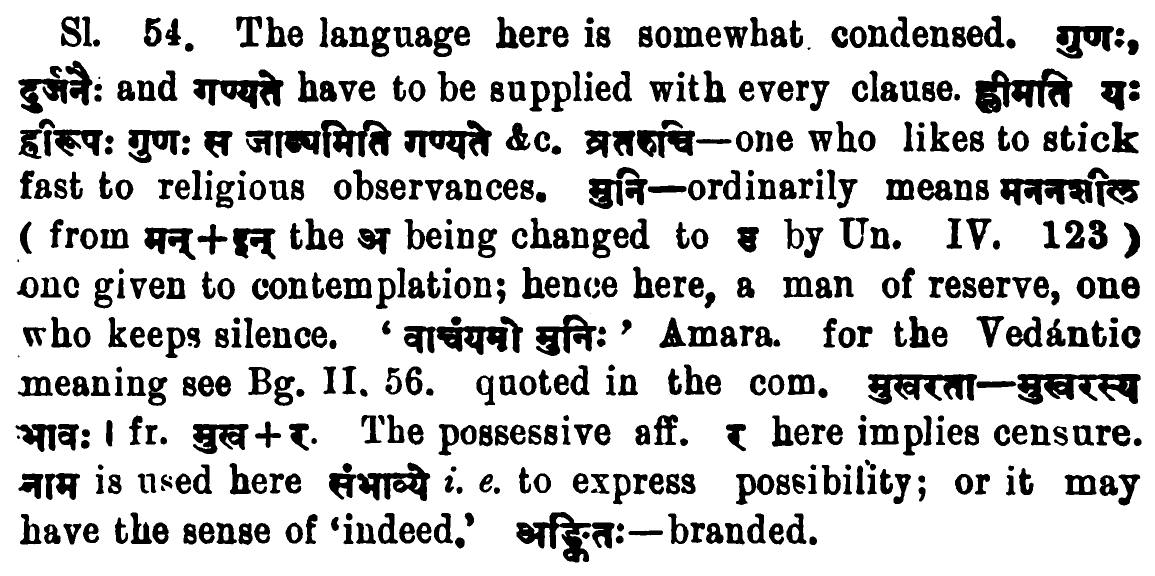
तेजस्विन्यवलिप्तता मुखरता वक्तर्यशक्तिः स्थिरे
तत्को नाम गुणो भवेत्स गुणिनां यो दुर्जनैर्नाङ्कितः ॥ ५४ ॥
Notes
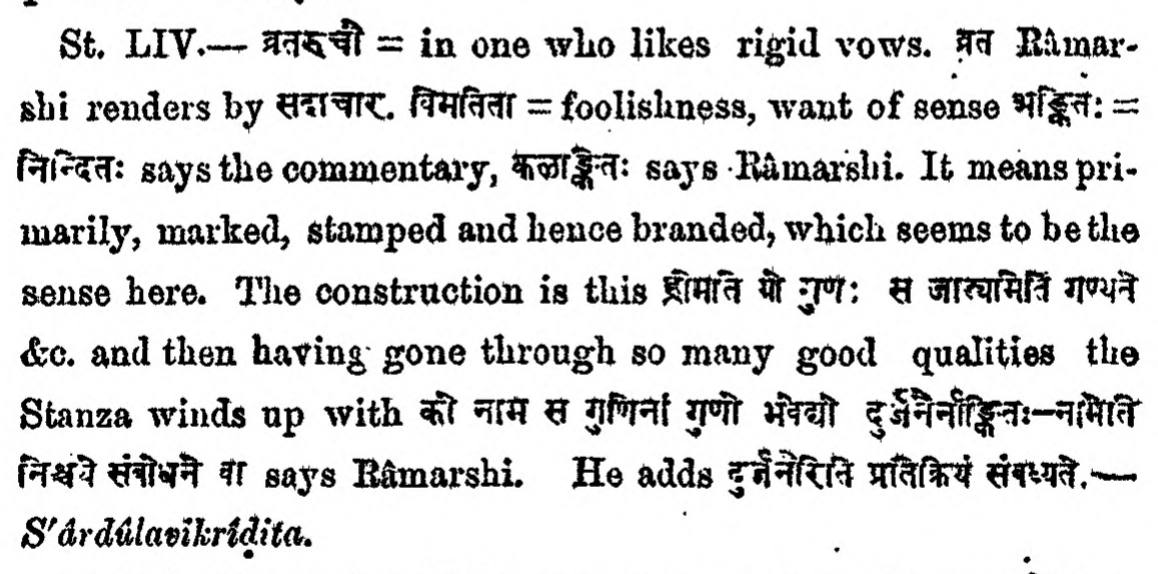
St. LIV.— व्रतरुचौ = in one who likes rigid vows. व्रत Râmarshi renders by सदाचार. विमतिता = foolishness, want of sense अङ्कितः = निन्दितः says the commentary, कलङ्कितः says Râmarshi. It means primarily, marked, stamped and hence branded, which seems to be the sense here. The construction is this ह्रीमति यो गुणः स जाड्यमिति गण्यते &c. and then having gone through so many good qualities the Stanza winds up with को नाम स गुणिनां गुणो भवेद्यो दुर्जनैर्नाङ्कितः—नामेति निश्चये संबोधने वा says Râmarshi. He adds दुर्जनेरिति प्रतिक्रियं संबध्यते.— S'ârdûlavikrîḍita.

Kale
all

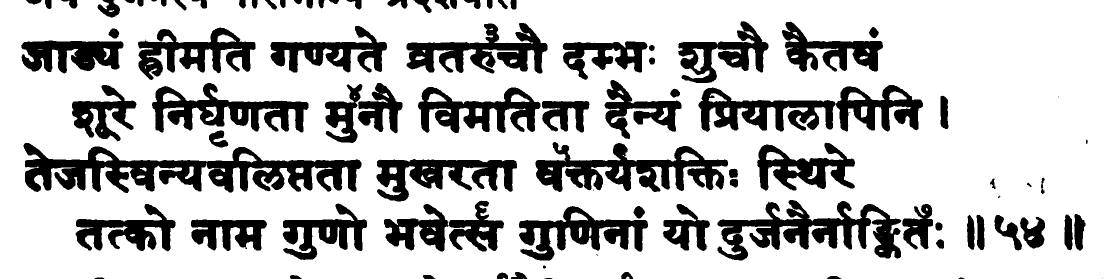
जाड्यं ह्रीमति गण्यते व्रतरुचौ दम्भः शुचौ कैतवं
शूरे निर्घृणता मुनौ विमतिता दैन्यं प्रियालापिनि ।
तेजस्विन्यवलिप्तता मुखरता वक्तर्यशक्तिः स्थिरे
तत्को नाम गुणो भवेत्स गुणिनां यो दुर्जनैर्नाङ्कितः ॥ ५४ ॥
Translation
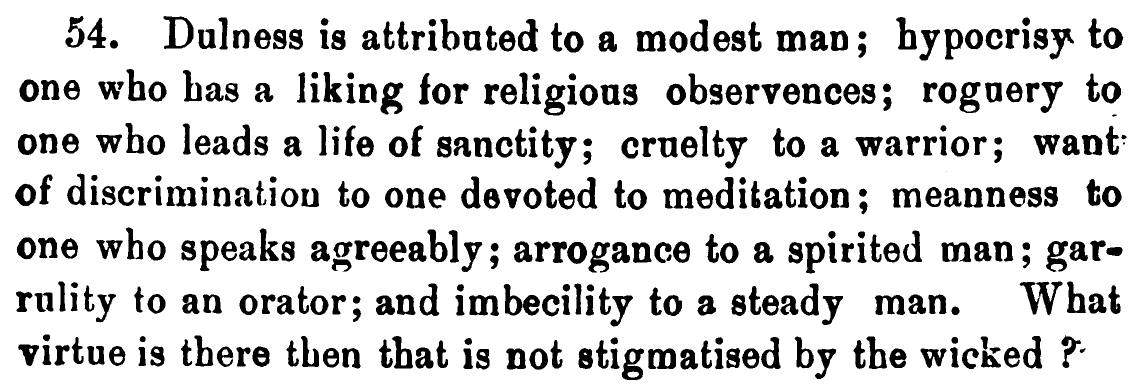
54. Dulness is attributed to a modest man; hypocrisy to one who has a liking for religious observences; roguery to one who leads a life of sanctity; cruelty to a warrior; want of discrimination to one devoted to meditation; meanness to one who speaks agreeably; arrogance to a spirited man; garrulity to an orator; and imbecility to a steady man. What virtue is there then that is not stigmatised by the wicked ?
Notes
Sl. 54. The language here is somewhat condensed. गुणः, दुर्जनैः and गण्यते have to be supplied with every clause. ह्रीमति यः ह्रीरूपः गुणः स जाड्यमिति गण्यते &c. व्रतरुचि—one who likes to stick fast to religious observances. मुनि—ordinarily means मननशील ( from मन् + इन् the अ being changed to उ by Un. IV. 123 ) one given to contemplation; hence here, a man of reserve, one who keeps silence. ‘ वाचंयमो मुनिः ’ Amara. for the Vedántic meaning see Bg. II. 56. quoted in the com. मुखरता—मुखरस्य भावः । fr. मुख + र. The possessive aff. र here implies censure. नाम is used here संभाव्ये i. e. to express possibility; or it may have the sense of ‘indeed.’ अङ्कितः—branded.



Gopinath1914
all
जाड्यं ह्रीमति गण्यते व्रतरुचौ दम्भः शुचौ
कैतवं शूरे निर्घृणता मुनौ विमतिता दैन्यं
प्रियालापिनि । तेजस्विन्यवलिप्तता मुखरता
वक्तर्यशक्तिः स्थिरे तत्को नाम गुणो भवेत्स
गुणिनां यो दुर्जनैनांकितः ॥ ५४ ॥
लज्जावान्को मूर्ख, व्रतोपवासादि करनेवालेको ठग, पवित्र रहनेवालेको धूर्त, शूरवीरको निर्दयी, मौनीको मतिहीन, प्रियभाषीको दरिद्री, तेजस्वीको अभिमानी, वक्ता (वचनचतुर ) को वाचाल, और धैर्यवान्को असमर्थ कहनेवाले दुष्ट मनुष्योंने गुणकौनसे गुणको कलंकित नहीं किया है ॥ ५४ ॥
Footnote
Quoted under Bhartrihari ( भर्तृहरि ) in the Subhashitavali ( सुभाषितावलि) at aNo. "Bad 464men .

Footnote
Cf. () give themselves no rest until they have done their utmost to make others as bad as themselvesBrown . " ). ( H. S.



Gopinath1896
all
जाड्यं ह्रीमति गण्यते व्रतरुचौ दम्भः शुचौ
कैतवं शूरे निर्घृणता मुनौ विमतिता दैन्यं
प्रियालापिनि। तेजस्विन्यवलिप्तता मुखरता
वक्तर्यशक्तिः स्थिरे तत्को नाम गुणो भवेत्स
गुणिनां यो दुर्जनैर्नाकितः ॥ ५४ ॥
लज्जावान् को मूर्ख, व्रतोपवासादि करनेवालेको ठग, पवित्र रहनेवालेको धूर्त, शूरवीरको निर्दयी, मौनीको मतिहीन, प्रियभाषीको दरिद्री, तेजस्वी को अभिमानी, वक्ता ( वचनचतुर ) को वाचाल, और धैर्यवान् को असमर्थ कहनेवाले दुष्ट मनुष्योंने गुणवानों के कौन से गुणको कलंकित नहीं किया है ।। ५४ ।।

Footnote
Cf. (a) 6 Bad men give themselves no rest until they have done their utmost to make others as bad as themselves.” (H. S. Brown ).



Kosambi
all

तेजस्विन्यवलिप्तता मुखरता वक्तर्यशक्तिः स्थिरे
तत् को नाम गुणो भवेत् स गुणिनां यो दुर्जनैर्नाङ्कितः ॥२४ ॥

Footnote
24 ° ) Y4.6.4 T G4 व्रतशुचौ ; M.5 व्रतपरे ( for ' रुचौ ) . J1.3 Y2_G1.4 M डंभः ;
G2 ( orig . ) दर्भ : ( for दम्भ :) . T3 कुचौ ( for शुचौ ) . 6 ) Eo . 1.2t सूरे ( for सूरे ) .
Eo ' निर्घृणिता . ( E3 com . निर्घृणता = निर्दयिता ) . [ To avoid hiatus ] B D Ea Fs HI
J1c . 2.8 X [ आ ] र्जवे ; Jit जडे ; W Y1 , 2.4 , 6.7.8 T G1 . 2.6 M1-8 मुनौ ; Y8 रुजे ; Yo गुरौ ; G +

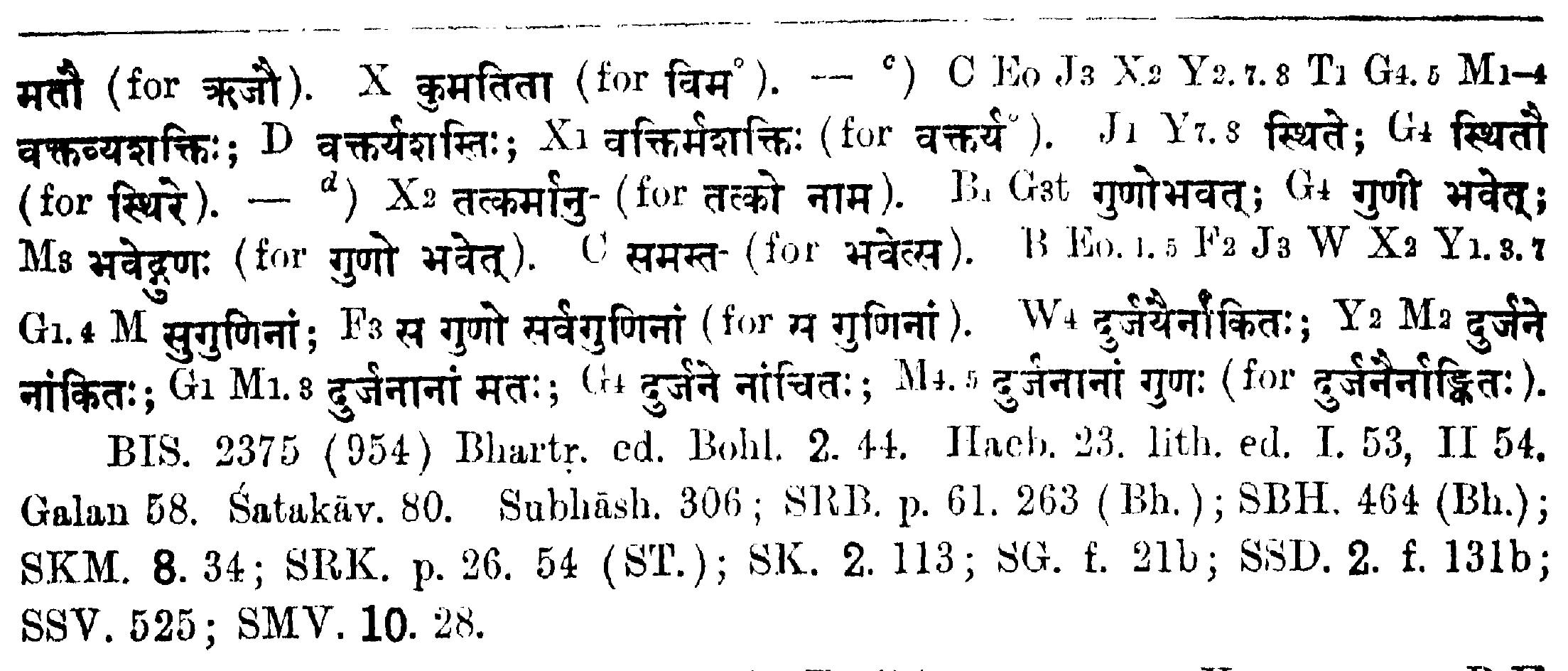
Footnote
मतो ( for ऋजौ ) . X कुमतिता ( for विम ) . ° ) C Ho J3 X Y 27. 8T1G4.5M14
वक्तव्यशक्तिः ; D वक्तर्यशस्तिः ; X 1 वक्तिर्मशक्ति : ( for वक्तर्य ५ ) . JY7.8 स्थिते ; G + स्थितौ
( for स्थिरे ) . d a ) X 2 तत्कर्मानु- ( for तत्को नाम ) . B Gst गुणोभवत् ; G + गुणी भवेत् ;
Ms भवेद्गुणा : ( for गुणो भवेत् ) . ( समस्त- ( for भवेत्स ) . BEo . 1. 5 Fa J3 W X2 Y1.4.1
G1.4 M सुगुणिनां ; F3 स गुणो सर्वगुणिनां ( for म गुणिनां ) . W + दुर्जयैनांकित : ; X 2 M2 दुर्जने
नांकित : ; G1 M1 . 3 दुर्जनानां मतः , ( दुर्जने नांचितः ; M. 5 दुर्जनानां गुणः ( for दुर्जनैर्नाङ्कितः ) .
BIS . 2375 ( 954 ) Bhartr . ed . Bohl . 2. 44. Hach . 23 lith ed . I. 53 , II 54 .
Galan 58. Satakäv . 80. Subhāsh . 306 ; SRB . p . 61.263 ( Bh . ) ; SBH 464 ( Bh . ) ; ;
SK.M. 8. 34 ; SRK . p . 26.54 ( ST . ) ; SK 2 113 ; SG . f . 21b ; SSD . 2. f . 131b ;
SSV . 525 ; SMV . 10.28 .
Commentary