Tawney
Why honour gods, who must submit to Fate,
Or Fate, who gives but what our deeds have won?
Upon our deeds alone depends our state
By these exalted, as by these undone.
More
LV
Before the Gods we bend in awe,
But lo, they bow to fate's dread law
Honor to Fate, then, austere lord!
But lo, it fashions but our works' reward.
Nay, if past works our present state
Engender, what of gods and fate?
Honor to Works! in them the power
Before whose awful nod even fate must cower.
Telang
all
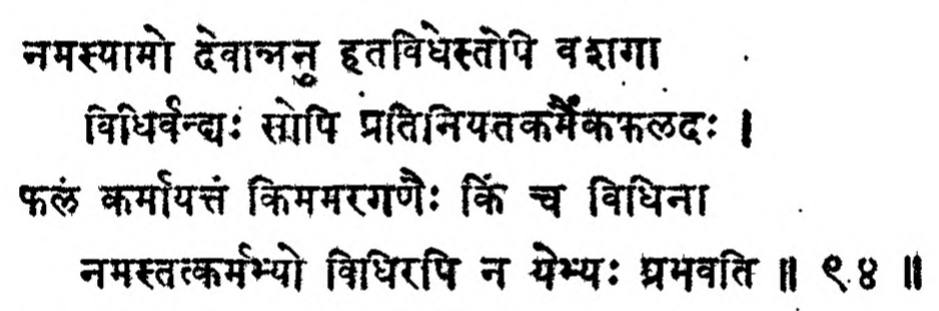
नमस्यामो देवान्ननु हतविधेस्तेपि वशगा
विधिर्वन्द्यः सोपि प्रतिनियतकर्मैकफलदः ।
फलं कर्मायत्तं किममरगणैः किं च विधिना
नमस्तत्कर्मभ्यो विधिरपि न येभ्यः प्रभवति ॥ ९४ ॥
Notes
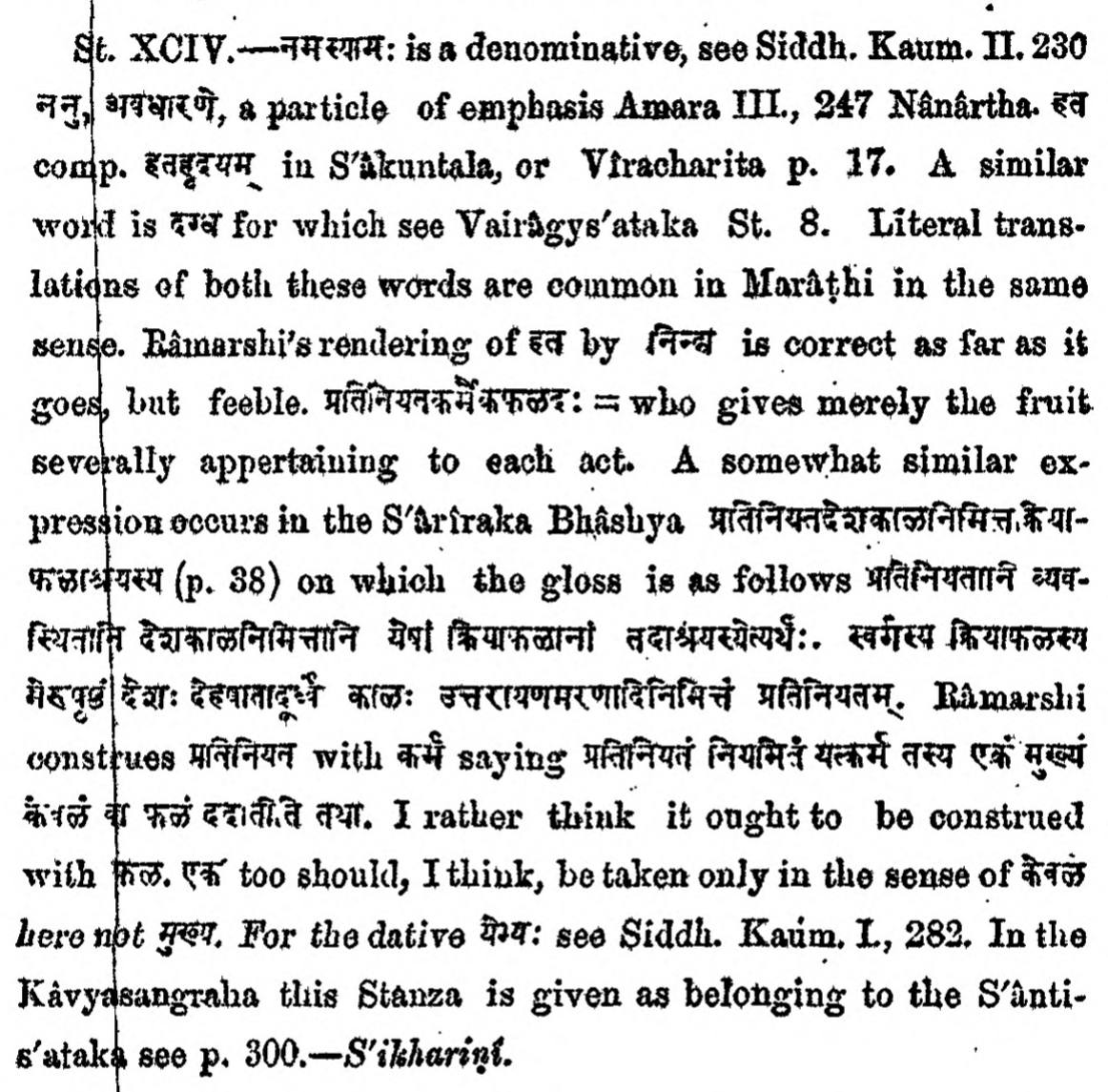
St. XCIV.—नमस्यामः is a denominative, see Siddh. Kaum. II. 230 ननु, अवधारणे, a particle of emphasis Amara III., 247 Nânârtha. हत comp. हतहृदयम् in S'âkuntala, or Vîracharita p. 17. A similar word is दग्ध for which see Vairâgys'ataka St. 8. Literal translations of both these words are common in Marâṭhi in the same sense. Râmarshi’s rendering of हत by निन्द्य is correct as far as it goes, but feeble. प्रतिनियतकर्मैकफलदः = who gives merely the fruit severally appertaining to each act. A somewhat similar expression occurs in the S'ârîraka Bhâshya प्रतिनियतदेशकालनिमित्तक्रियाफलाश्रयस्य (p. 38) on which the gloss is as follows प्रतिनियतानि व्यवस्थितानि देशकालनिमित्तानि येषां क्रियाफलानां तदाश्रयस्येत्यर्थः. स्वर्गस्य क्रियाफलस्य मेरुपृष्ठं देशः देहपातादूर्ध्वं कालः उत्तरायणमरणादिनिमित्तं प्रतिनियतम्. Râmarshi construes प्रतिनियत with कर्म saying प्रतिनियतं नियमितं यत्कर्म तस्य एकं मुख्यं केवलं वा फलं ददातीति तथा. I rather think it ought to be construed with फल. एक too should, I think, be taken only in the sense of केवल here not मुख्य. For the dative येभ्यः see Siddh. Kaum. I., 282. In the Kâvyasangraha this Stanza is given as belonging to the S'ântis'ataka see p. 300.—S'ikhariṇî.

Kale
all
Introduction
अथ दैवपद्धतेरनन्तरं दैवस्यापि कर्माधीनत्वात्कर्मपद्धतिं निरूपयति । तत्रादौ कर्मणो बलीयस्त्वं वर्णयति—

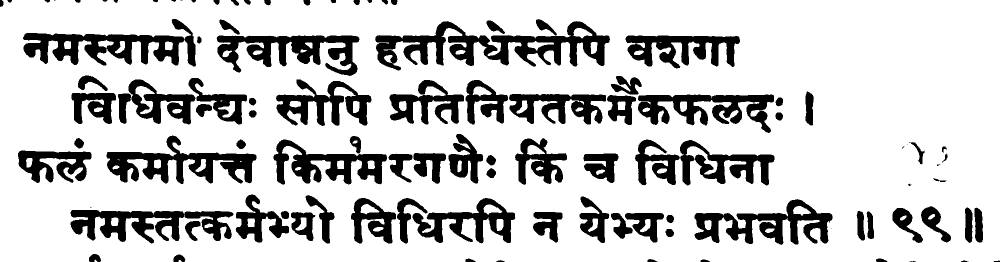
नमस्यामो देवान्ननु हतविधेस्तेपि वशगा
विधिर्वन्द्यः सोपि प्रतिनियतकर्मैकफलदः ।
फलं कर्मायत्तं किममरगणैः किं च विधिना
नमस्तत्कर्मभ्यो विधिरपि न येभ्यः प्रभवति ॥ ९९ ॥
Translation
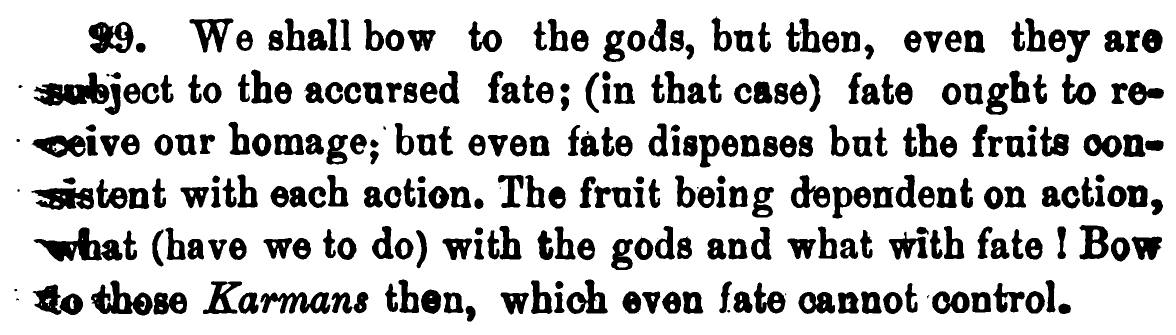
99. We shall bow to the gods, but then, even they are subject to the accursed fate; (in that case) fate ought to receive our homage; but even fate dispenses but the fruits consistent with each action. The fruit being dependent on action, what (have we to do) with the gods and what with fate ! Bow to those Karmans then, which even fate cannot control.
Notes
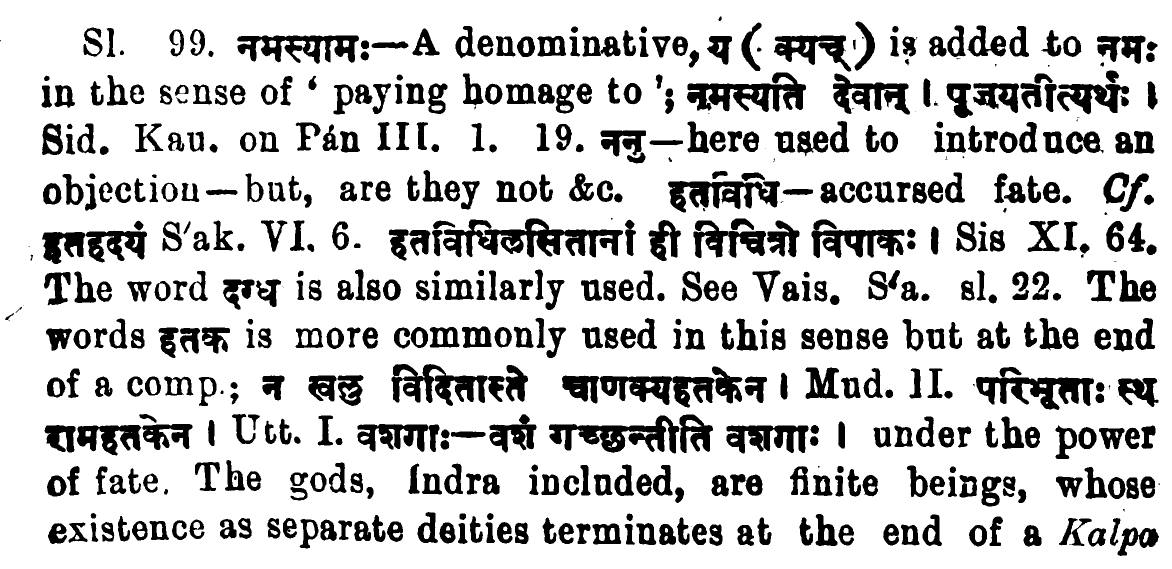
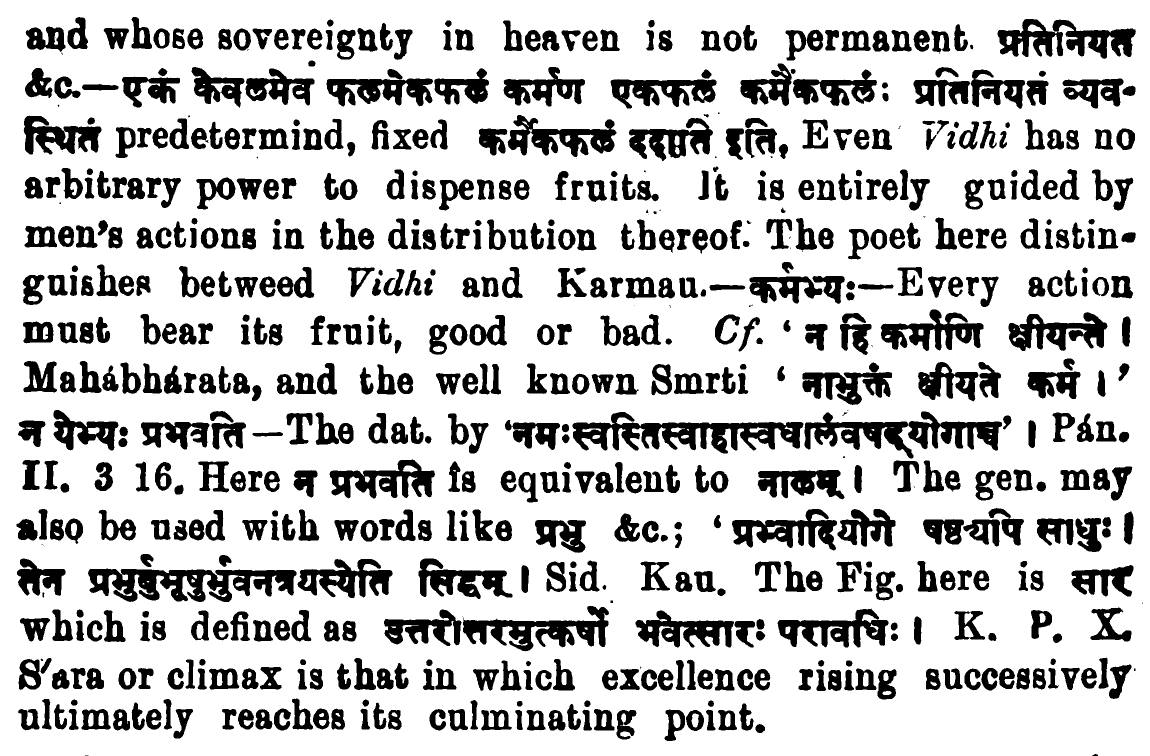
Sl. 99. नमस्यामः—A denominative, य ( क्यच् ) is added to नमः in the sense of ' paying homage to '; नमस्यति देवान् । पूजयतीत्यर्थः । Sid. Kau. on Pán III. 1. 19. ननु—here used to introduce an objection—but, are they not &c. हतविधि—accursed fate. Cf. हतहृदयं S'ak. VI. 6. हतविधिलसितानां ही विचित्रो विपाकः । Sis XI. 64. The word दग्ध is also similarly used. See Vais. S'a. sl. 22. The words हतक is more commonly used in this sense but at the end of a comp.; न खलु विदितास्ते चाणक्यहतकेन । Mud. II. परिभूताः स्थ रामहतकेन । Utt. I. वशगाः—वशं गच्छन्तीति वशगाः । under the power of fate. The gods, Indra included, are finite beings, whose existence as separate deities terminates at the end of a Kalpa and whose sovereignty in heaven is not permanent. प्रतिनियत &c.—एकं केवलमेव फळमेकफलं कर्मण एकफलं कर्मैकफलंः प्रतिनियतं व्यवस्थितं predetermind, fixed कर्मैकफलं ददाति इति, Even Vidhi has no arbitrary power to dispense fruits. It is entirely guided by men’s actions in the distribution thereof. The poet here distinguishes betweed Vidhi and Karman.—कर्मभ्यः—Every action must bear its fruit, good or bad. Cf. ‘न हि कर्माणि क्षीयन्ते । Mahábhárata, and the well known Smrti ‘नाभुक्तं क्षीयते कर्म ।’ न येभ्यः प्रभवति—The dat. by ‘नमःस्वस्तिस्वाहास्वधालंवषड्योगाच्च’ । Pán. II. 3 16. Here न प्रभवति is equivalent to नालम् । The gen. may also be used with words like प्रभु &c.; ‘प्रभ्वादियोगे षष्ठ्यपि साधुः । तेन प्रभुर्बुभूषुर्भुवनत्रयस्येति सिद्धम् । Sid. Kau. The Fig. here is सार which is defined as उत्तरोत्तरमुत्कर्षो भवेत्सारः परावधिः । K. P. X. S'ara or climax is that in which excellence rising successively ultimately reaches its culminating point.
Gopinath1914
all
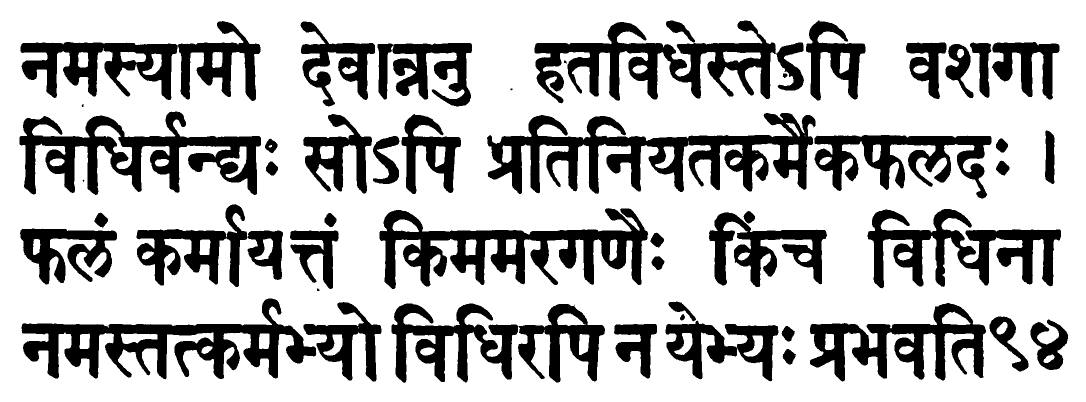
नमस्यामो देवान्ननु हतविधेस्तेऽपि वशगा
विधिर्वन्द्यः सोऽपि प्रतिनियतकर्मैकफलदः ।
फलं कर्मायत्तं किममरगणैः किंच विधिना
नमस्तत्कर्मभ्यो विधिरपि न येभ्यः प्रभवति९४
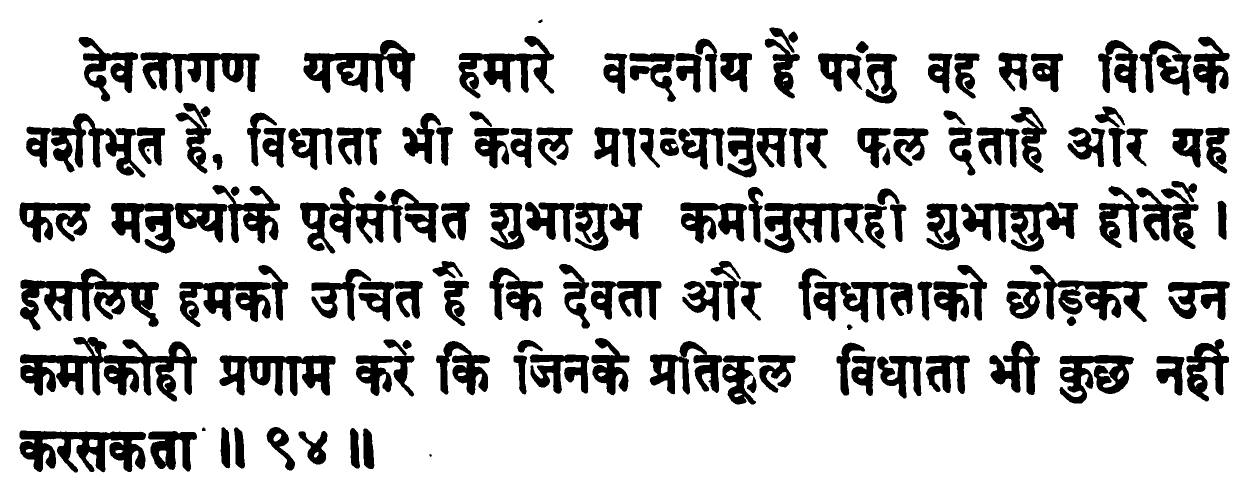
देवतागण यद्यपि हमारे वन्दनीय हैं परंतु वह सब विधिके वशीभूत हैं, विधाता भी केवल प्रारब्धानुसार फल देता है और यह फल मनुष्योंके पूर्वसंचित शुभाशुभ कर्मानुसारही शुभाशुभ होते हैं । इसलिए हमको उचित है कि देवता और विधाताको छोड़कर उन प्रणाम करें कि जिनके प्रतिकूल विधाता भी कुछ नहीं करसकता ॥ ९४ ॥
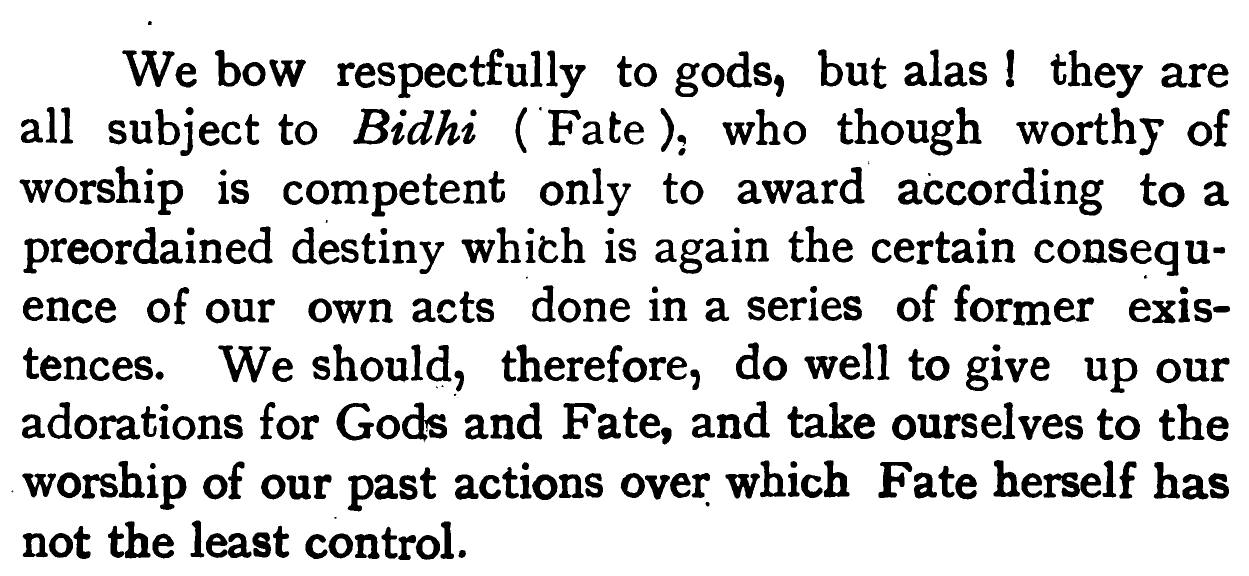
We bow respectfully to gods, but alas! they are all subject to Bidhi (Fate), who though worthy of worship is competent only to award according to a preordained destiny which is again the certain consequence of our own acts done in a series of former existences. We should, therefore, do well to give up our adorations for Gods and Fate, and take ourselves to the worship of our past actions over which Fate herself has not the least control.
Footnote
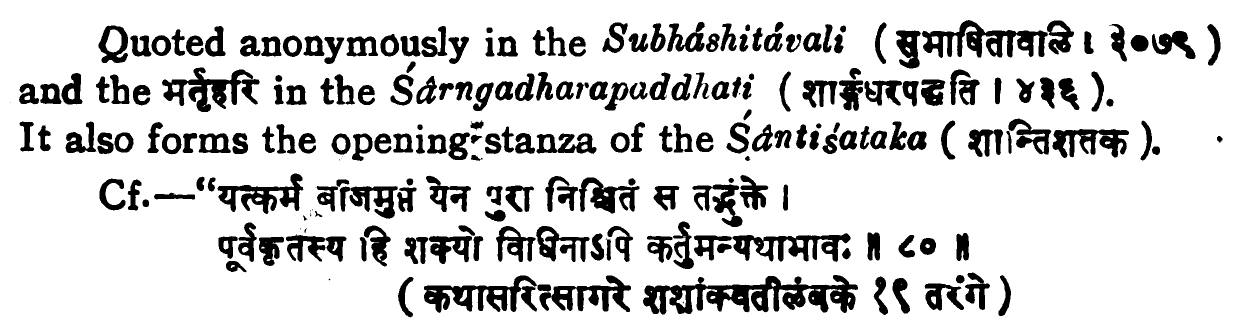
Quoted anonymously in the Subhäshitävali ( सुभाषितावलि । ३०७९) and the भर्तृहरि in the Sarngadharapaddhati ( शार्ङ्गधरपद्धति । ४३६ ). It also forms the opening stanza of the Santisataka ( शान्तिशतक). Cf. -- ~ " यत्कर्म बजिमुतं येन पुरा निश्चितं स तद्भुक्ते । पूर्वकृतस्य हि शक्यो विधिनाऽपि कर्तुमन्यथाभावः ॥ ८० ॥ ( कथासरित्सागरे शशांक्वतीलंबके १९ तरंगे )
Gopinath1896
all
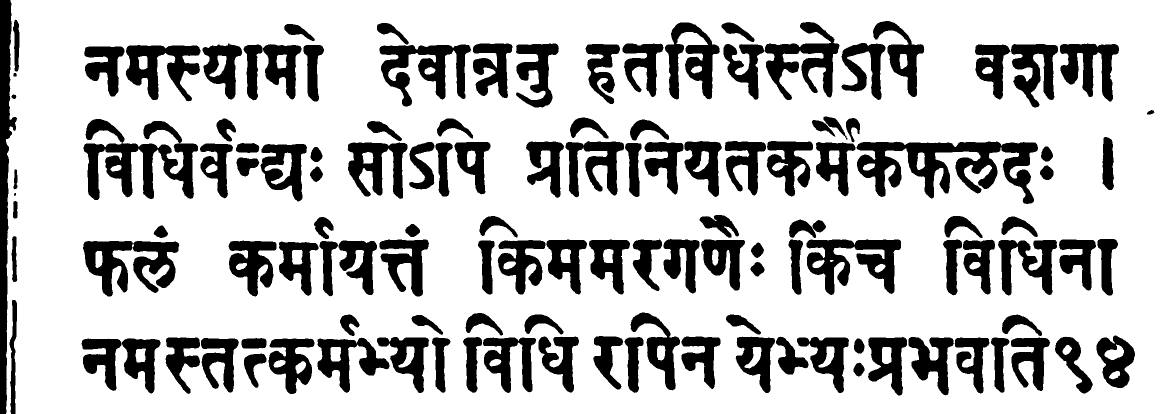
नमस्यामो देवान्ननु हतविधेस्तेऽपि वशगा
विधिर्वन्द्यः सोऽपि प्रतिनियतक मैकफलदः ।
फलं कर्मायत्तं किममरगणैः किंच विधिना
नमस्तत्कर्मभ्यो विधि रपिन येभ्यः प्रभवति ९४
देवतागण यद्यपि हमारे वन्दनीय हैं परंतु वह संब विधिके वशीभूत हैं, विधाताभी केवल प्रारब्धानु सार फल देता है और यह फल मनुष्योंके पूर्व संचित शुभाशुभ कर्मानुसारही शुभाशुभ होतें हैं । इसलिए हमको उचित है कि देवता और विधाताको छोड़कर उन कर्मोंकोही प्रणाम करें कि जिनके प्रतिकूल विधाताभी कुछ नहीं कर सकता ॥ ९४ ॥
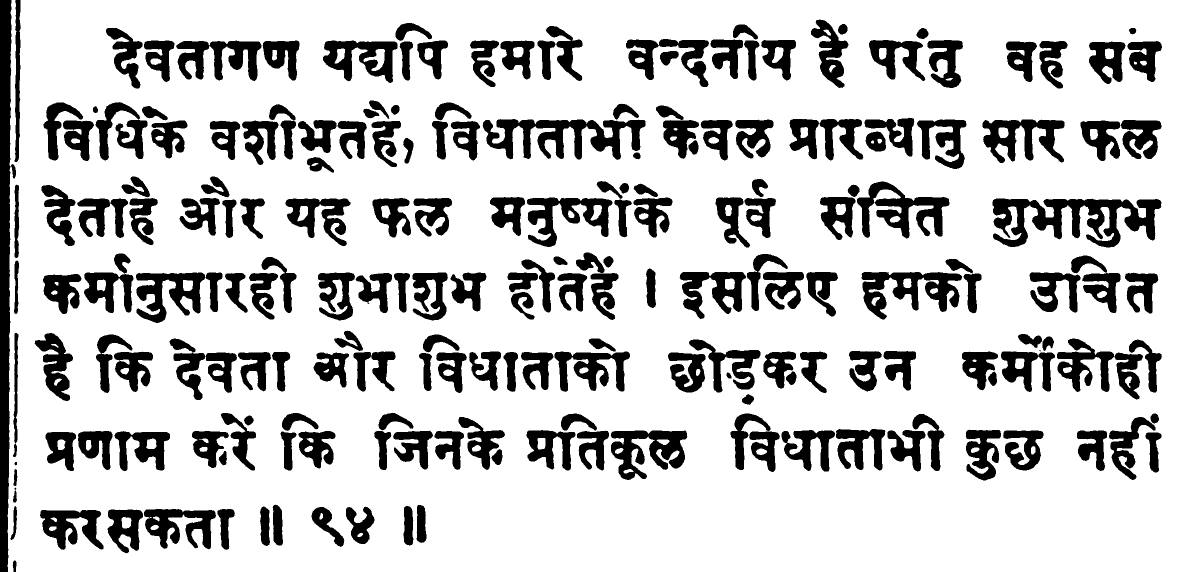
We bow respectfully to gods, but alas! they are all subject to Bilhi ( Fate ), who though worthy of worship is competent only to award according to a preordained destiny which is again the certain consequence of our own acts done in a series of former existences. We should, therefore, do well to give up our adorations for Gods and Fate, and take ourselves to the worship of our past actions over which Fate herself has not the least control.
Footnote
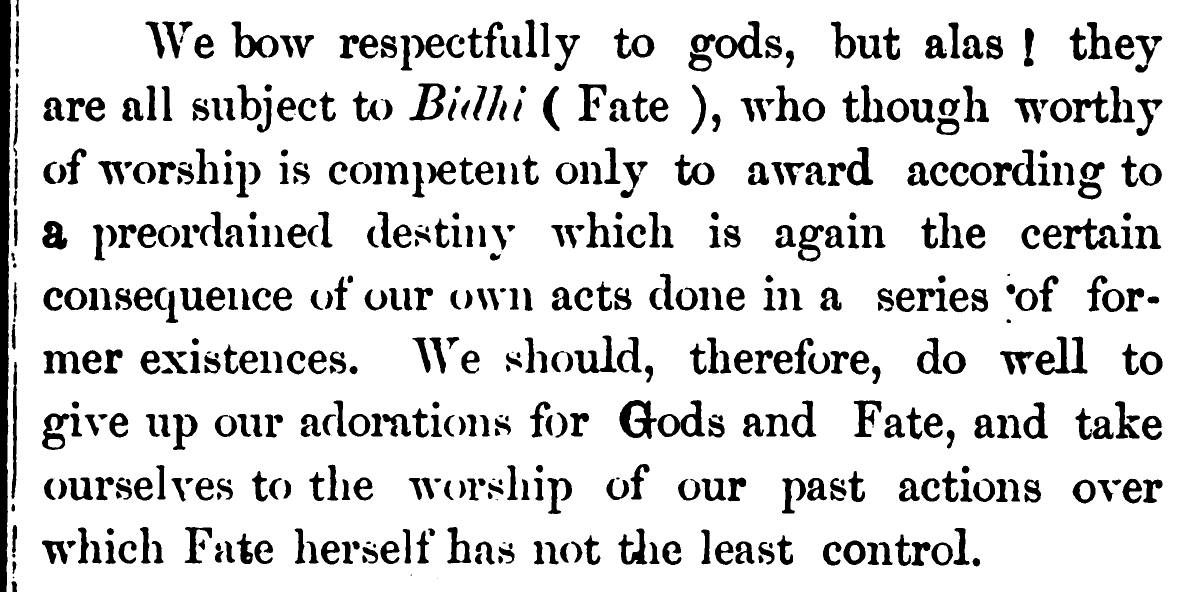
Quoted anonymously in the Subhashitarali ( सुभाषितावलि । ३०७९) and under भर्तृहरि in the Sarmagadharayoddhati ( शार्ङ्गधरपद्धति । ४३६ ). 1t also forms the opening stanza of the Santisataka ( शान्तिशतक ). Cf. - " यत्कर्मवीजमुतं येन पुरा निश्चितं सतद्भुते । पूर्वकृतस्य हि शक्यो विधिनाऽपिकर्तु मन्यथाभावः ॥ ८० ॥ ( कथासरित्सागरेशशांकवतीलंबके १९ तरंगे )
Kosambi
all
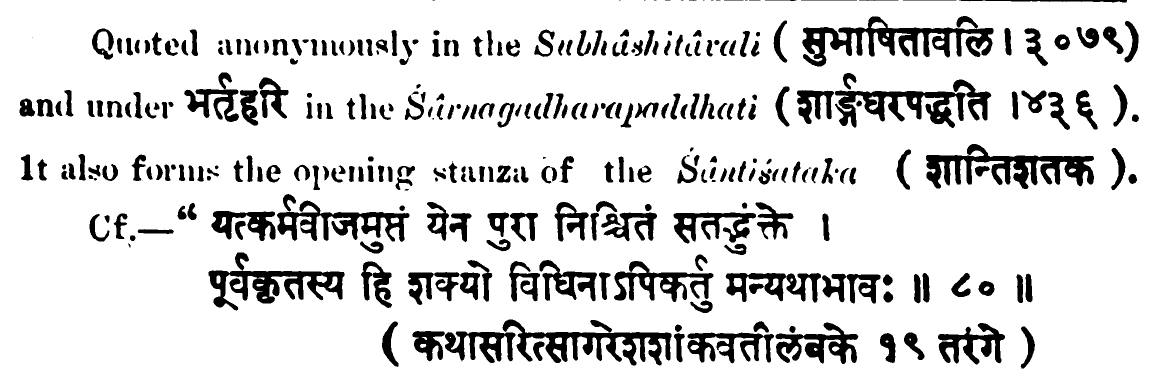
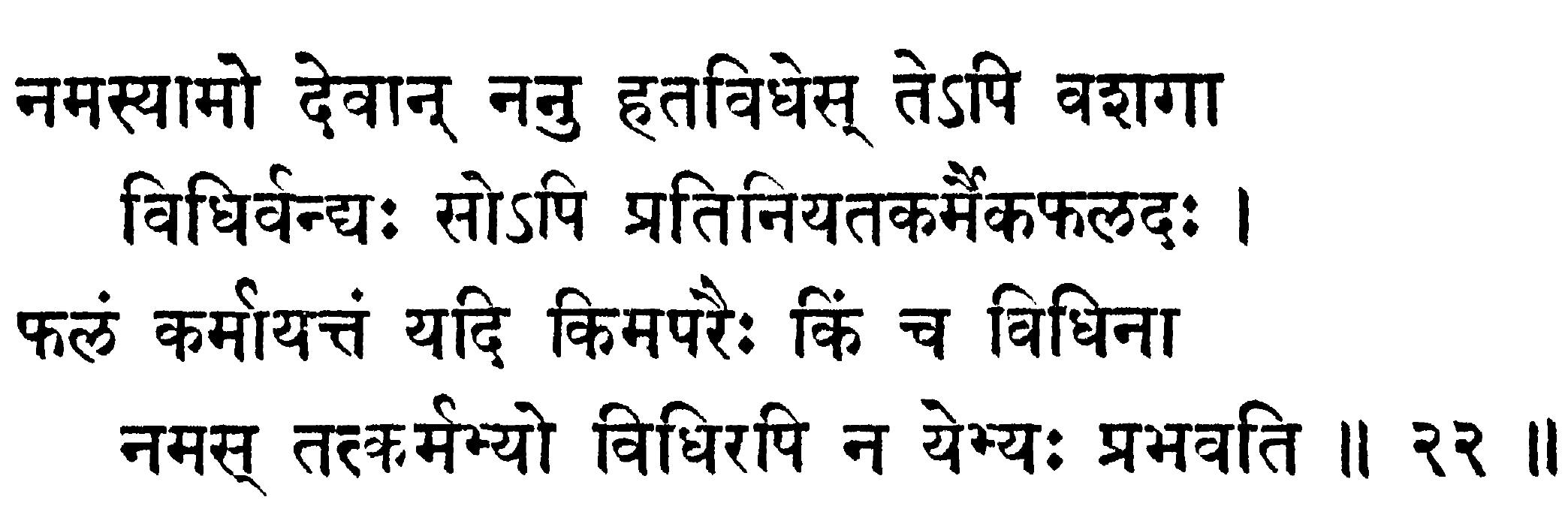
नमस्यामो देवान् ननु हतविधेस् तेऽपि वशगा
विधिर्वन्द्यः सोऽपि प्रतिनियतकर्मैकफलदः ।
फलं कर्मायत्तं यदि किमपरैः किं च विधिना
नमस् तत्कर्मभ्यो विधिरपि न येभ्यः प्रभवति ॥ २२ ॥
Footnote
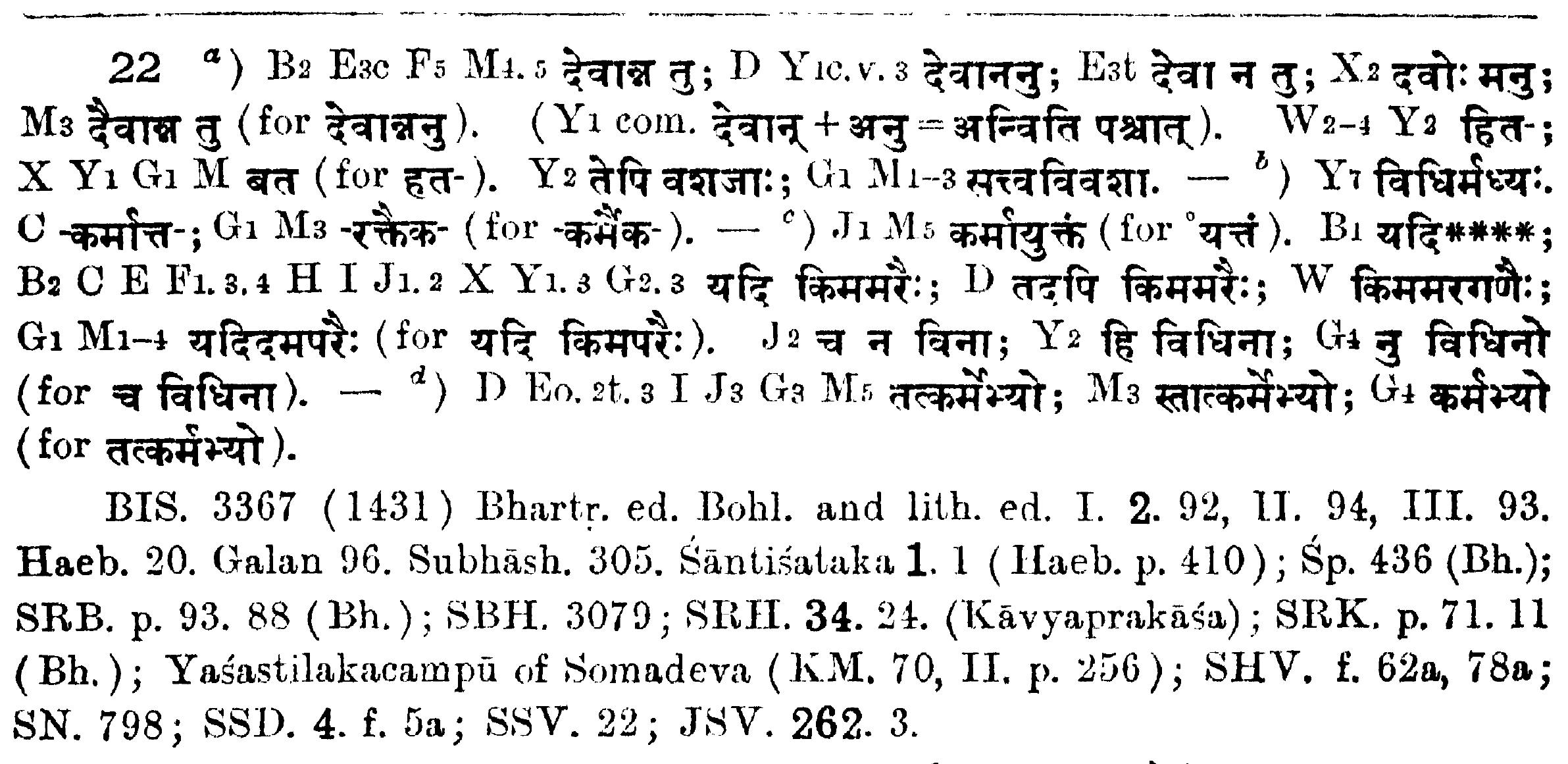
22 4 ) Ba E3c F5 M M 1. 5 देवान्न तु ; D Yic.v. 3 देवाननु ; Est देवा न तु ; X 2 दवोः मनु ;
M3 दैवान तु ( for देवान्ननु ) . ( Y1com . देवान् + अनु - अन्विति पश्चात् ) . W2-4 Y3 हित ;
X Y1 G1 M बत ( for हत- ) . Y 2 तेपि वशजा :; G1 M1-3 सत्त्वविवशा . 8 ) Y7 विधिर्मध्यः .
C कर्मात्त ; G1 M3 - रक्तैक- ( for कर्मैक- ) . ● ) J1 Ms कर्मायुक्तं ( for ' यत्तं ) . B1 यदि **** ;
B2C_E F1 . 3 , 4 H I J 1.2 X Y1 . 3 G2 . 3 यदि किसमरै ; D तदपि किममरैः ; W किममरगणैः ;
G1 M1 - 1 यदिदमपरैः ( for यदि किमपरैः ) . J2 च न विना ; Y2 हि विधिना ; G4 G + नु विधिनो
( for च विधिना ) . —– 4 ) D Eo.2t . 3 I J3 Ga M5 तत्कर्मेभ्यो ; M3 स्तात्कर्मेभ्यो ; G + कर्मभ्यो
( for तत्कर्मभ्यो ) .
BIS . 3367 ( 1431 ) Bhartr ed . Bohl . and lith ed . I. 2. 92 , II . 94 , III . 93 .
Haeb . 20. Galan 96. Subhash . 305. Sāntiśataka 1. 1 ( Haeb . p . 410 ) ; Śp . 436 ( Bh . ) ;
SRB . p . 93.88 ( Bh . ) ; SBH 3079 ; SRI 34. 24. ( Kāvyaprakāśa ) ; SRK p . 71 11
( Bh . ) ; Yaśastilakacampū of Somadeva ( K.M. 70 , II . p . 256 ) ; SHV . f . 62 & , 78 & ;
SN . 798 ; SSD . 4. f . Sa ; SSV . 22 ; JSV . 262. 3 .
Commentary