Tawney
Not to swerve from truth or mercy, not for life to stoop to shame;
From the poor no gifts accepting, nor from men of evil fame;
Lofty faith and proud submission,—who on Fortune's giddy ledge
Firm can tread this path of duty, narrow as the sabre's edge?
Telang
all
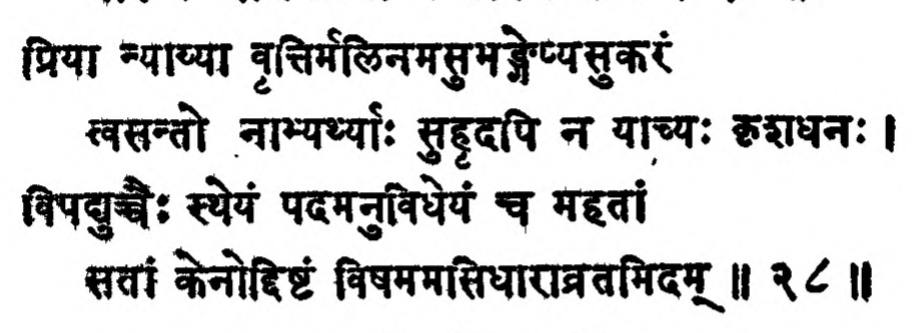
प्रिया न्याय्या वृत्तिर्मलिनमसुभङ्गेप्यसुकरं
त्वसन्तो नाभ्यर्थ्याः सुहृदपि न याच्यः कृशधनः ।
विपद्युच्चैः स्थेयं पदमनुविधेयं च महतां
सतां केनोद्दिष्टं विषममसिधाराव्रतमिदम् ॥ २८ ॥
Notes
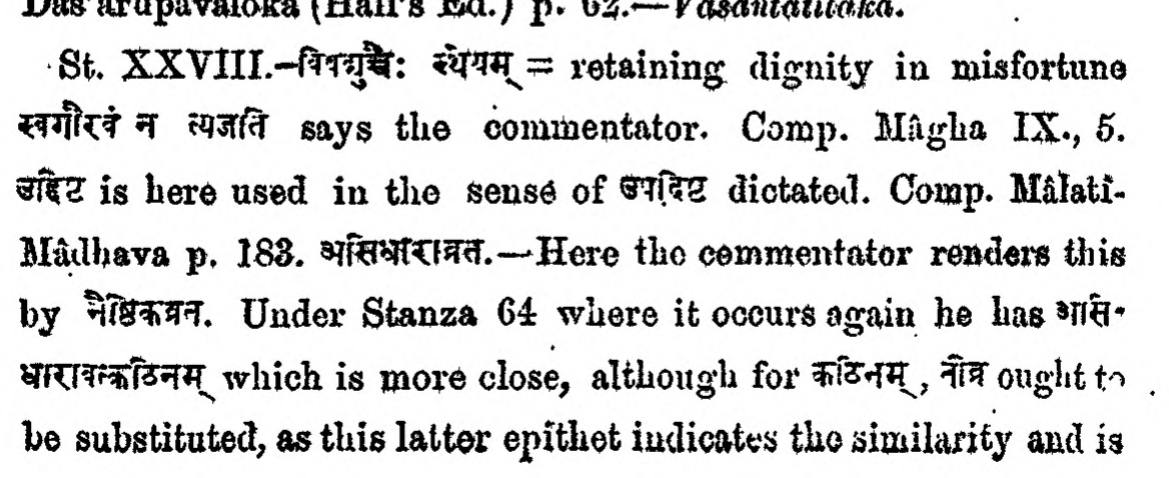
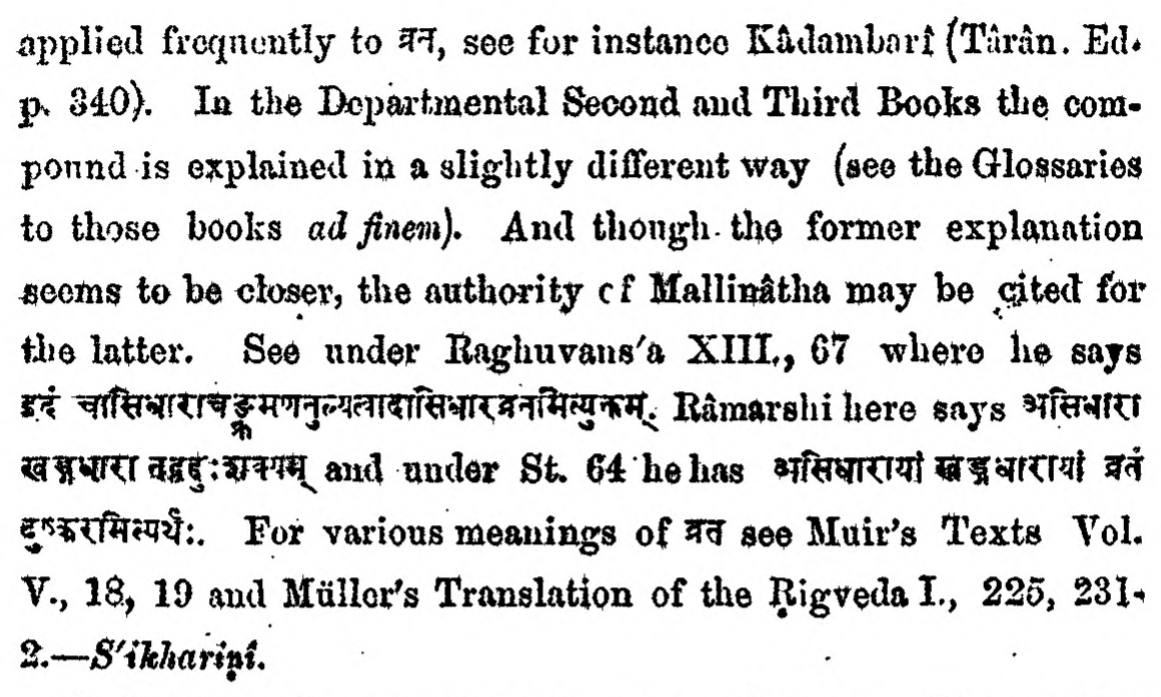
St. XXVIII.—विपदुच्चैः स्थेयम् = retaining dignity in misfortune स्वगौरवं न त्यजति says the commentator. Comp. Mâgha IX., 5. उद्दिष्ट is here used in the sense of उपदिष्ट dictated. Comp. MâlatîMâdhava p. 183. असिधाराव्रत.—Here the commentator renders this by नैष्ठिकव्रत. Under Stanza 64 where it occurs again he has असिधारावत्कठिनम् which is more close, although for कठिनम्, तीव्र ought to be substituted, as this latter epithet indicates the similarity and is applied frequently to व्रत, see for instance Kâdambarî (Târân. Ed. p. 340). In the Departmental Second and Third Books the compound is explained in a slightly different way (see the Glossaries to those books ad finem). And though the former explanation seems to be closer, the authority of Mallinâtha may be cited for the latter. See under Raghuvans'a XIII., 67 where he says इदं चासिधाराचङ्क्रमणतुल्यतादासिधारव्रतमित्युक्तम्. Râmarshi here says असिधारा खड्गधारा तद्वद्दुःशक्यम् and under St. 64 he has असिधारायां खड्गधारायां व्रतं दुष्करमित्यर्थः. For various meanings of व्रत see Muir's Texts Vol. V., 18, 19 and Müller's Translation of the Ṛigveda I., 225, 2312.—S'ikhariṇî.

Kale
all

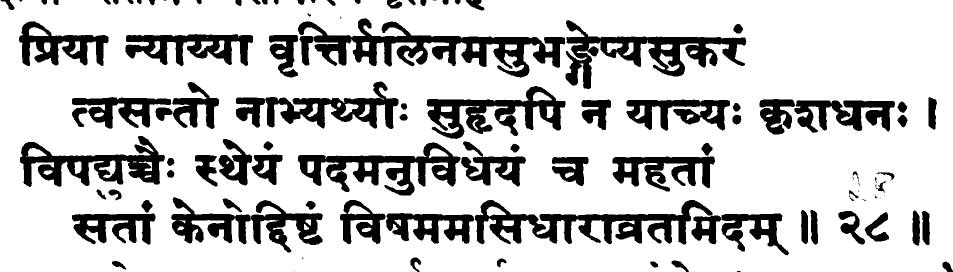
प्रिया न्याय्या वृत्तिर्मलिनमसुभङ्गेप्यसुकरं
त्वसन्तो नाभ्यर्थ्याः सुहृदपि न याच्यः कृशधनः ।
विपद्युच्चैः स्थेयं पदमनुविधेयं च महतां
सतां केनोद्दिष्टं विषममसिधाराव्रतमिदम् ॥ २८ ॥
Translation
28. A course of conduct pleasing and upright ( at once ), not stooping to a sinful act even when life is in danger, never to supplicate the wicked nor to beg of a friend who has very little wealth, living nobly in adversity, and following in the footsteps of the great,—by whom has this vow, as difficult ( to perform ) as walking on the edge of a sword, been taught to the good, ?


Notes
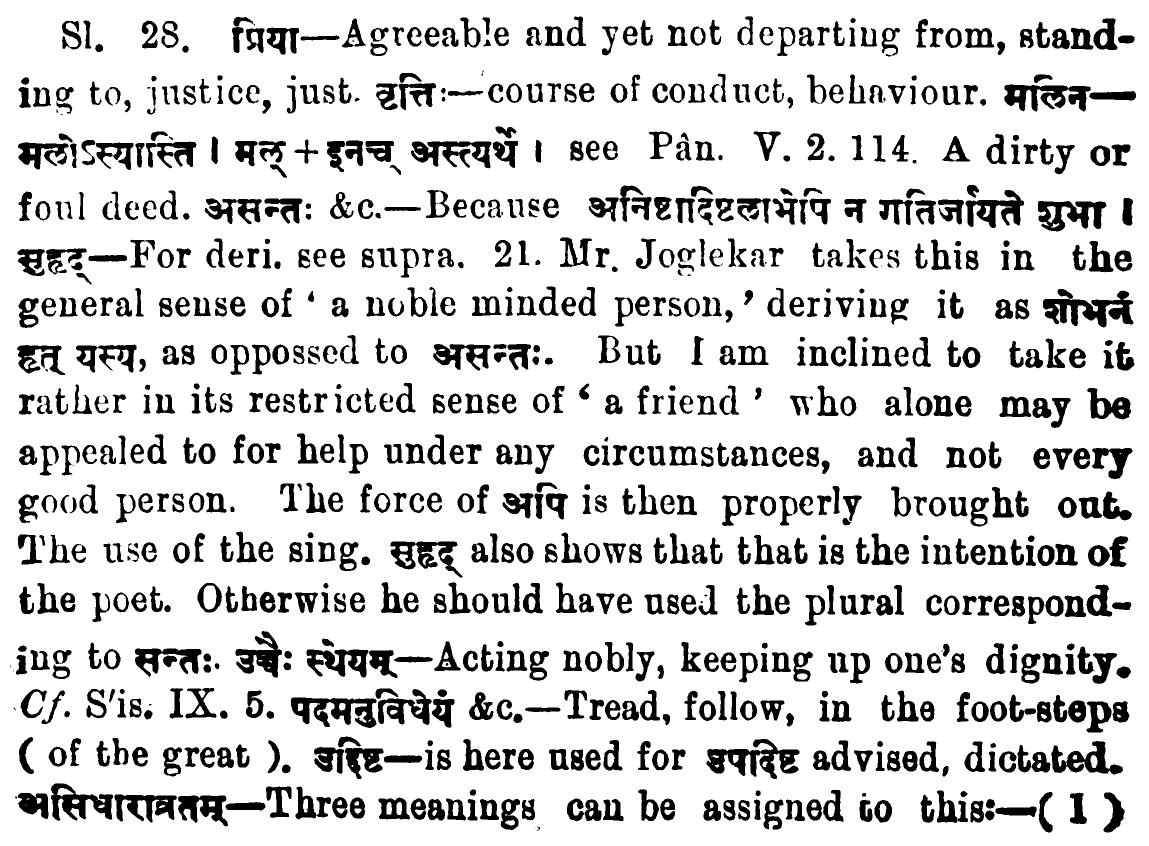
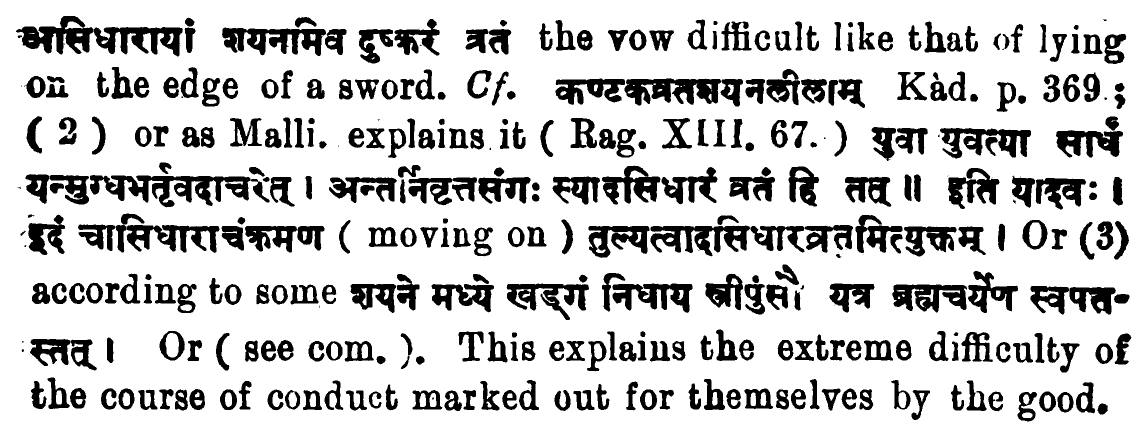
Sl. 28. प्रिया—Agreeable and yet not departing from, standing to, justice, just. वृत्तिः—course of conduct, behaviour. मलिन— मलोऽस्यास्ति । मल् + इनच् अस्त्यर्थे । see Pân. V. 2. 114. A dirty or foul deed. असन्तः &c.—Because अनिष्टादिष्टलाभेपि न गतिर्जायते शुभा । सुहृद्—For deri. see supra. 21. Mr. Joglekar takes this in the general sense of ‘ a noble minded person, ’ deriving it as शोभनं हृत् यस्य, as oppossed to असन्तः. But I am inclined to take it rather in its restricted sense of ‘ a friend ’ who alone may be appealed to for help under any circumstances, and not every good person. The force of अपि is then properly brought out. The use of the sing. सुहृद् also shows that that is the intention of the poet. Otherwise he should have used the plural corresponding to सन्तः. उच्चैः स्थेयम्—Acting nobly, keeping up one’s dignity. Cf. S'is. IX. 5. पदमनुविधेयं &c.—Tread, follow, in the foot-steps ( of the great ). उद्दिष्ट—is here used for उपदिष्ट advised, dictated. असिधाराव्रतम्—Three meanings can be assigned to this:—( 1 ) असिधारायां शयनमिव दुष्करं व्रतं the vow difficult like that of lying on the edge of a sword. Cf. कण्टकव्रतशयनलीलाम् Kâd. p. 369.; ( 2 ) or as Malli. explains it ( Rag. XIII. 67. ) युवा युवत्या सार्धं यन्मुग्धभर्तृवदाचरेत् । अन्तर्निवृत्तसंगः स्यादसिधारं व्रतं हि तत् ॥ इति यादवः । इदं चासिधाराचंकमण ( moving on ) तुल्यत्वादसिधारव्रतमित्युक्तम् । Or (3) according to some शयने मध्ये खड्गं निधाय स्त्रीपुंसौ यत्र ब्रह्मचर्येण स्वपतस्तत् । Or ( see com. ). This explains the extreme difficulty of the course of conduct marked out for themselves by the good.
Gopinath1914
all
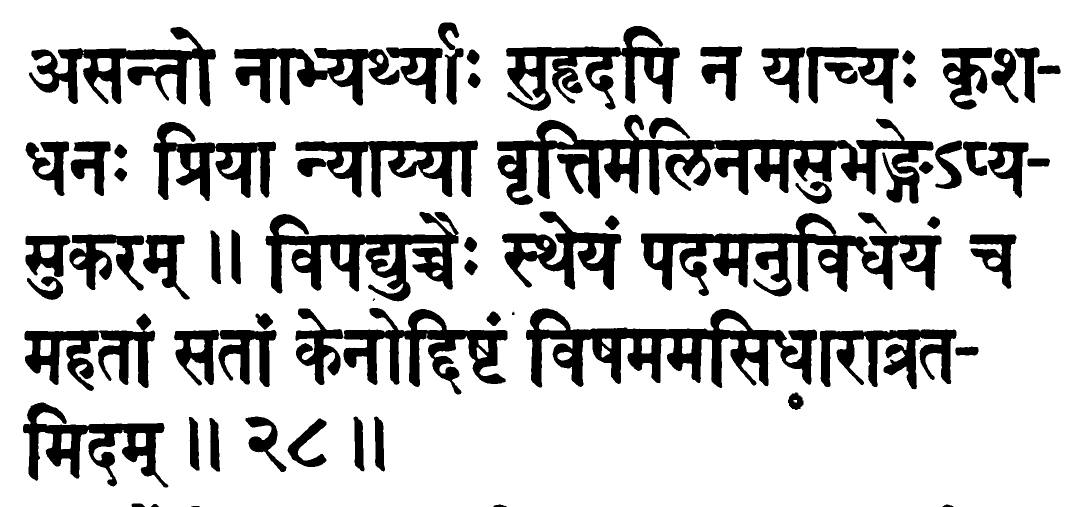
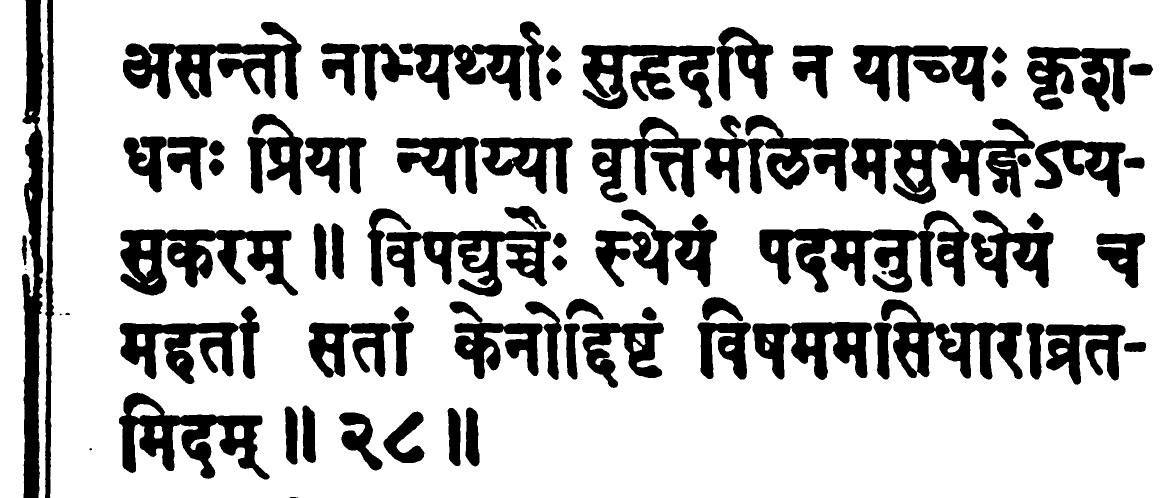
असन्तो नाभ्यर्थ्याः सुहृदपि न याच्यः कृश-
धनः प्रिया न्याय्या वृत्तिर्मलिनमसुभङ्गेऽप्य-
सुकरम् ॥ विपद्युच्चैः स्थेयं पदमनुविधेयं च
महतां सतां केनोद्दिष्टं विषममसिधाराव्रत-
मिदम् ॥ २८ ॥
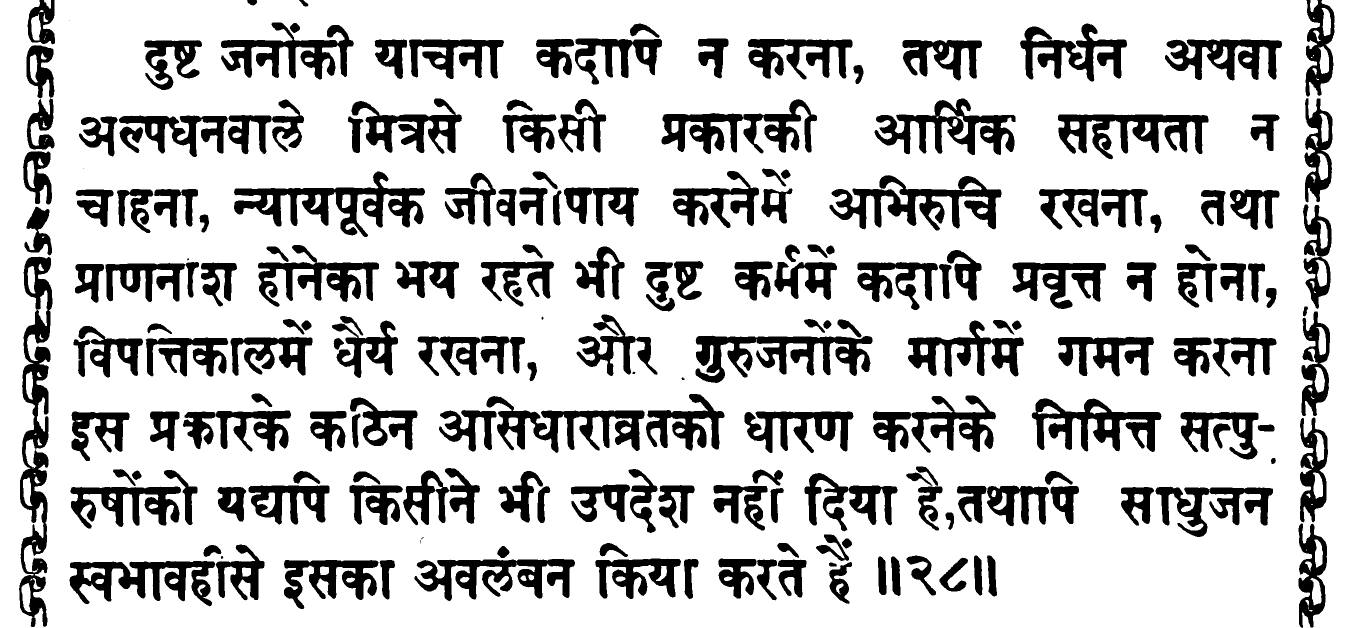
दुष्ट जनोंकी याचना कदापि न करना, तथा निर्धन अथवा अल्पधनवाले मित्रसे किसी प्रकारकी आर्थिक सहायता न चाहना, न्यायपूर्वक जीवनोपाय करनेमें अभिरुचि रखना, तथा प्राणनाश होनेका भय रहते भी दुष्ट कर्ममें कदापि प्रवृत्त न होना, विपत्तिकाल में धैर्य रखना, और गुरुजनोंके मार्ग में गमन करना इस प्रकारके कठिन असिधाराव्रतको धारण करनेके निमित्त सत्पु रुषोंको यद्यपि किसीने भी उपदेश नहीं दिया है, तथापि साधुजन स्वभावही से इसका अवलंबन किया करते हैं ॥ २८॥
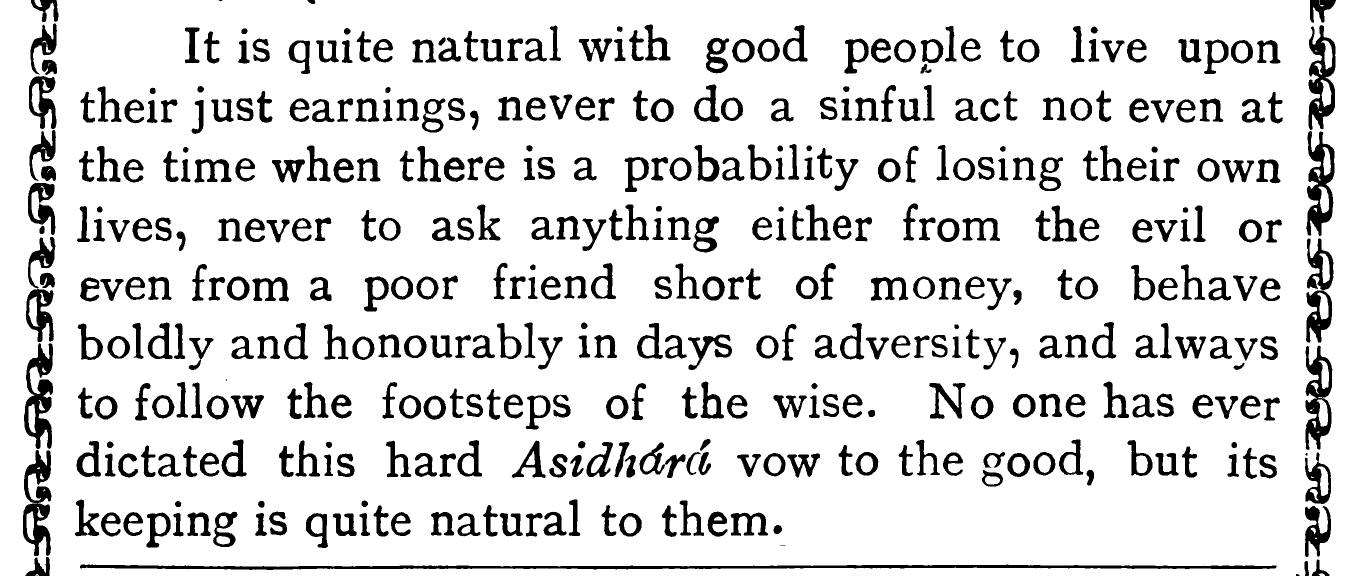
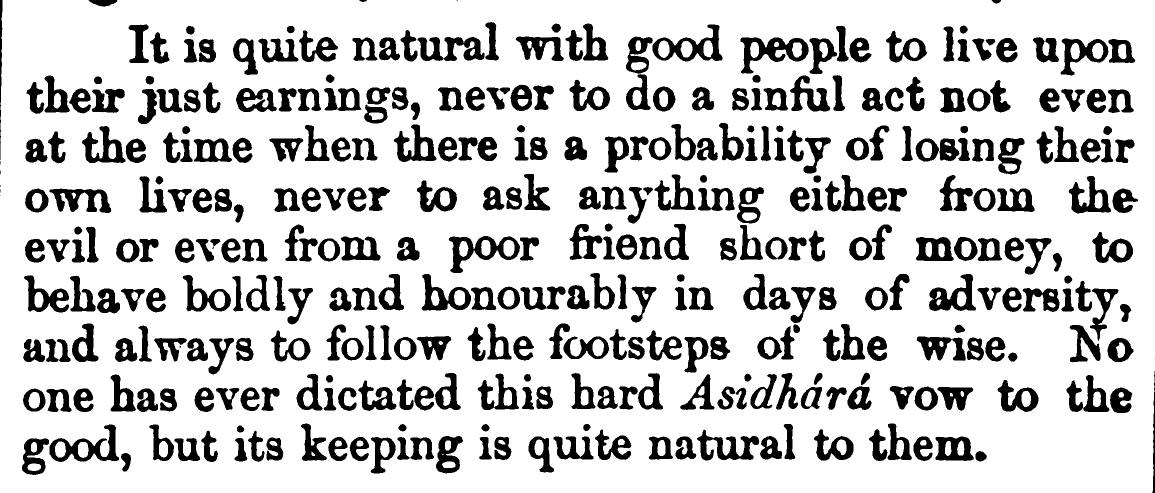
It is quite natural with good people to live upon their just earnings, never to do a sinful act not even at the time when there is a probability of losing their own lives, never to ask anything either from the evil or even from a poor friend short of money, to behave boldly and honourably in days of adversity, and always to follow the footsteps of the wise. No one has ever dictated this hard Asidhárá vow to the good, but its keeping is quite natural to them.
Footnote
Quoted under Jayaditya ( जयादित्य) in the Subhashitavali ( सुभाषितावाले ). ( No. 280. B. S. S. No. XXXI.).


Gopinath1896
all
असन्तो नाभ्यर्थ्याः सुहृदपि न याच्यः कृश-
धनः प्रिया न्याय्या वृत्तिर्मलिनमसुभङ्गेऽप्य-
सुकरम् ॥ विपद्युच्चैः स्थेयं पदमनुविधेयं च
महतां सतां केनोद्दिष्टं विषममसिधाराव्रत-
मिदम् ॥ २८ ॥
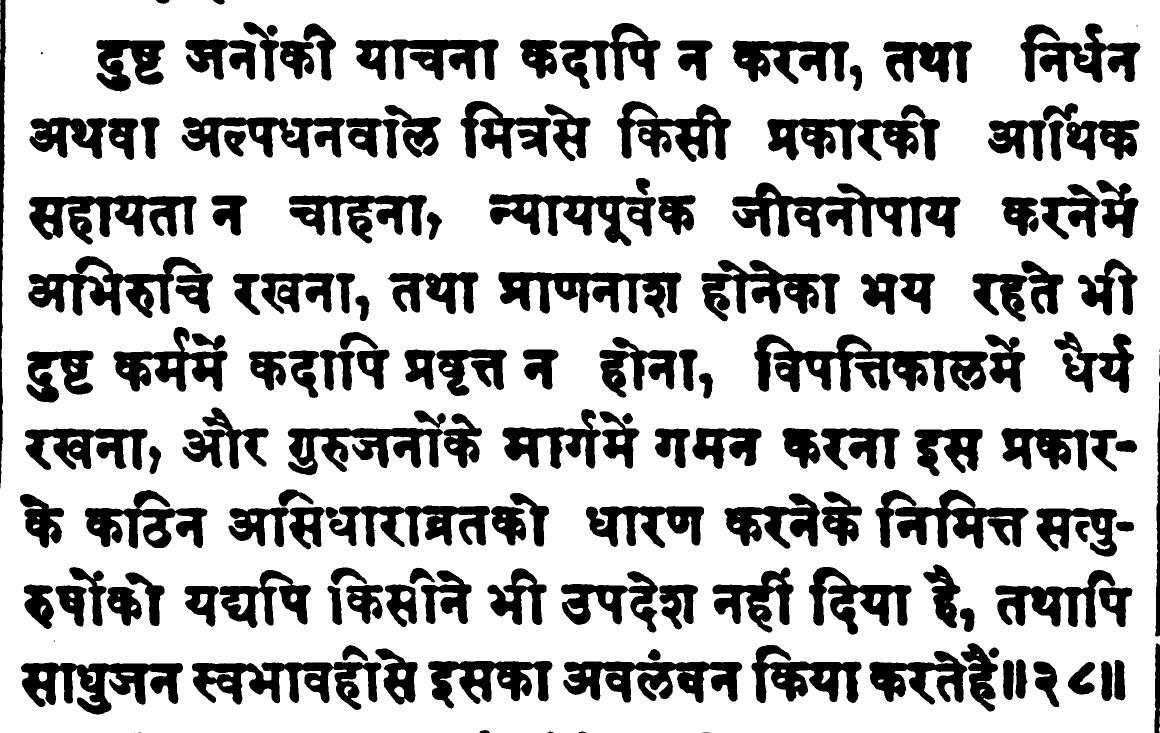
दुष्ट जनोंकी याचना कदापि न करना, तथा निर्धन अथवा अल्पधनवाल मित्रसे किसी प्रकारकी आर्थिक सहायता न चाहना, न्यायपूर्वक जीवनोपाय करनेमें अभिरुचि रखना, तथा प्राणनाश होनेका भय रहते भी दुष्ट कर्ममें कदापि प्रवृत्त न होना, विपत्तिकालमें धैर्य रखना, और गुरुजनोंके मार्गमें गमन करना इस प्रकारके कठिन असिधाराव्रतको धारण करने के निमित्त सत्पुरुषोंको यद्यपि किसीने भी उपदेश नहीं दिया है, तथापि साधुजन स्वभावही से इसका अवलंबन किया करते हैं ॥ २८ ॥
It just is quite earningsnatural never with good do a sinful people act to not live upon even their , to at the time when there is a probability of losing their lives, never to ask anything either from the evil own or even from a poor friend short of money, to behave boldly and honourably in days of adversity, and always to follow the footsteps of the wise. No one has ever dictated this hard Asidhárá vow to the good, but its keeping is quite natural to them.
Footnote
Quoted under Jayäditya ( जयादित्य ) in the Subhashitāvali (सुभाfres). (No. 280. B. S. S. No. XXXI.).


Kosambi
all
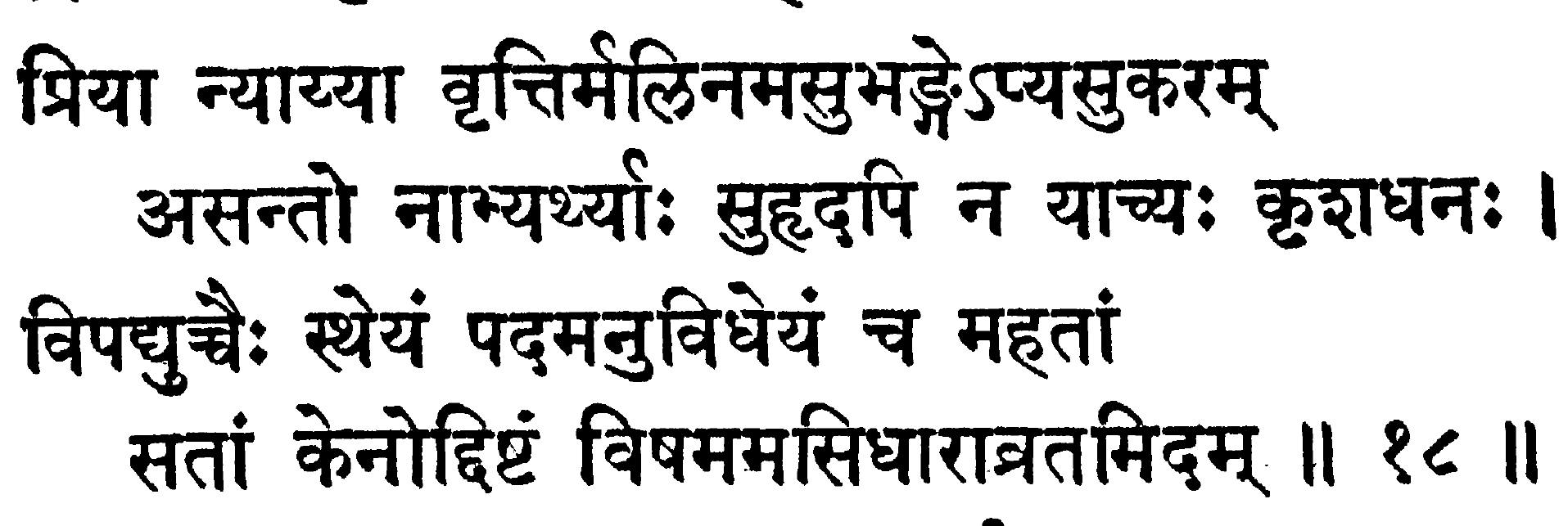
प्रिया न्याय्या वृत्तिर्मलिनमसुभङ्गेऽप्यसुकरम्
असन्तो नाभ्यर्थ्याः सुहृदपि न याच्यः कृशधनः ।
विपद्युच्चैः स्थेयं पदमनुविधेयं च महतां
सतां केनोद्दिष्टं विषमम सिधाराव्रतमिदम् ॥ १८ ॥
Footnote
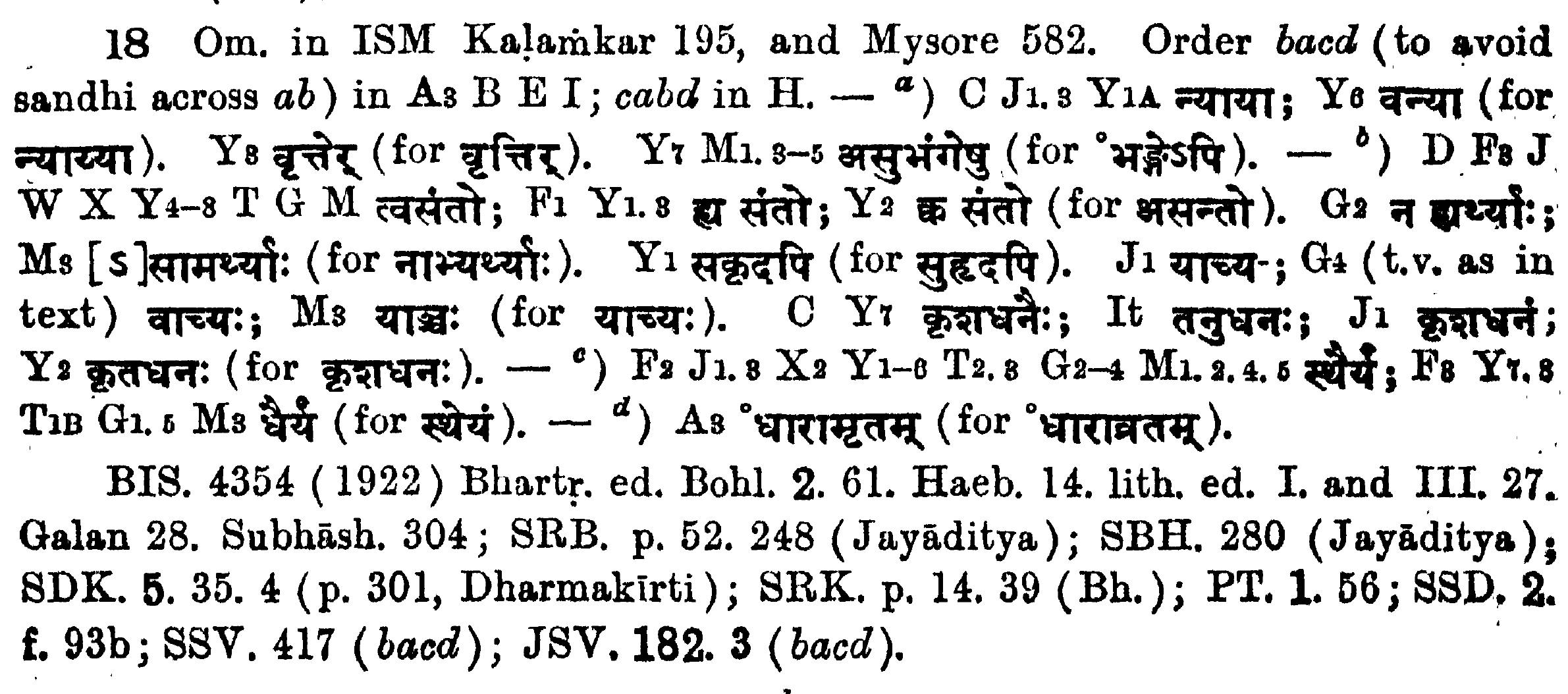
18 Om . in ISM Kalamkar 195 , and Mysore 582. Order bacd ( to avoid
sandhi across ab ) in A3 BE I ; cabd in H. a ) C J1.3 Y14 न्याया ; Yo वन्या ( for .
न्याय्या ) . Y8 वृत्तेर् ( for वृत्तिर् ) . Yr M1.8-5 असुभंगेषु ( for भङ्गेऽपि ) . . 6 ) D F3 J
W_X_Y4–4 T G_M त्वसंतो ; F1 Y1.8 ह्य संतो ; Y2 व संतो ( for असन्तो ) . G2 न झर्थ्याः ;
Ms [ s ] सामर्थ्या : ( for नाभ्यर्थ्या : ) . Y1 सकृदपि ( for सुहृदपि ) . Ja J2 याच्य ; G ( tv as in
text ) वाच्यः ; Ms याञ्च ( for याच्यः ) . C CY1 Y1 कृशधनैः कृशधनैः ; ; It तनुधनः ; J1 कृशधनं ;
Y 2 कृतधन : ( for कृशधनः ) . – ° ) F2 J1 . 8 X 2 Y1 - 8 T2 . 8 G2 – 4 M1 . 2. 4.6 स्थैर्य ; F8 X1.8
T1B G1 . 5 M3 धैर्य ( for स्थेयं ) . d ) A3 धारामृतम् ( for ' धाराव्रतम् ) .
BIS . 4354 ( 1922 ) Bhartr ed . Bohl . 2. 61. Haeb . 14. lith ed . I. and III . 27 .
Galan 28. Subhash . 304 ; SRB . p . 52. 248 ( Jayāditya ) ; SBH . 280 ( Jayāditya ) ;
SDK . 5. 35. 4 ( p . 301 , Dharmakirti ) ; SRK . p . 14 , 39 ( Bh . ) ; PT . 1.56 ; SSD , 2
f . 93b ; SSV . 417 ( baed ) ; JSV . 182. 3 ( bacd ) .
Commentary