Tawney
Worn with hunger, faint and feeble, shorn of glory and of power,
Still the king of beasts is kingly, even to his dying hour;
Will he graze on hay like oxen ? No, he longs to meet once more
Tusk-armed elephants in battle, and to drink their spouting gore.
Telang
all
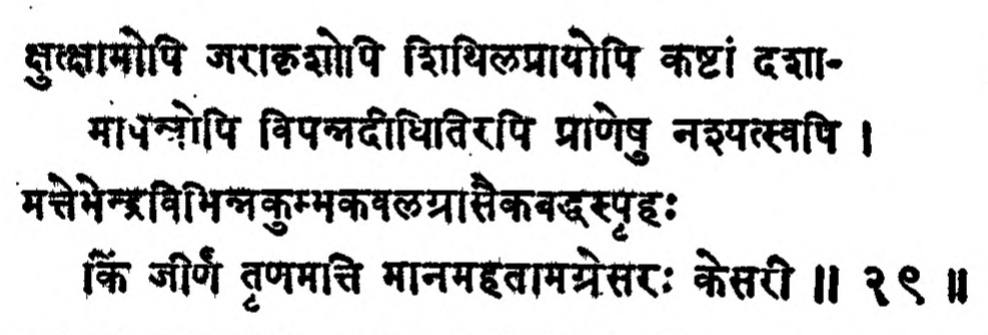
क्षुत्क्षामोपि जराकृशोपि शिथिलप्रायोपि कष्टां दशा-
मापन्नोपि विपन्नदीधितिरपि प्राणेषु नश्यत्स्वपि ।
मत्तेभेन्द्रविभिन्नकुम्भकवलग्रासैकबद्धस्पृहः
किं जीर्णं तृणमत्ति मानमहतामग्रेसरः केसरी ॥ २९ ॥
Notes
St. XXIX.—ग्रास after कवल means swallowing. The reading दलन for कवल has a parallel in S'ṛingâras'ataka St. 59 (Kâvyasangraha). मानमहताम् = great in self-respect or dignity compare मानिन्.—S'ârdûlavikrîḍita.

Kale
all
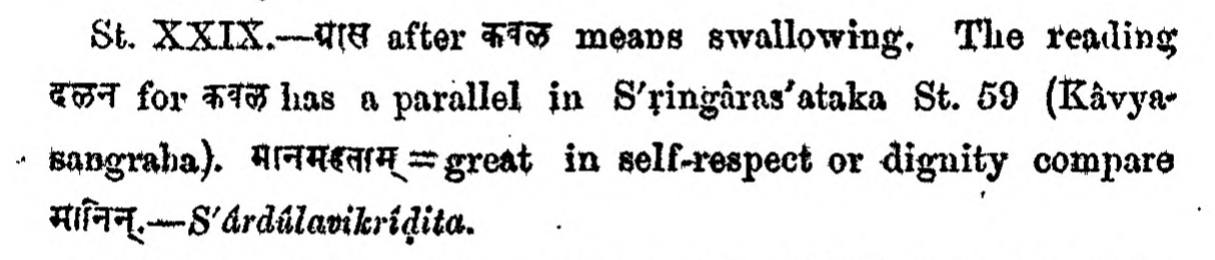
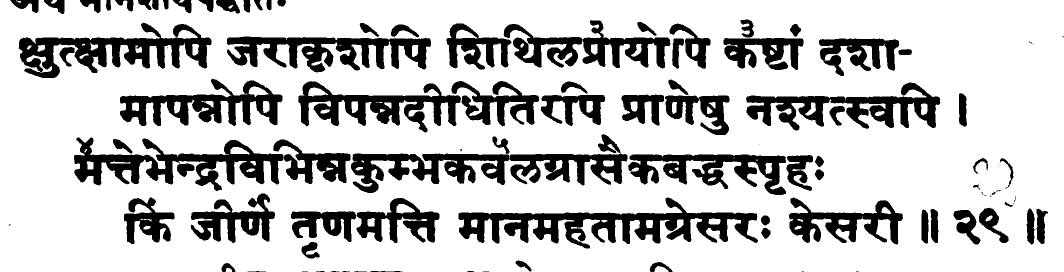
क्षुत्क्षामोपि जराकृशोपि शिथिलप्रायोपि कष्टां दशा-
मापन्नोपि विपन्नदीधितिरपि प्राणेषु नश्यत्स्वपि ।
मत्तेभेन्द्रविभिन्नकुम्भकवलग्रासैकबद्धस्पृहः
किं जीर्णं तृणमत्ति मानमहतामग्रेसरः केसरी ॥ २९ ॥
Translation
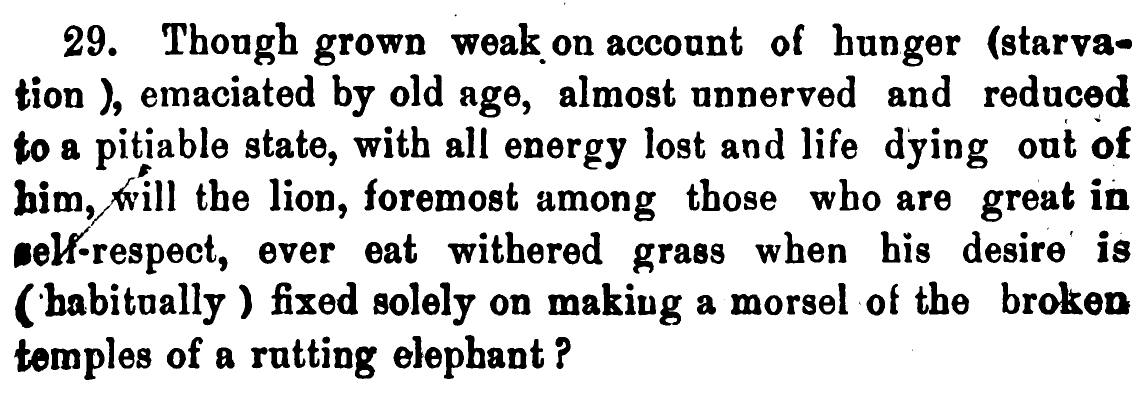
29. Though grown weak on account of hunger (starvation ), emaciated by old age, almost unnerved and reduced to a pitiable state, with all energy lost and life dying out of him, will the lion, foremost among those who are great in self-respect, ever eat withered grass when his desire is ( habitually ) fixed solely on making a morsel of the broken temples of a rutting elephant ?
Notes
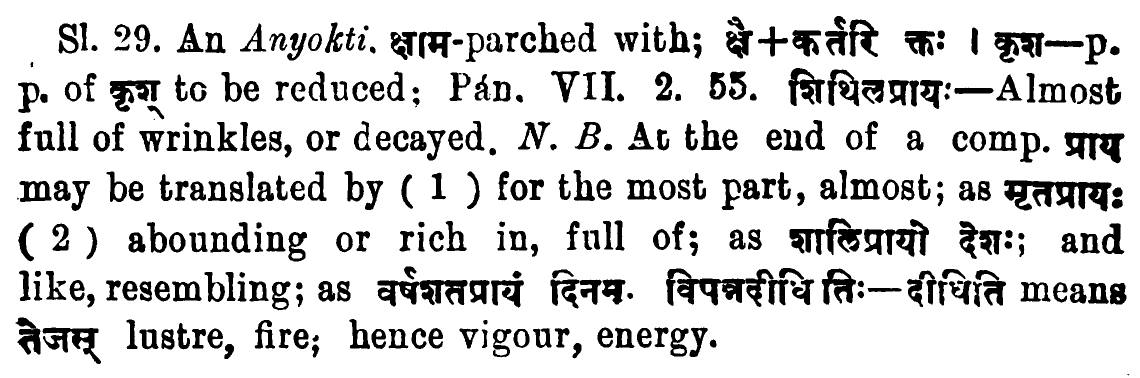
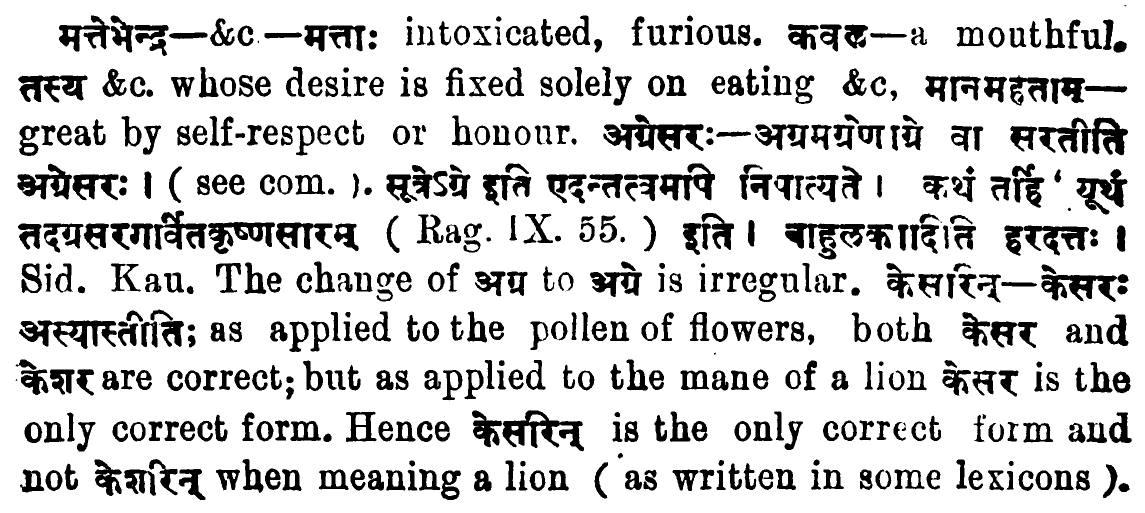
Sl. 29. An Anyokti. क्षाम-parched with; क्षै+कर्तरि क्तः । कृश—p. p. of कृश् to be reduced; Pán. VII. 2. 55. शिथिलप्रायः—Almost full of wrinkles, or decayed. N. B. At the end of a comp. प्राय may be translated by ( 1 ) for the most part, almost; as मृतप्रायः ( 2 ) abounding or rich in, full of; as शालिप्रायो देशः; and like, resembling; as वर्षशतप्रायं दिनम्. विपन्नदीधितिः—दीधिति means तेजस् lustre, fire; hence vigour, energy. मत्तेभेन्द्र—&c—मत्ताः intoxicated, furious. कवल—a mouthful. तस्य &c. whose desire is fixed solely on eating &c, मानमहताम्— great by self-respect or honour. अग्रेसरः—अग्रमग्रेणाग्रे वा सरतीति अग्रेसरः । ( see com. ). सूत्रेऽग्रे इति एदन्तत्वमपि निपात्यते । कथं तर्हि ‘यूथं तदग्रसरगर्वितकृष्णसारम् ( Rag. IX. 55. ) इति । बाहुलकादिति हरदत्तः । Sid. Kau. The change of अग्र to अग्रे is irregular. केसरिन्—केसरः अस्यास्तीति; as applied to the pollen of flowers, both केसर and केशर are correct; but as applied to the mane of a lion केसर is the only correct form. Hence केसरिन् is the only correct form and not केशरिन् when meaning a lion ( as written in some lexicons ).
Gopinath1914
all
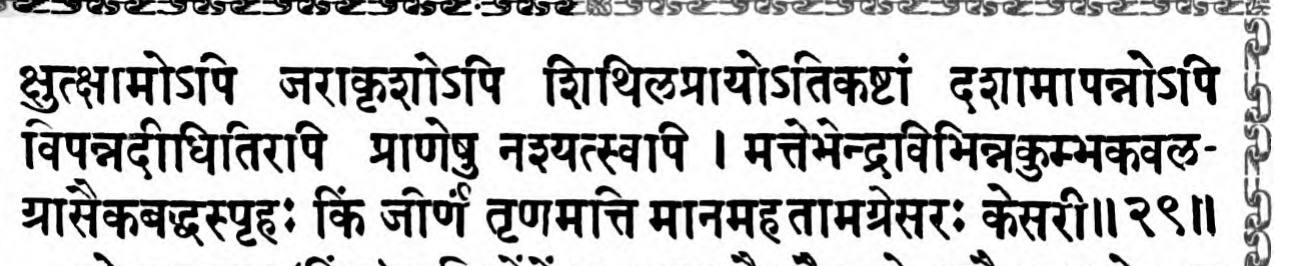
क्षुत्क्षामोऽपि जराकृशोऽपि शिथिलप्रायोऽतिकष्टां दशामापन्नोऽपि
विपन्नदीधितिरपि प्राणेषु नश्यत्स्वपि । मत्तेभेन्द्रविभिन्नकुम्भकवल-
ग्रासैकबद्धस्पृहः किं जीर्णं तृणमत्ति मानमहतामग्रेसरः केसरी ॥२९॥
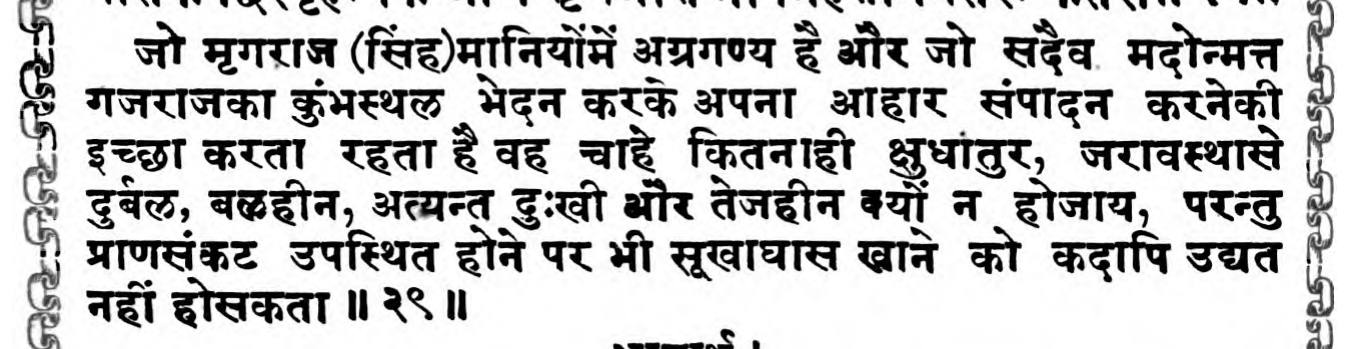
जो मृगराज (सिंह) मानियोंमें अग्रगण्य है और जो सदैव मदोन्मत्त गजराजका कुंभस्थल भेदन करके अपना आहार संपादन करने की इच्छा करता रहता है वह चाहे कितना ही क्षुधांतुर, जरावस्थासे दुर्बल, बलहीन, अत्यन्त दुःखी और तेजहीन क्यों न होजाय, परन्तु प्राणसंकट उपस्थित होने पर भी सूखाघास खाने को कदापि उद्यत नहीं होसकता ॥ २९॥
Footnote
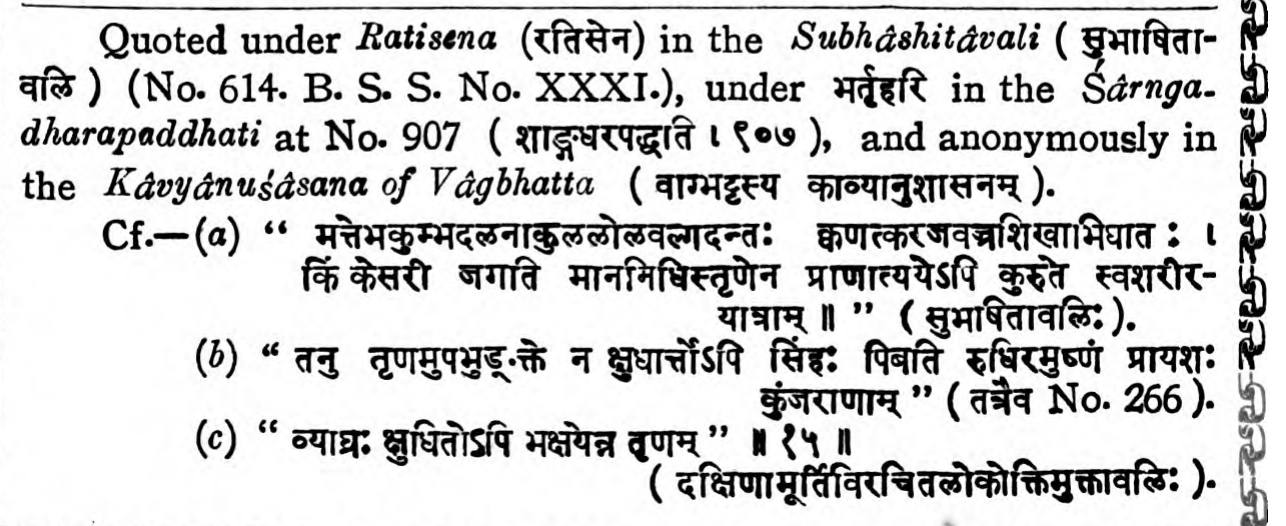
Quoted under Ratisena ( रतिसेन ) in the Subhashitavali ( वलि ) (No. 614. B. S. S. No. XXXI.), under भर्तृहरि in the सुभाषिता- Sarnga. dharapaddhati at No. 907 ( शाङ्गधरपद्धति । ९०७), and anonymously in the Kavyanuśasana of Vagbhatta (वाग्भट्टस्य काव्यानुशासनम् ). Cf.-(a) 66 मत्तेभकुम्भदलनाकुललोलवल्गदन्तः क्वणत्करजवञ्चशिखाभिघात: । किं केसरी जगति मानमिधिस्तृणेन प्राणात्ययेऽपि कुरुते स्वशरीर(b) “ तनु तृणमुपभुङ्क्ते न क्षुधार्त्तोऽपि यात्राम् सिंहः ॥ " पिबति ( सुभाषितावलिःरुधिरमुष्णं )प्रायशः . कुंजराणाम् " ( तत्रैव No. 266 ). (c) " व्याघ्रः क्षुधितोऽपि भक्षयन्न तृणम् " ॥ १५ ॥ ( दक्षिणामूर्तिविरचितलोकोक्तिमुक्तावलिः ).
Gopinath1896
all
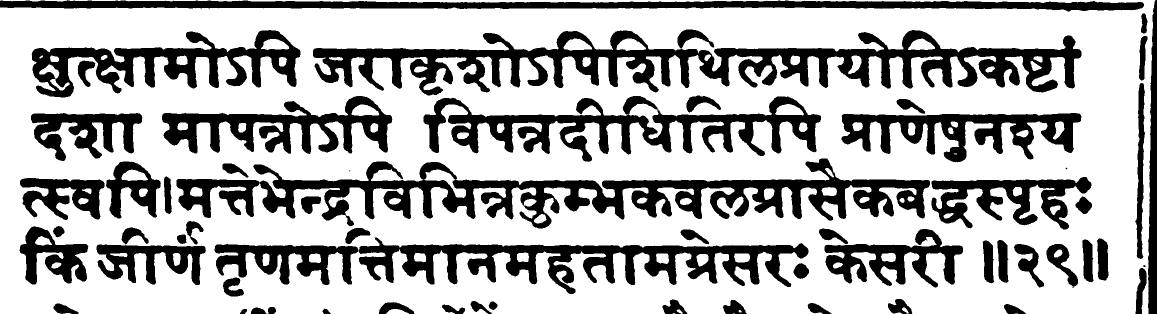
क्षुत्क्षामोऽपि जराकृशोऽपिशिथिलप्रायोति कष्टां
दशा मापन्नोऽपि विपन्नदीधितिरपि प्राणेषुनश्य
त्स्वपि मत्तेभेन्द्र विभिन्नकुम्भकवलमासैकबद्धस्पृहः
किं जीर्ण तृणमत्तिमानमहतामप्रेसरः केसरी ॥ २९ ॥
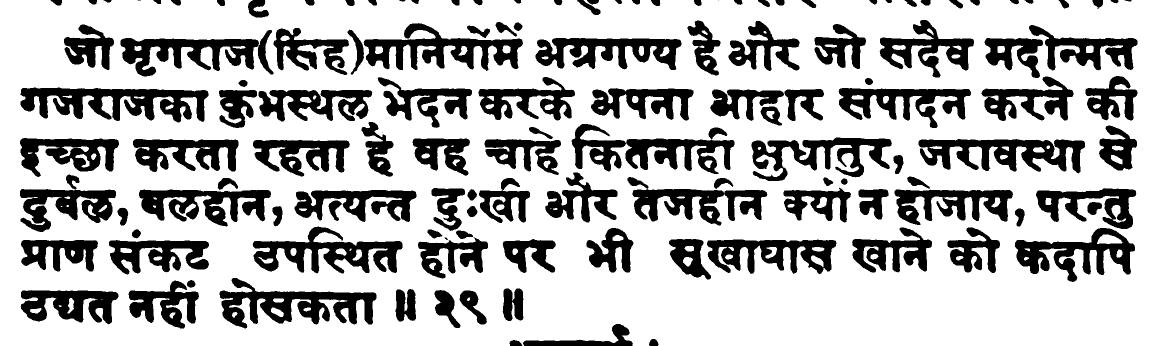
जो भृगराज (सिंह) मानियोंमें अग्रगण्य है और जो सदैव मदोन्मत्त गजराजका कुंभस्थल भेदन करके अपना आहार संपादन करने की इच्छा करता रहता है वह चाहे कितनाही क्षुधातुर, जरावस्था से दुर्बल, बलहीन, अत्यन्त दुःखी और तेजहीन क्यों न होजाय, परन्तु प्राण संकट उपस्थित होने पर भी सूखाघास खाने को कदापि उद्यत नहीं होसकता ॥ २९ ॥
Footnote
Quoted under Ratisena ( रतिसेन ) in the Subhashitavali (सुभाषितावलि) ( No. 614. B. S. S. No. XXXI.), under भर्तृहरि in the Sarngadharapaddhati at No. 907 (शार्ङ्गधरपद्धति । ९०७), and anonymously in the Kāvyānuśāsana of Vagbhatta (वाग्भट्टस्य काव्यानुशासनम् ).

Footnote
. - (a) “मत्तेभकुम्भदलनाकुललोलवरगदन्तः कणत्करजवशिखाभिघातः । किं केसरी जगति माननिधिस्तृणेन प्राणत्ययेऽपि कुरुते स्वशरीरयात्राम् ॥ " (सुभाषितावलिः).

Footnote
(8) “ तनु तृणमुपभुङ्क्ते न क्षुधार्तोऽपि सिंहः पिबति रुधिरमुष्णं प्रायशः कुंजराणाम् " ( तत्रैव No. 266 ).


Kosambi
all
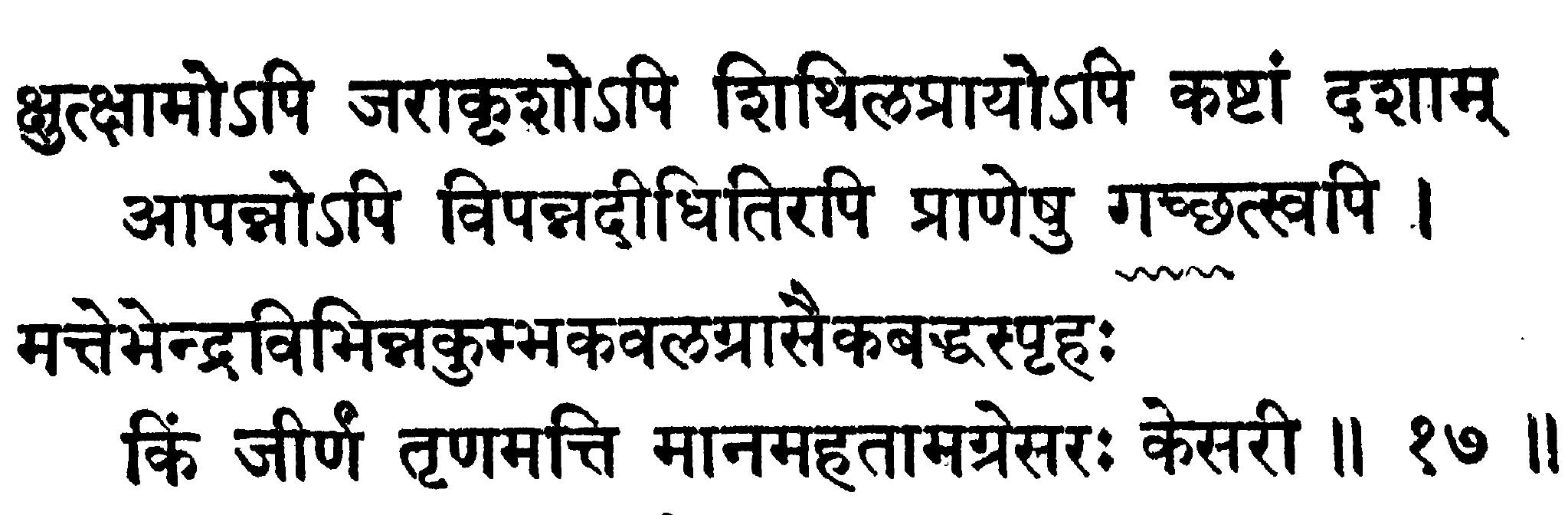
क्षुत्क्षामोऽपि जराकृशोऽपि शिथिलप्रायोऽपि कष्टां दशाम्
आपन्नोऽपि विपन्नदीधितिरपि प्राणेषु गच्छत्खपि ।
मन्तेभेन्द्रविभिन्नकुम्भकवलग्रासैकबद्धस्पृहः
किं जीर्ण तृणमत्ति मानमहतामग्रेसरः केसरी ॥ १७ ॥
Footnote
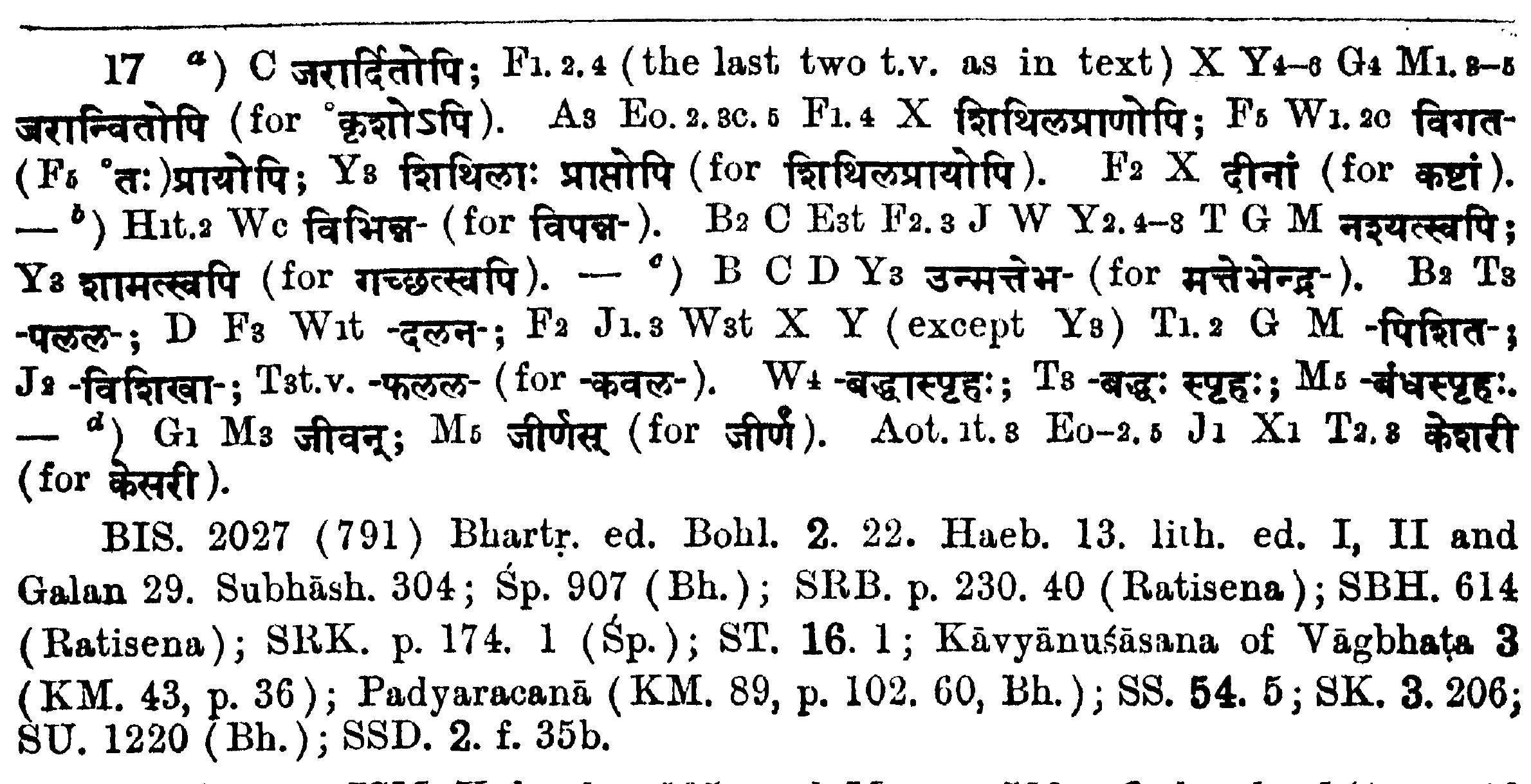
17 ) 4 C जरार्दितोपि ; F1 24 ( the last two tv as in text ) X Y 4–6 G4 M1 . 8-8
जरान्वितोपि ( for कृशोऽपि ) . A3 Eo . 2. 30.6 F1 4 X शिथिलप्राणोपि ; Fs W 1.20 विगत
( Fs ' तः ) प्रायोपि ; Y : शिथिलाः प्राप्तोपि ( for शिथिलप्रायोपि ) . F2 X दीनां ( for कष्टां ) .
8 ) H1t.2 We विभिन्न - ( for विपन्न - ) . B2 C Est F2 . 3 J W_Y2 . 4 – 4 T GM नश्यत्स्वपि ;
Y3 शामत्स्वपि ( for गच्छत्स्वपि ) . ● ) BCDY 3 उन्मत्तेभ ( for मत्तेभेन्द्र - ) . Ba T3
- पलल- ; D F3 Wit - दलन - ; F2 J1.3 Wst X Y ( except Y 3 ) T1 . 2 GM -पिशित -3
Js -विशिखा- ; Tst . v . - फलल - ( for -कवल- ) . W + - बद्धास्पृहः ; T3 बद्धः स्पृहः ; Ms - बंधस्पृहः .
d a ) G1 M3 जीवनू ; Ms जीर्णस् ( for जीर्ण ) . Aot.it. 8 Eo 2.6 J1 X 1 T2 . 8 केशरी
( for केसरी ) .
BIS . 2027 ( 791 ) Bhartr . ed . Bobl . 2. 22. Haeb . 13. litb . ed . I , II and
Galan 29. Subhāsh . 304 ; Sp . 907 ( Bh . ) ; SRB . p . 23040 ( Ratisena ) ; SBH . 614
( Ratisena ) ; SRK . p . 174. 1 ( Śp . ) ; ST . 16. 1 ; Kāvyānuśāsana of Vägbhața 3
( KM . 43 , p . 36 ) ; Padyaracanā ( KM . 89 , p . 102.60 , Bh . ) ; SS . 54 5 ; 8K . 3. 206 ;
SU . 1220 ( Bh . ) ; SSD . 2. f . 35b .
Commentary