Tawney
Scorn not those sages who have scaled the topmost heights of truth;
Who snap the cords of wealth like bonds of straw.
For lotus-strings will never hold in awe
Th' infuriate sovereign of the herd, drunk with the pride of youth.
Telang
all
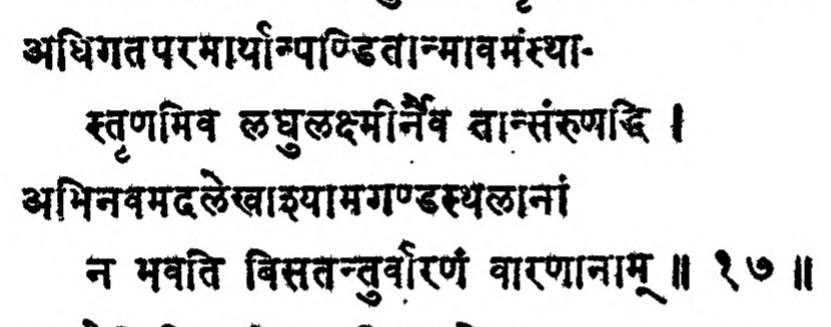
अधिगतपरमार्थान्पण्डितान्मावमंस्था-
स्तृणमिव लघुलक्ष्मीर्नैव तान्संरुणद्धि ।
अभिनवमदलेखाश्यामगण्डस्थलानां
न भवति बिसतन्तुर्वारणं वारणानाम् ॥ १७ ॥
Notes
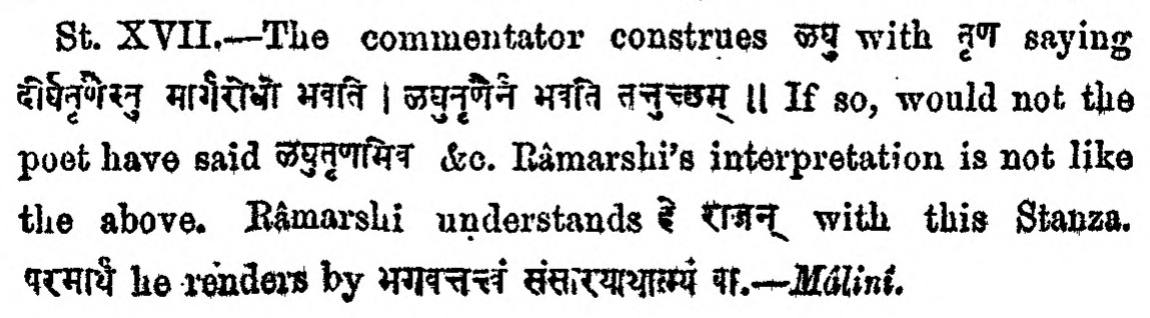
St. XVII.—The commentator construes लघु with तृण saying दीर्घतृणैस्तु मार्गरोधो भवति । लघुतृणैर्न भवति तत्तुच्छम् ॥ If so, would not the poet have said लघुतृणमिव &c. Râmarshi’s interpretation is not like the above. Râmarshi understands हे राजन् with this Stanza. परमार्थं he renders by भगवत्तत्त्वं संसारयाथात्म्यं वा.—Mâlinî.

Kale
all

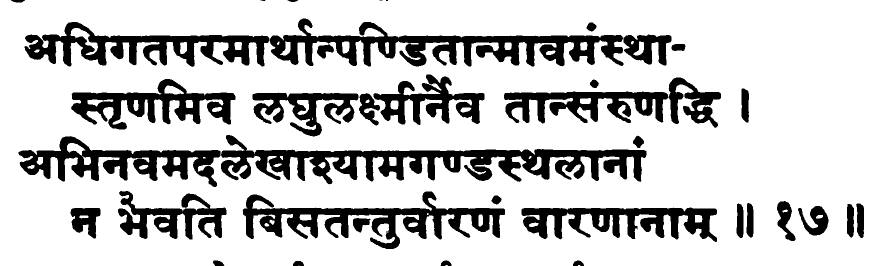
अधिगतपरमार्थान्पण्डितान्मावमंस्था-
स्तृणमिव लघुलक्ष्मीर्नैव तान्संरुणद्धि ।
अभिनवमदलेखाश्यामगण्डस्थलानां
न भवति बिसतन्तुर्वारणं वारणानाम् ॥ १७ ॥
Translation
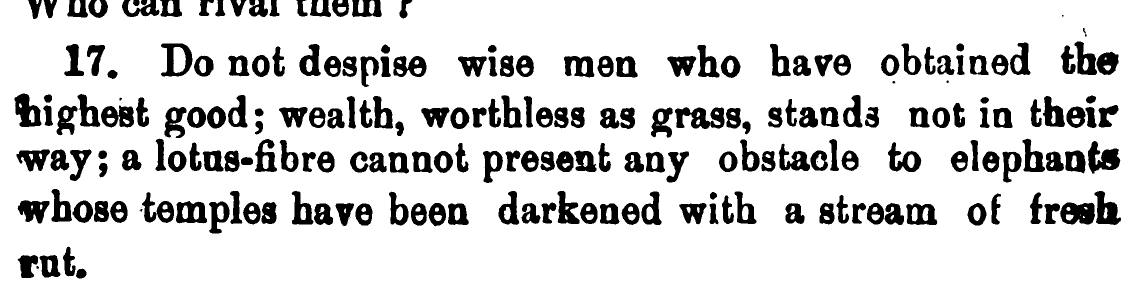
17. Do not despise wise men who have obtained the highest good; wealth, worthless as grass, stands not in their way; a lotus-fibre cannot present any obstacle to elephants whose temples have been darkened with a stream of fresh rut.
Notes
Sl. 17. परमार्थ-the highest object to be aimed at; the highest truth i. e. Knowledge about Brahma or the Surpreme Spirit. पण्डित.—see sl. 7. लघुलक्ष्मी;—Wealth-that insignificant thing (like grass ). The contrast is between परमार्थ and तृणमिव लघुलक्ष्मी. वारणम्—a hindrance.
Gopinath1914
all
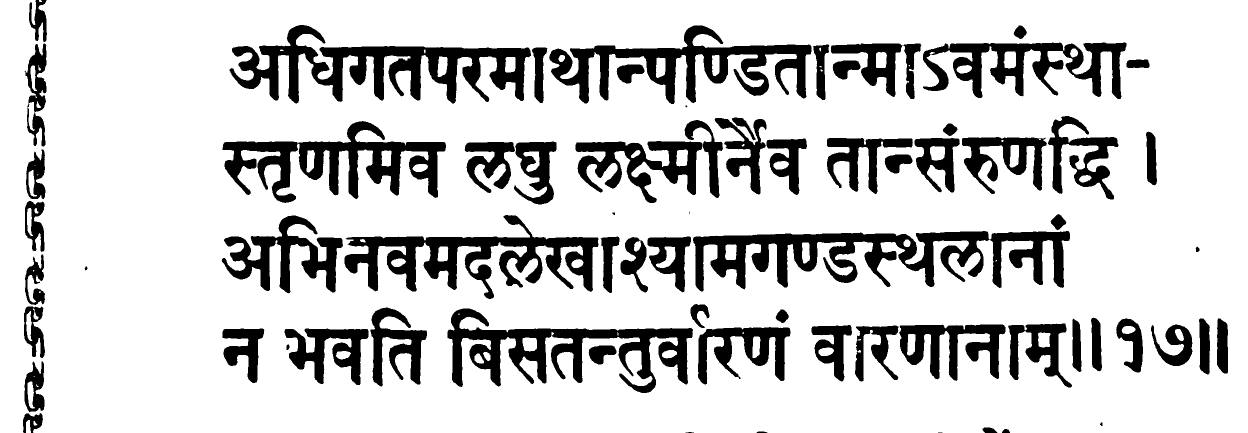
अधिगतपरमाथान्पण्डितान्माऽवमंस्था-
स्तृणमिव लघु लक्ष्मीर्नैव तान्संरुणद्धि ।
अभिनवमदलेखाश्यामगण्डस्थलानां
न भवति बिसतन्तुर्वारणं वारणानाम् ॥१७॥
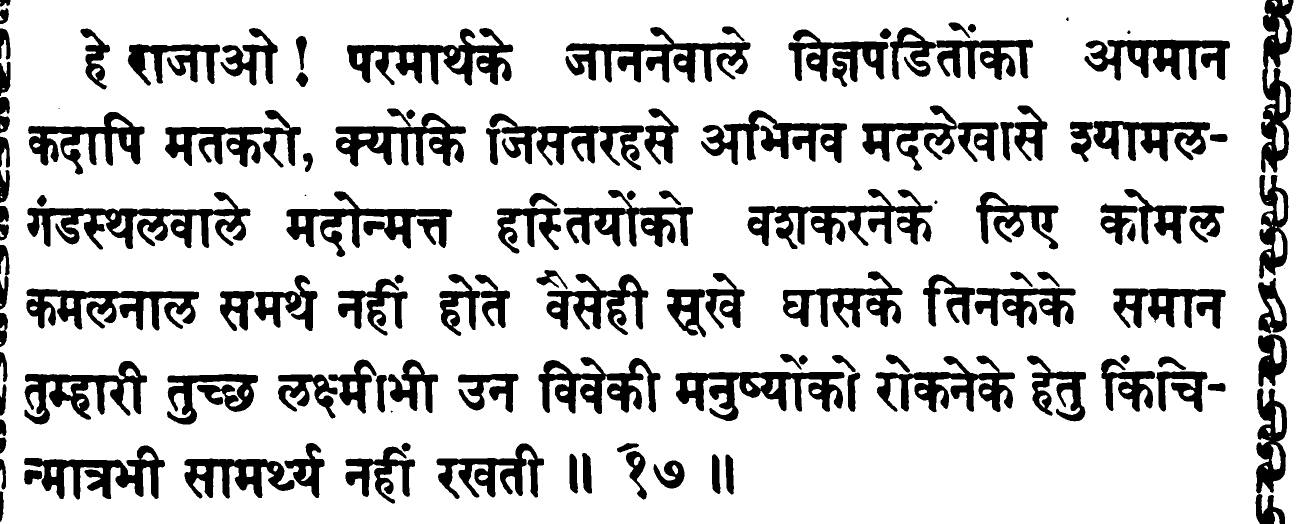
हे राजाओ ! परमार्थके जाननेवाले विज्ञपंडितोंका अपमान कदापि मतकरो, क्योंकि जिसतरह से अभिनव मदलेखासे श्यामलगंडस्थलवाले मदोन्मत्त हस्तियोंको वशकरनेके लिए कोमल कमलनाल समर्थ नहीं होते वैसेही सुखे घासके तिनकेके समान तुम्हारी तुच्छ लक्ष्मीभी उन विवेकी मनुष्योंको रोकने के हेतु किंचिन्मात्रभी सामर्थ्य नहीं रखती ॥ १७ ॥
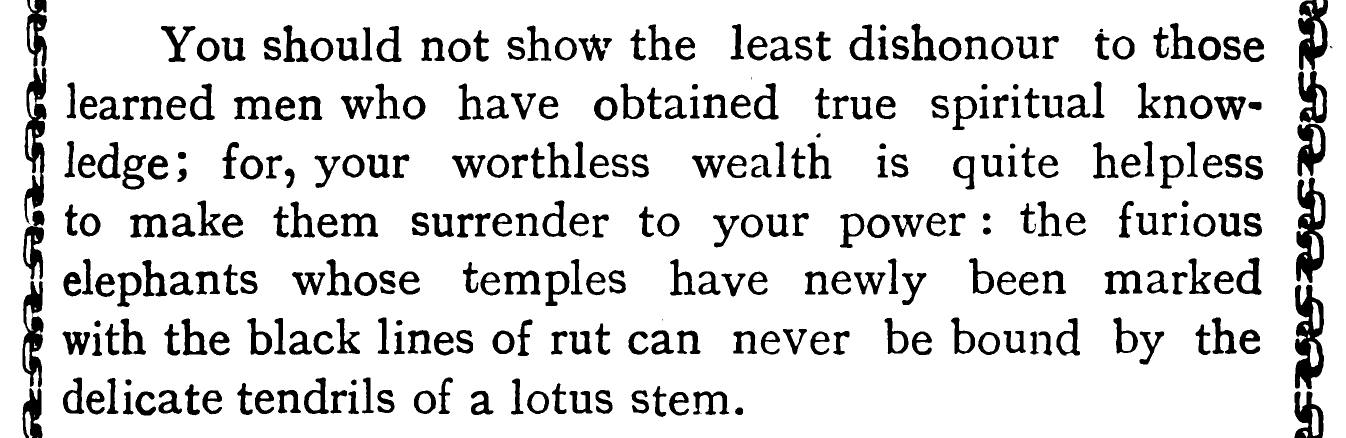
You should not show the least dishonour to those learned men who have obtained true spiritual knowledge; for, your worthless wealth is quite helpless to make them whose surrender temples to have your newly powerbeen : the furious elephants marked with the black lines of rut can never be bound by the delicate tendrils of a lotus stem.
Footnote
Quoted anonymously in the Subhashitavali ( सुभाषितावलि) at No. 2933, and also in the Sarngadharapaddhati ( शार्ङ्गधरपद्धति) at No. 197.

Footnote
Rudrata's " अधिगतपरमार्थान " is also found in the 7th Śloka of Kavyálankara Ch. 1. ( रुद्रटस्य काव्यालङ्कारः । १ अध्यायः 1 ).


Gopinath1896
all
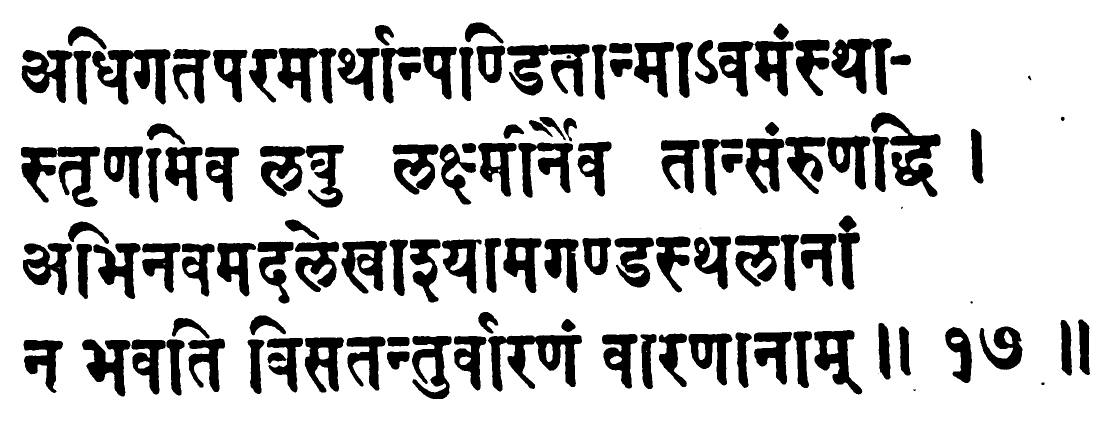
अधिगतपरमार्थान्पण्डितान्माऽवमंस्था-
स्तृणमिव लघु लक्ष्मीर्नैव तान्संरुणद्धि ।
अभिनवमदलेखाइयामगण्डस्थलानां
न भवति बिसतन्तुर्वारणं वारणानाम् ॥ १७ ॥
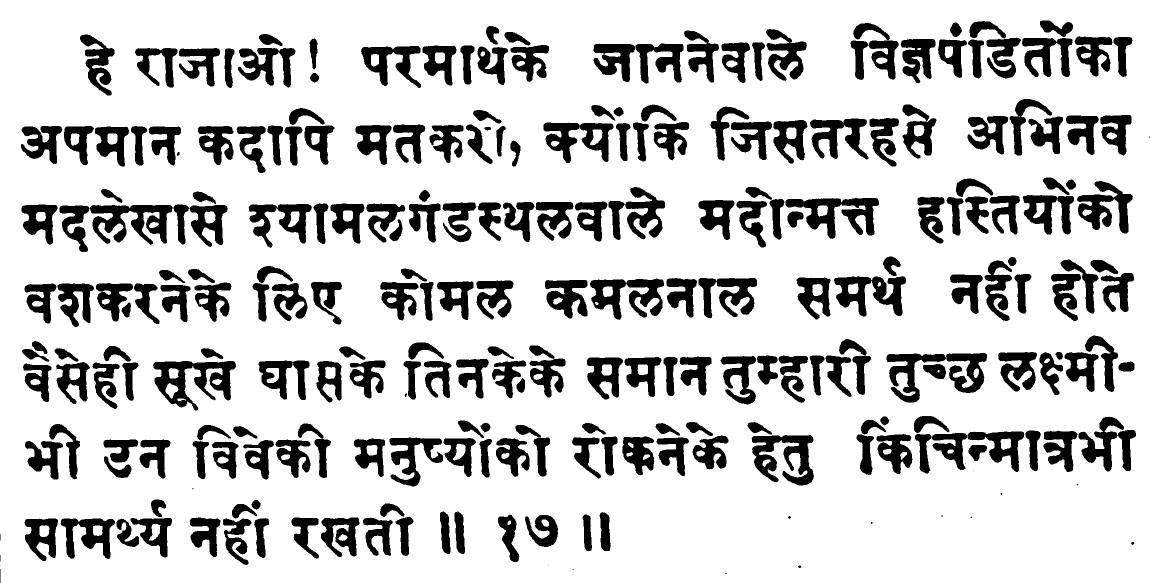
हे राजाओ ! परमार्थके जाननेवाले विज्ञपंडितोंका अपमान कदापि मत करो, क्योंकि जिसतरह से अभिनव मदलेखासे श्यामलगंडस्थलवाले मदोन्मत्त हस्तियोंको वशकरनेके लिए कोमल कमलनाल समर्थ नहीं होते वैसे ही सूखे घास के तिनकेके समान तुम्हारी तुच्छ लक्ष्मीभी उन विवेकी मनुष्यों को रोकने के हेतु किंचिन्मात्र भी सामर्थ्य नहीं रखती ॥ १७ ॥
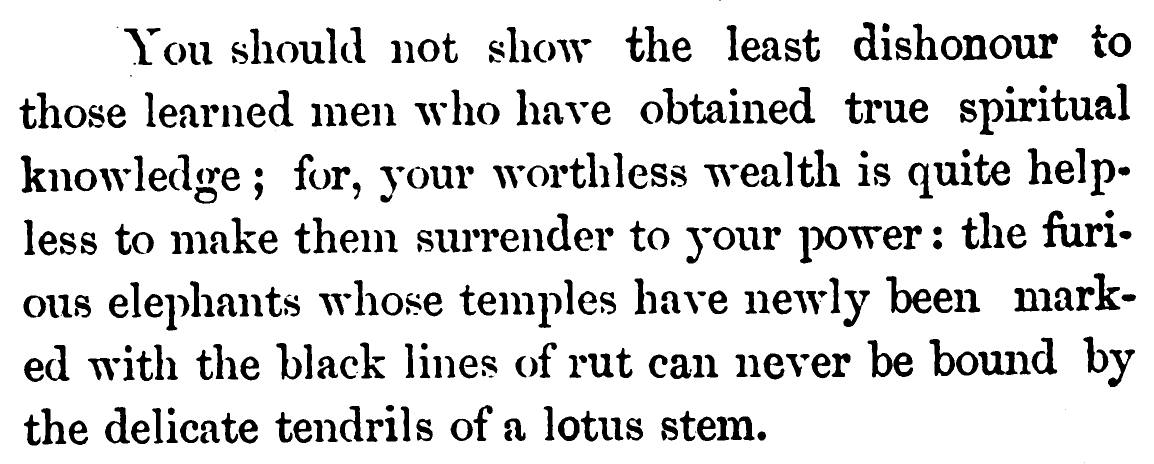
You should not show the least dishonour to those learned men who have obtained true spiritual knowledge; for, your worthless wealth is quite help less to make them surrender to your power: the furious elephants whose temples have newly been marked with the black lines of rut can never be bound by the delicate tendrils of a lotus stem.
Footnote
Quoted anonymously in the Subhishitürali ( सुभाषितावलि) at No. 2933, and also in the Sarngadharapaddhati ( शार्ङ्गधरपद्धति) at No. 197.

Footnote
66 अधिगतपरमार्थान् " is also found in the 7th Sloka of Rudrata's Kâryâlankira Ch. 1. ( रुद्रटस्थ काव्यालङ्कारः । १ अध्यायः । ).


Kosambi
all
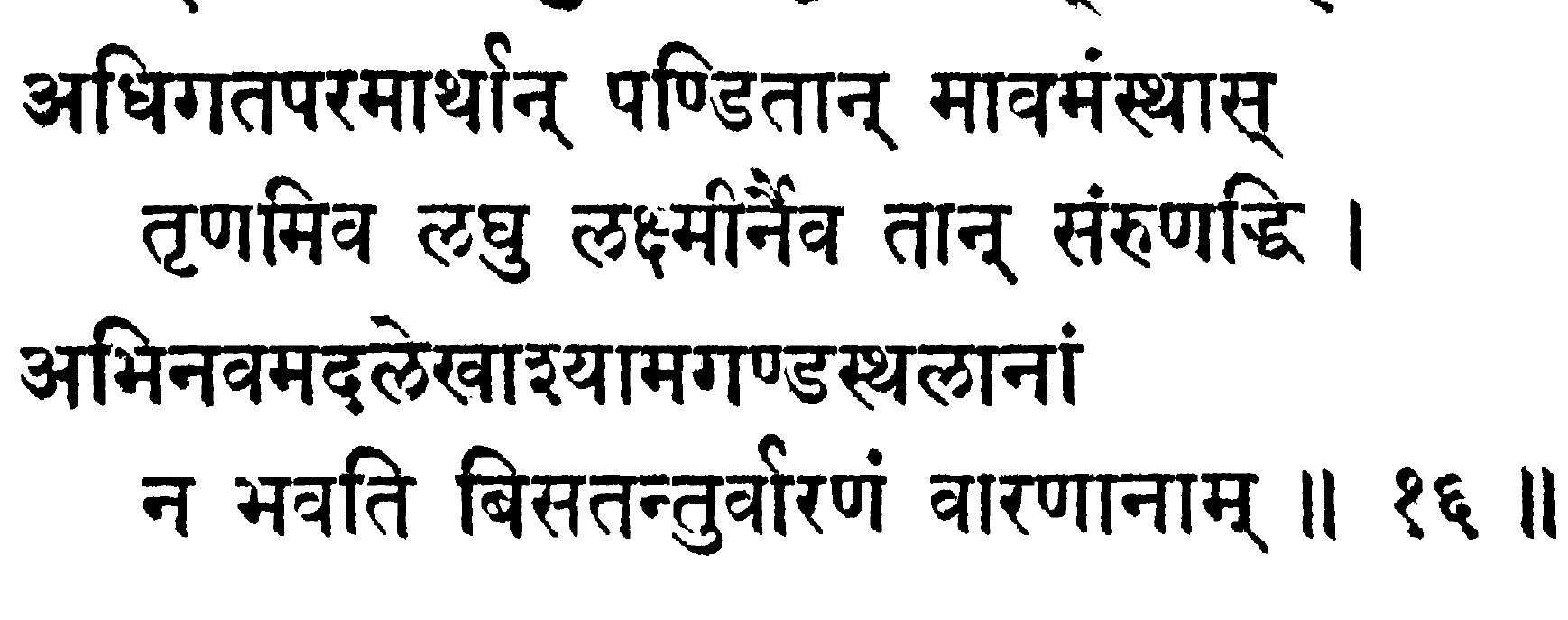
अधिगतपरमार्थान् पण्डितान् मावमंस्थास्
तृणमिव लघु लक्ष्मीनैव तान् संरुणद्धि |
अभिनवमदलेखाश्यामगण्डस्थलानां
न भवति बिसतन्तुर्वारणं वारणानाम् ॥ १६ ॥
Footnote
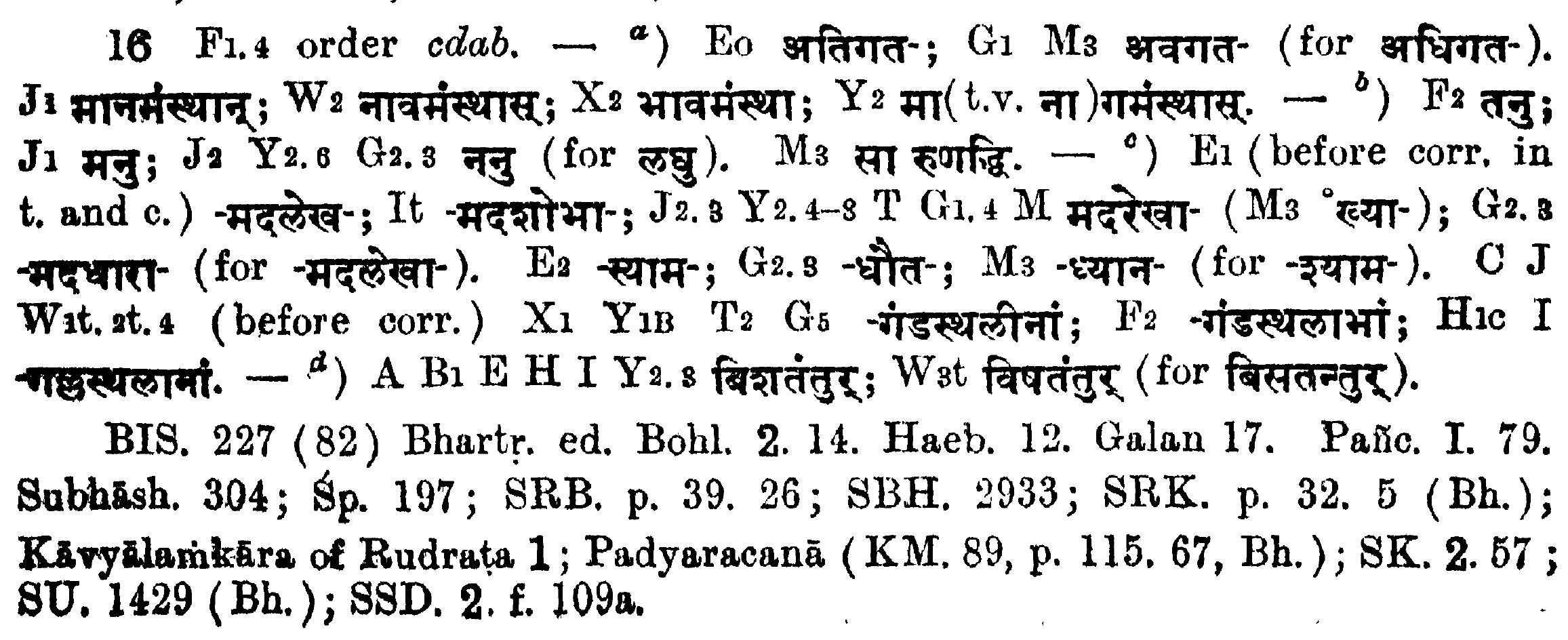
16 F1.4 order cdab . a ) Eo अतिगत ; G1 M3 अवगत- ( for अधिगत- ) .
J1 मानम॑स्थान् ; W 2 नावसंस्थास् ; X 2 भावसंस्था ; X 2 2 मा ( t.v. ना ) गम॑स्थास् – ० ) F2 तनु ;
J1 मनु ; J2 Y2.0 G2 3 ननु ( for लघु ) . M.3 सा रुणद्धि . ● ) E1 ( before corr , in
t . and c . ) -मदलेख - ; It -मदशोभा- ; J2 . 3 Y2 . 4 – 4 T G1 , 4M मदरेखा ( M3 ° ख्या- ) ; G2 . 3
-मदधारा ( for -मदलेखा - ) . E2 स्याम ; G2 . 8 - धौत ; M3 - ध्यान - ( for - श्याम- ) . CJ
Watat . 4 ( before corr . ) X1 Yin T2 G5 -गंडस्थलीनां ; F2 -गंडस्थलाभां ; He I
गल्लस्थलामां . -4 ) AB1EHIY23 बिशतंतुर् ; Wst विषतंतुर् ( for बिसतन्तुर् ) .
BIS . 227 ( 82 ) Bhartr . ed . Bohl . 2. 14. Haeb . 12. Galan 17. Pañc . I. 79 .
Subhāsh . 304 ; Sp . 197 ; SRB . p . 39. 26 ; SBH . 2933 ; SRK . p . 32. 5 ( Bh . ) ;
Kävyālamkāra of Rudrata 1 ; Padyaracanã ( KM , 89 , p . 115. 67 , Bh . ) ; SK . 2. 57 ;
SU . 1429 ( Bb . ) ; SSD . 2. f . 1098 .
Commentary