Tawney
Those who possess that treasure which no thief can take away,
Which, though on suppliants freely spent, increaseth day by day,
A source of inward happiness which shall outlast the earth—
To them e'en kings should yield the palm, and own their higher worth.
Telang
all
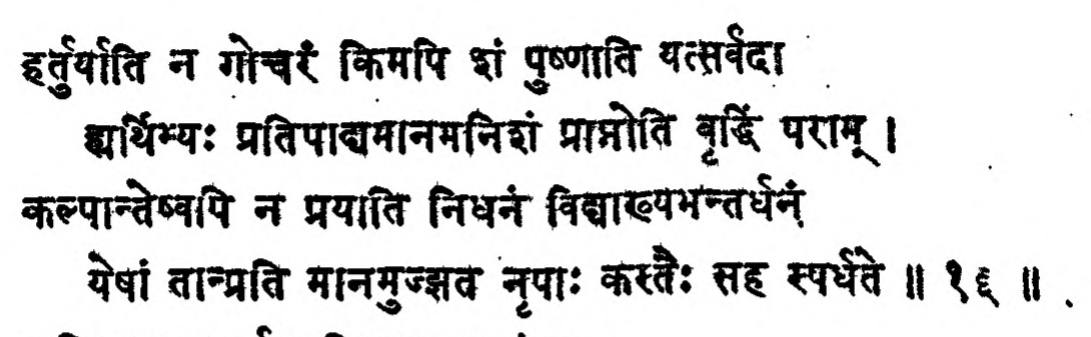
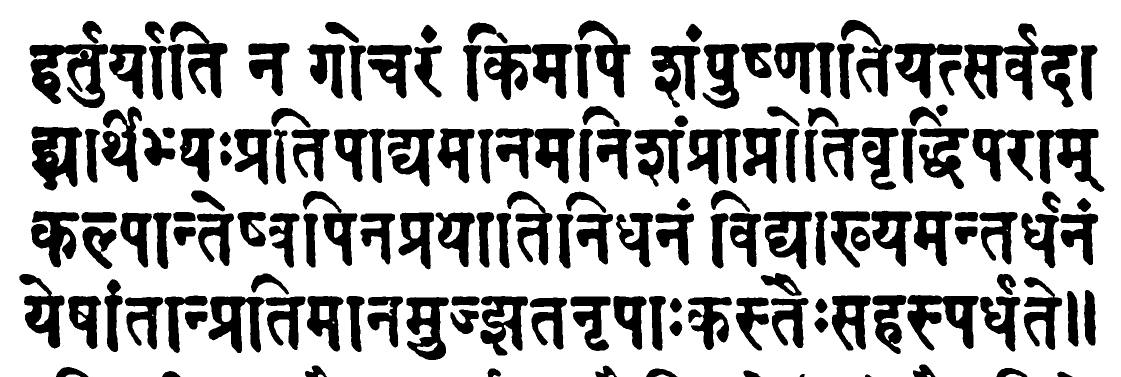
हर्तुर्याति न गोचरं किमपि शं पुष्णाति यत्सर्वदा
ह्यर्थिभ्यः प्रतिपाद्यमानमनिशं प्राप्नोति वृद्धिं पराम् ।
कल्पान्तेष्वपि न प्रयाति निधनं विद्याख्यमन्तर्धनं
येषां तान्प्रति मानमुज्झत नृपाः कस्तैः सह स्पर्धते ॥ १६ ॥
Notes
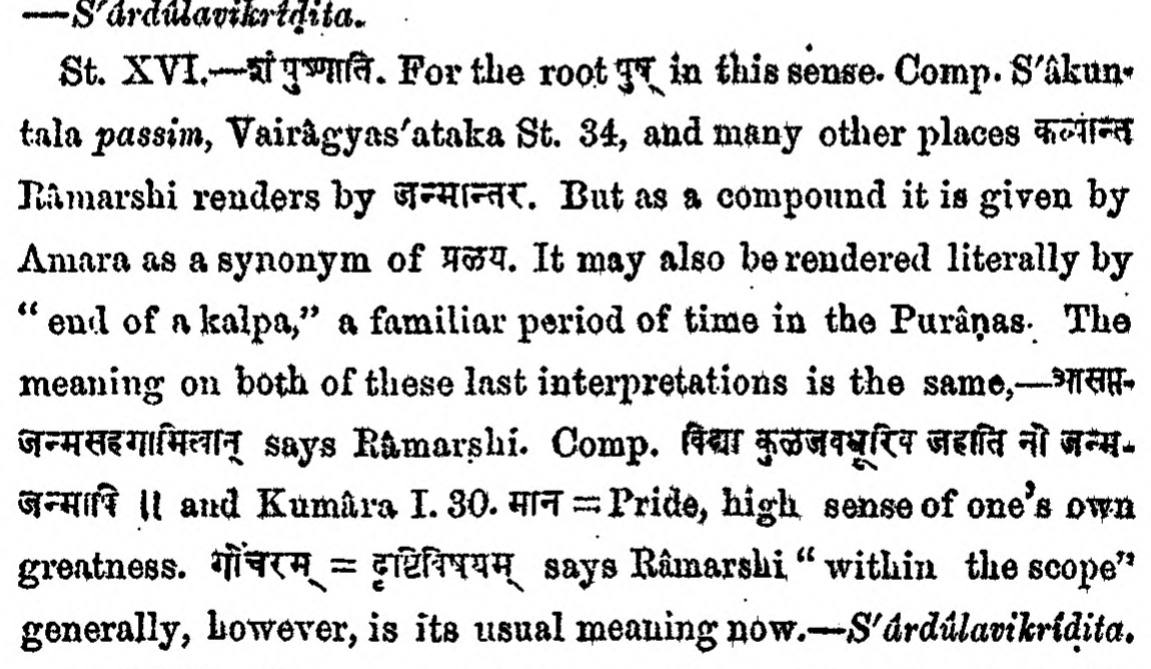
St. XVI.—शं पुष्णाति. For the root पुष् in this sense. Comp. S'âkuntala passim, Vairâgyas'ataka St. 34, and many other places कल्पान्त Râmarshi renders by जन्मान्तर. But as a compound it is given by Amara as a synonym of प्रलय. It may also be rendered literally by “ end of a kalpa,” a familiar period of time in the Purâṇas. The meaning on both of these last interpretations is the same,—आसप्तजन्मसहगामित्वात् says Râmarshi. Comp. विद्या कुलजवधूरिव जहाति नो जन्मजन्मापि ॥ and Kumâra I. 30. मान = Pride, high sense of one’s own greatness. गोचरम् = दृष्टिविषयम् says Râmarshi “within the scope” generally, however, is its usual meaning now.—S'ârdûlavikrîḍita.

Kale
all
Introduction
अथ विद्याधनैः का स्पर्धा ते हि नम्रत्वेन गौरवेण च बहु माननीया इति प्रतिपादयन् नृपान् संबोधयति—

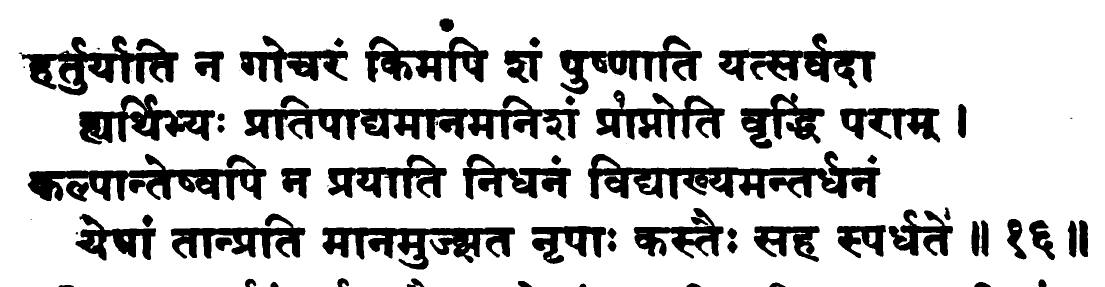
हर्तुर्याति न गोचरं किमपि शं पुष्णाति यत्सर्वदा
ह्यर्थिभ्यः प्रतिपाद्यमानमनिशं प्राप्नोति वृद्धिं पराम् ।
कल्पान्तेष्वपि न प्रयाति निधनं विद्याख्यमन्तर्धनं
येषां तान्प्रति मानमुज्झत नृपाः कस्तैः सह स्पर्धते ॥ १६ ॥
Translation
16 The secret treasure of knowledge is not destroyed even at the end of the world, does not fall into the hands of a thief, ever yields some ( indescribable ) happiness, and when given to those that solicit it, increases plentifully. Cast away your pride, ye kings, towards those who have this treasure. Who can rival them ?

Notes
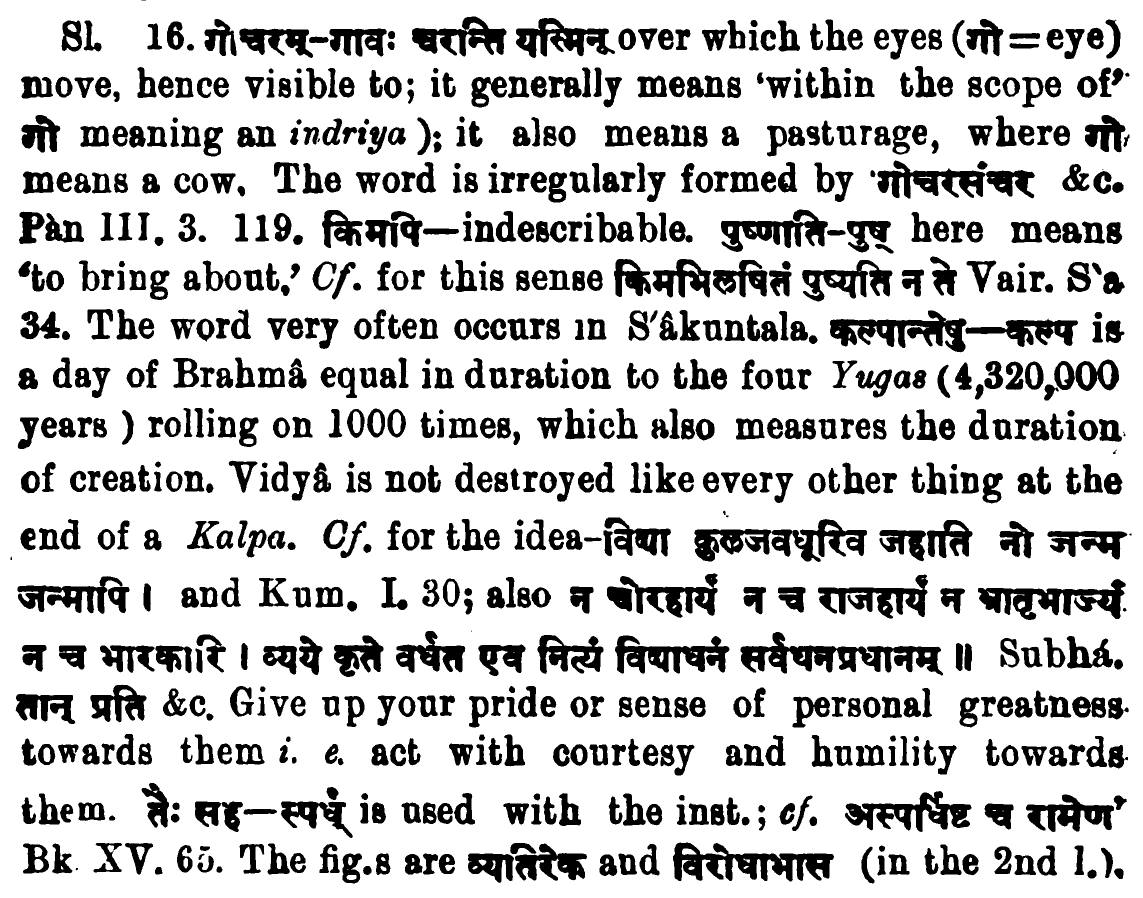
Sl. 16. गोचरम्-गावः चरन्ति यस्मिन् over which the eyes (गो =eye) move, hence visible to; it generally means ‘within the scope of’ गो meaning an indriya ); it also means a pasturage, where गो means a cow. The word is irregularly formed by 'गोचरसंचर &c. Pàn III. 3. 119. किमपि—indescribable. पुष्णाति-पुष् here means ‘to bring about.’ Cf. for this sense किमभिलषितं पुष्यति न ते Vair. S`a 34. The word very often occurs in S'âkuntala. कल्पान्तेषु—कल्प is a day of Brahmâ equal in duration to the four Yugas (4,320,000 years ) rolling on 1000 times, which also measures the duration of creation. Vidyâ is not destroyed like every other thing at the end of a Kalpa. Cf. for the idea–विद्या कुलजवधूरिव जहाति नो जन्म जन्मापि । and Kum. I. 30; also न चोरहार्यं न च राजहार्यं न भ्रातृभाज्यं न च भारकारि । व्यये कृते वर्धत एव नित्यं विद्याधनं सर्वधनप्रधानम् ॥ Subhá. तान् प्रति &c. Give up your pride or sense of personal greatness towards them i. e. act with courtesy and humility towards them. तैः सह—स्पर्ध् is used with the inst.; cf. अस्पर्धिष्ट च रामेण' Bk. XV. 65. The fig.s are व्यतिरेक and विरोधाभास (in the 2nd l.).
Gopinath1914
all
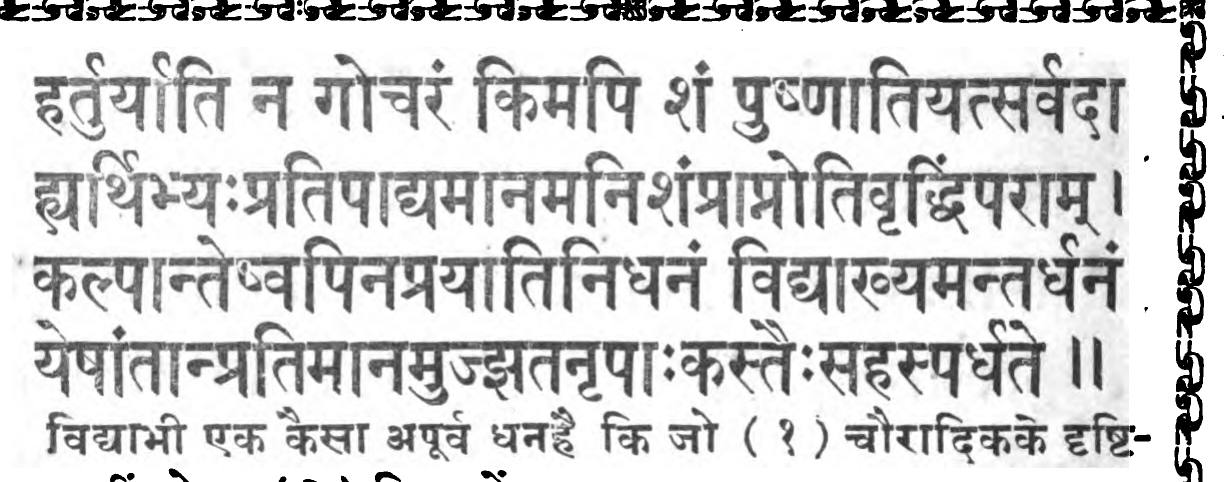
हर्तुर्याति न गोचरं किमपि शं पुष्णातियत्सर्वदा
ह्यार्थिभ्यः प्रतिपाद्यमानमनिशंप्राप्नोतिवृद्धिंपराम् विद्याख्यमन्तर्धनं ।
'कल्पान्तेष्वपिनप्रयातिनिधनं
कस्तैःसहस्पर्धते ॥
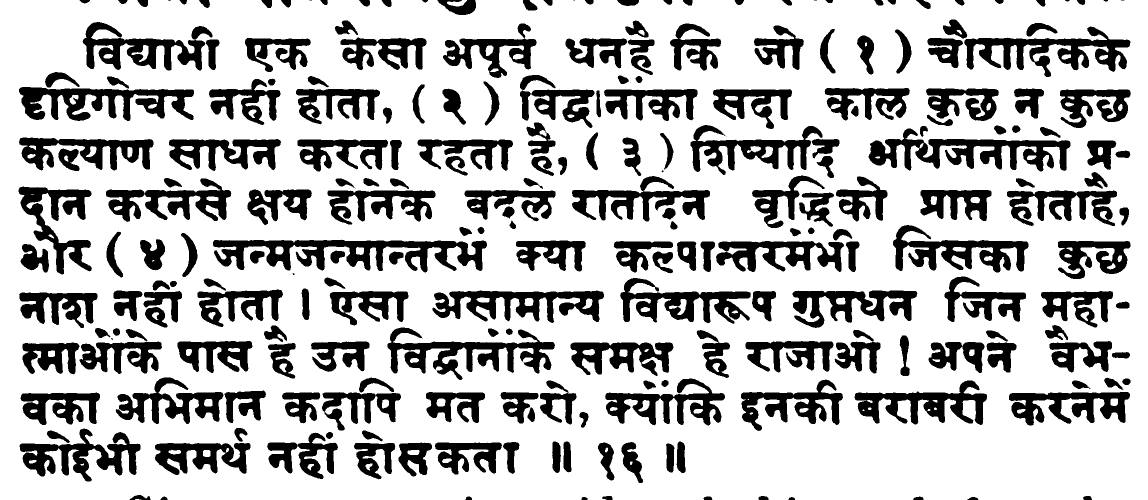
येषांतान्प्रतिमानमुज्झतनृपाः विद्याभी एक कैसा अपूर्व धन है कि जो ( १ ) चौरादिकके दृष्टि-
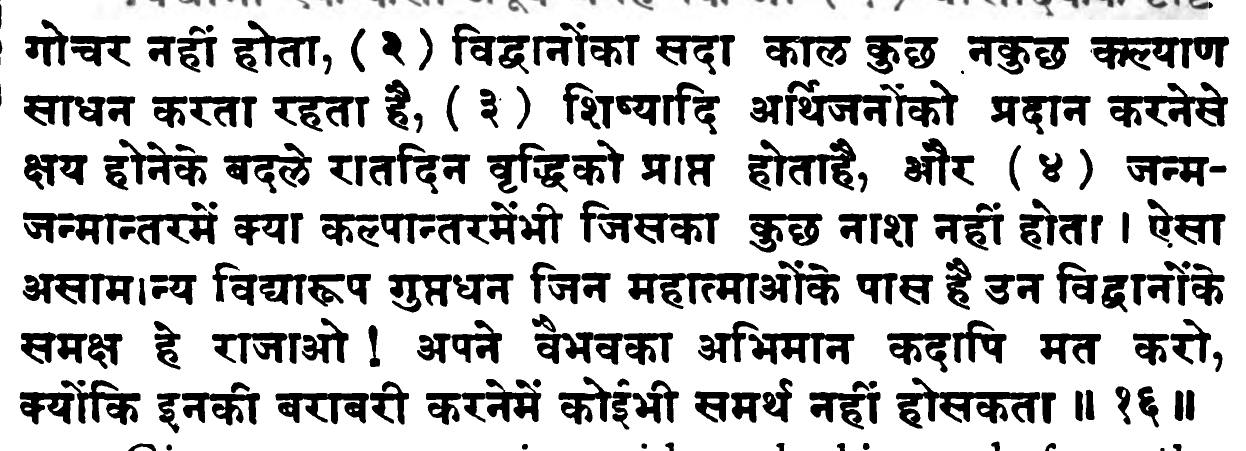
गोचर नहीं होता, (२) विद्वानोंका सदा काल कुछ नकुछ कल्याण साधन करता रहता है, (३) शिष्यादि अर्थिजनोंको प्रदान करनेसे क्षय होनेके बदले रातदिन वृद्धिको प्राप्त होताहै, भौर ( ४ ) जन्मजन्मान्तरमें क्या कल्पान्तरमेंभी जिसका कुछ नाश नहीं होता । ऐसा असामान्य विद्यारूप गुप्तधन जिन महात्माओंके पास है उन विद्वानोंके समक्ष हे राजाओ ! अपने वैभवका अभिमान कदापि मत करो, क्योंकि इनकी बराबरी करनेमें कोईभी समर्थ नहीं होसकता ॥ १६ ॥
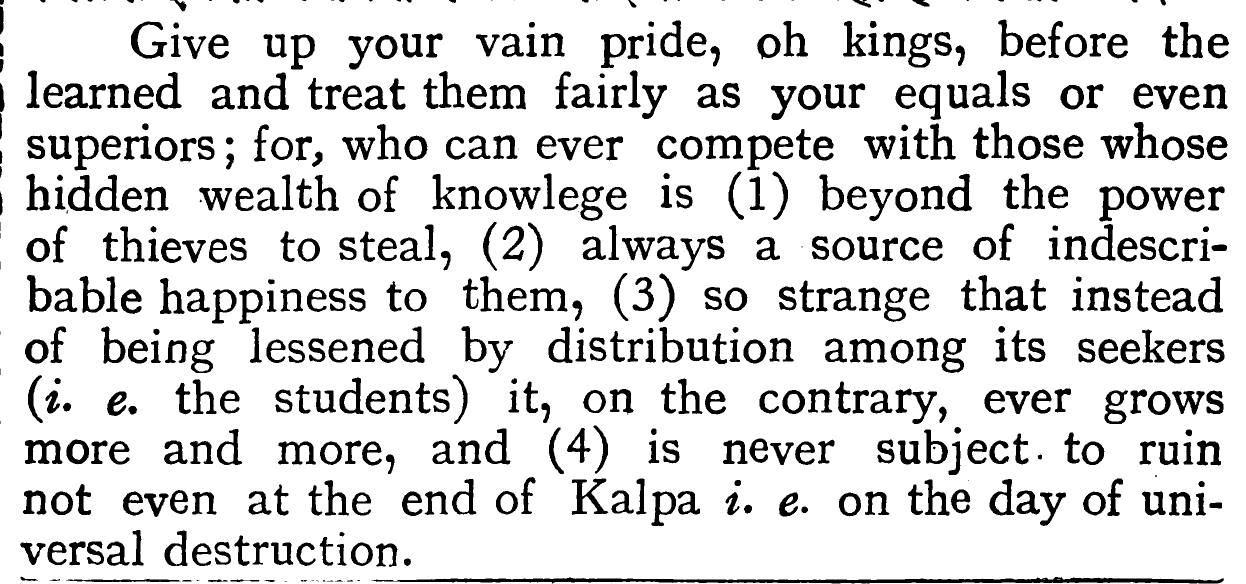
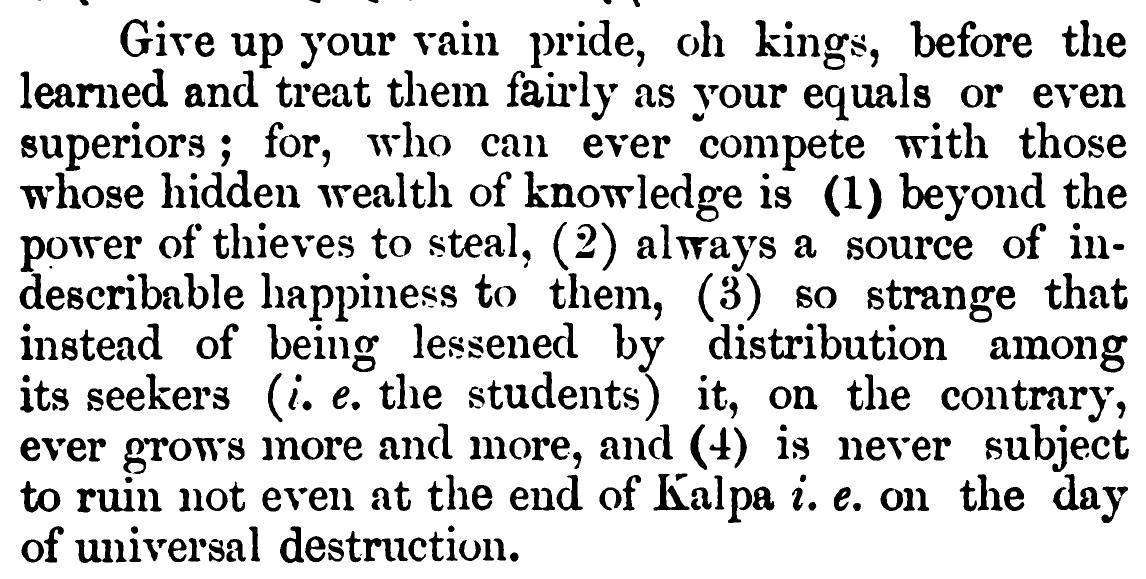
Give up your vain pride, oh kings, before the learned and treat them fairly as your equals or even superiors; for, who can ever compete with those whose hidden wealth of knowlege is (1) beyond the power of thieves to steal, ( 2 ) always a source of indescribable happiness to them, (3) so strange that instead of being lessened by distribution among its seekers (i. e. the students) it, on the contrary, ever grows more and more, and ( 4 ) is never subject to ruin not even at the end of Kalpa i. e. on the day of universal destruction.
(a) “Education is a companion that no misfortune can depress, no disease destroy, no enemy alienate, no despotism en- slave ; at home a friend, abroad an introduction ; in society an ornament, in solitude a solace.”

(b) " ज्ञातिभिर्वय्यते नैव चौरेणापि न नीयते । दाने नैव क्षयं याति विद्यारत्नं महाधनम् ॥ ॥ ११ ॥ " ” ( भवभूतेर्गुणरस्ने).

(c) "हर्तुर्न गोचरं याति दत्ता भवति विस्तृता । कल्पान्तेऽपि न या नश्येत्किमन्यद्विद्यया समम् ॥ " ” ( सुभाषितरत्नभाण्डागारे ४४.४)


Gopinath1896
all
हर्तुर्याति न गोचरं किमपि शंपुष्णातियत्सर्वदा
ह्यार्थभ्यः प्रतिपाद्यमानमनिशं प्राप्नोतिवृद्धिं पराम्
कल्पान्तेष्वपिनप्रयातिनिधनं विद्याख्यमन्तर्धनं
येषां तान्प्रतिमानमुज्झतनृपाः कस्तैः सह स्पर्धते ॥
विद्याभी एक कैसा अपूर्व धन है कि जो ( १ ) चौरादिकके दृष्टिगोचर नहीं होता, (२) विद्वानांका सदा काल कुछ न कुछ कल्याण साधन करता रहता है, (३) शिष्यादि अर्थिजनाको प्रकरनेसे क्षय होनेके बदले रातदिन वृद्धिको प्राप्त होता है, और दान ( ४ ) जन्मजन्मान्तरमें क्या कल्पान्तरमंभी जिसका कुछ नाश नहीं होता। ऐसा असामान्य विद्यारूप गुप्तधन जिन महास्माओंके पास है उन विद्वानांके समक्ष हे राजाओ ! अपने वैभअभिमान कदापि मत करो, क्योंकि इनकी बराबरी करनेमें कोई भी समर्थ नहीं हो सकता ॥ १६ ॥
Give up your vain pride, oh kings, before the learned and treat them fairly as your equals or even superiors; for, who can ever compete with those whose hidden wealth of knowledge is (1) beyond the power of thieves to steal, ( 2 ) always a source of indescribable happiness to them, (3) so strange that instead of being lessened by distribution among its seekers (i. e. the students) it, on the contrary, ever grows more and more, and (4) is never subject to ruin not even at the end of Kalpa i. e. on the day of universal destruction.
(a) "Education is a companion that no misfortune can depress, no disease destroy, no enemy alienate, no despotism slave; at home a friend, abroad an " introduction; in society en- ornament, in solitude a solace.

(b) " ज्ञातिभिर्वव्यते an नैव यौरेणापि न नीयते । दानेनैव क्षयं याति विद्या- रत्नं महाधनम् ॥ ११ ॥ " ( भवभूतेर्गुणरत्रे ).

(c) " इर्तुर्न गोचरं याति दत्ता भवति विस्तृता । कल्पान्तेऽपि न या नश्ये- त्किमन्यद्विद्यया समम् ॥” ( सुभाषितरत्नभाण्डागारे ४४।४).


Kosambi
all
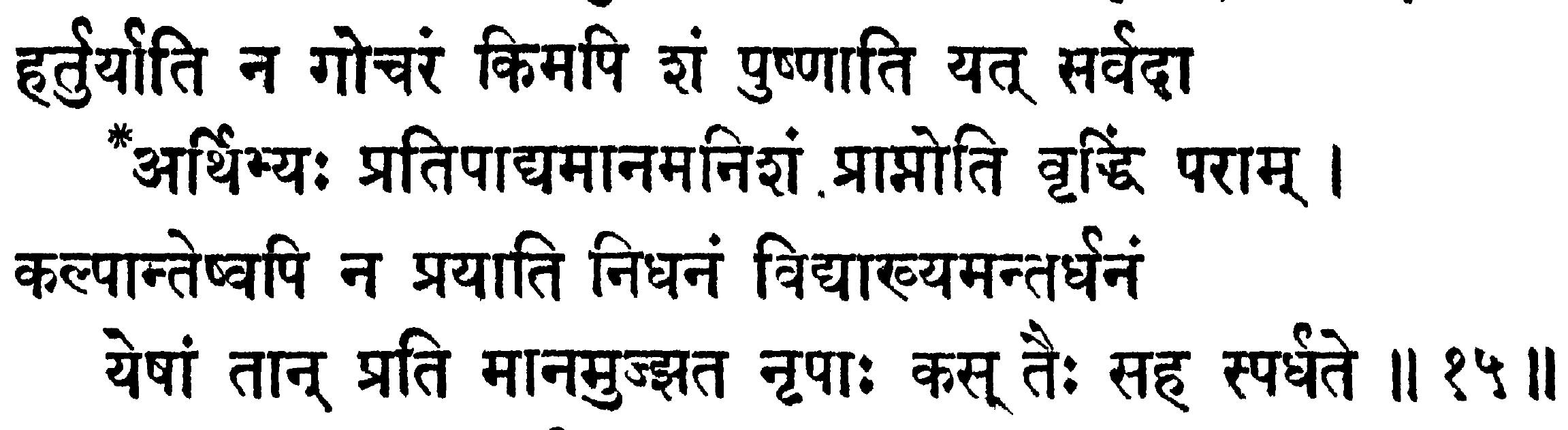
हर्तुर्याति न गोचरं किमपि शं पुष्णाति यत् सर्वदा
* अर्थिभ्यः प्रतिपाद्यमानमनिशं प्राप्नोति वृद्धिं पराम् ।
कल्पान्तेष्वपि न प्रयाति निधनं विद्याख्यमन्तर्धनं
येषां तान् प्रति मानमुज्झत नृपाः कस् तैः सह स्पर्धते ॥ १५ ॥
Footnote
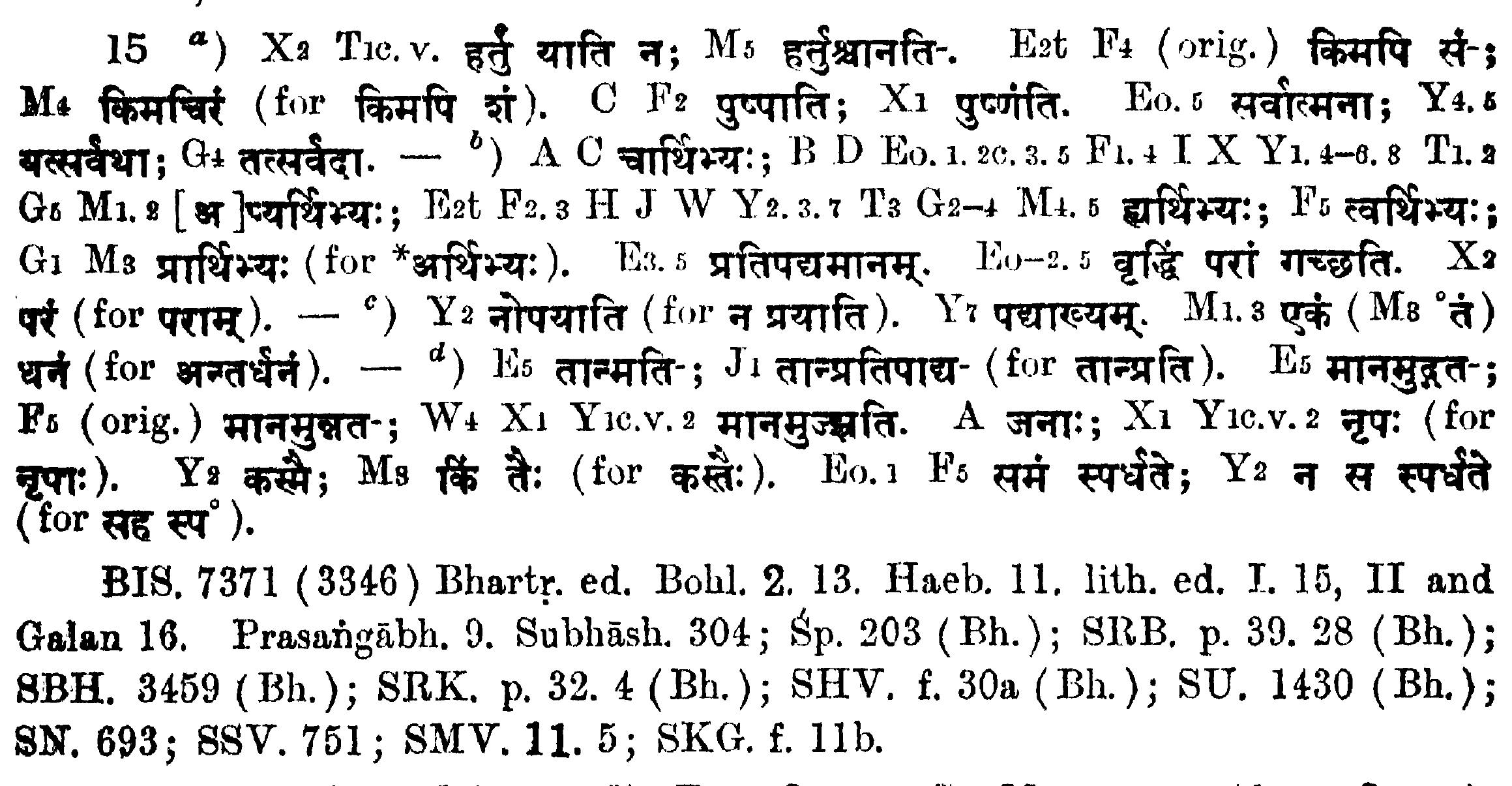
15 4 ) X 2 Tie . v . हर्तु याति न ; M6 हर्तुश्चानति Eat F + ( orig . ) किमपि सं- ;
M + किमचिरं ( for किमपि शं ) . C F2 पुष्पाति ; X 1 पुष्णंति . Eo . 5 सर्वात्मना ; Y4.6
बत्सर्वथा ; G + तत्सर्वदा . 8 ) A C चार्थिभ्यः ; BDEo . 1. 20.35 F1 + I X Y1 4–6 , 8 T1 . 2
Go M1 . 8 [ अ ] प्यर्थिभ्यः ; E2t F2 3 HJ W_Y2.3.7 T3 G24 M4.5 ह्यर्थिभ्यः ; Fः त्वर्थिभ्यः ;
G1 M3 प्रार्थिभ्य : ( for * अर्थिभ्यः ) . E3.5 प्रतिपद्यमानम् . Bo - 25 वृद्धिं परां गच्छति . X 2
परं ( for पराम् ) . c ) Y 2 नोपयाति ( for न प्रयाति ) . Y7 पद्याख्यम् . M1.3 एकं ( Ms ' तं )
धनं ( for अन्तर्धनं ) . 4 ) is ताम्मति - ; J1 तान्प्रतिपाद्य ( for तान्प्रति ) . Es मानमुद्रत ;
Fs ( orig . ) मानमुन्नत- ; W + X 1 Yic.v. 2 मानमुज्झति A जनाः ; X1 Y1c . v . 2 नृपः ( ( for
नृपाः ) . Y2 कस्मै ; Ms कि तैः ( for कस्तैः ) . Eo . 1 Fs समं स्पर्धते ; Y2 न स स्पर्धेते
( for सह स्पं ) .
BIS . 7371 ( 3346 ) Bhartr . ed . Bobl . 2. 13. Haeb . 11 . lith ed . I. 15 , II and
Galan 16 Prasangābh . 9. Subhāsh . 304 ; Sp . 203 ( Bh . ) ; SRB . p . 39.28 ( Bh . ) ;
SBH . 3459 ( Bh . ) ; SRK . p . 32. 4 ( Bh . ) ; SHV · f . 30a ( Bh . ) ; SU . 1430 ( Bh . ) ;
SN . 693 ; SSV . 751 ; SMV . 11. 5 ; SKG f 11b .
Commentary