Tawney
Lo! the same man who longs for a handful of meal
As a treasure of infinite worth,
When his hunger is sated, esteems not a straw
All the riches and glories of earth;
Hence this moral we draw—in this transient world
Nothing 's trifling or great in itself,
'Tis the mind that projects its own hues on the mass,
Now 'tis gold, now 'tis counted but pelf.
Telang
all
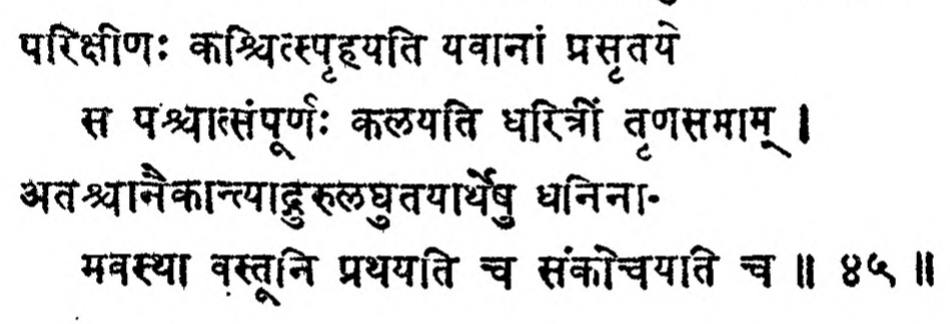
परिक्षीणः कश्चित्स्पृहयति यवानां प्रसृतये
स पश्चात्संपूर्णः कलयति धरित्रीं तृणसमाम् ।
अतश्चैकान्त्याद्गुरुलघुतयार्थेषु धनिना-
मवस्था वस्तूनि प्रथयति च संकोचयति च ॥ ४५ ॥
Notes
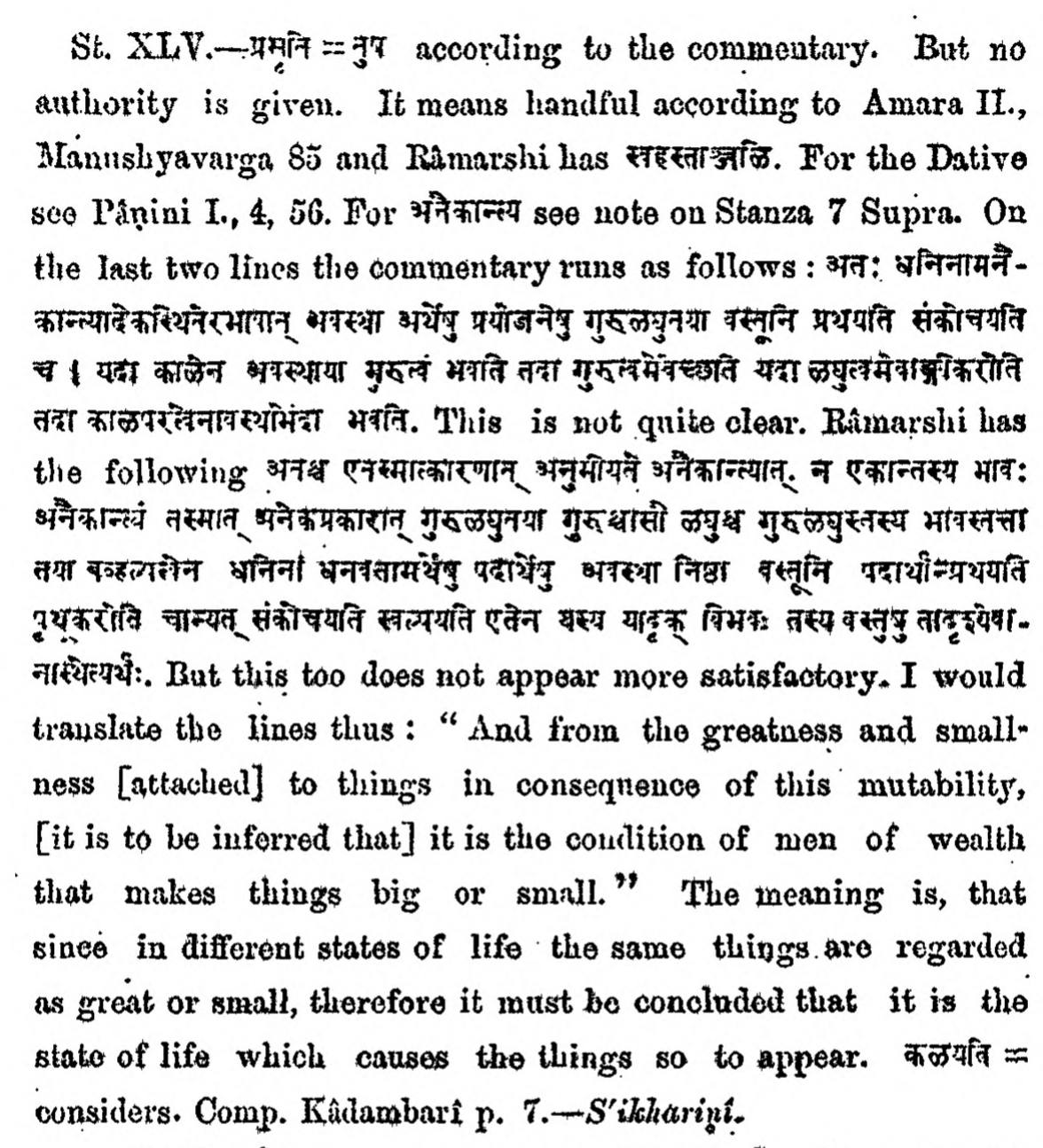
St. XLV.—प्रमृति = नृप according to the commentary. But no authority is given. It means handful according to Amara II., Manushyavarga 85 and Râmarshi has सहस्ताञ्जलि. For the Dative see Pâṇini I., 4, 56. For अनैकान्त्य see note on Stanza 7 Supra. On the last two lines the commentary runs as follows : अतः धनिनामनैकान्त्यादेकस्थितेरभावात् अवस्था अर्थेषु प्रयोजनेषु गुरुलघुतया वस्तूनि प्रथयति संकोचयति च । यदा कालेन अवस्थाया गुरुत्वं भवति तदा गुरुत्वमेवेच्छति यदा लघुत्वमेवाङ्गीकरोति तदा कालपरत्वेनावस्थभिन्ना भवति. This is not quite clear. Râmarshi has the following अतश्च एतस्मात्कारणात् अनुमीयते अनैकान्त्यात् न एकान्तस्य भावः अनैकान्त्यं तस्मात् अनेकप्रकारात् गुरुलघुतया गुरुश्चासौ लघुश्च गुरुलघुस्तस्य भावस्तत्ता तया बव्हल्पत्वेन धनिनां धनवतामर्थेषु पदार्थेषु अवस्था निष्ठा वस्तूनि पदार्थान्प्रथयति पृथूकरोति चान्यत् संकोचयति स्वल्पयति एतेन यस्य यादृक् विभवः तस्य वस्तुषु तादृश्येव।नास्येत्यर्थः. But this too does not appear more satisfactory. I would translate the lines thus : “And from the greatness and smallness [attached] to things in consequence of this mutability, [it is to be inferred that] it is the condition of men of wealth that makes things big or small.” The meaning is, that since in different states of life the same things are regarded as great or small, therefore it must be concluded that it is the state of life which causes the things so to appear. कलयति = considers. Comp. Kâdambarî p. 7.—S'ikhariṇî.

Kale
all

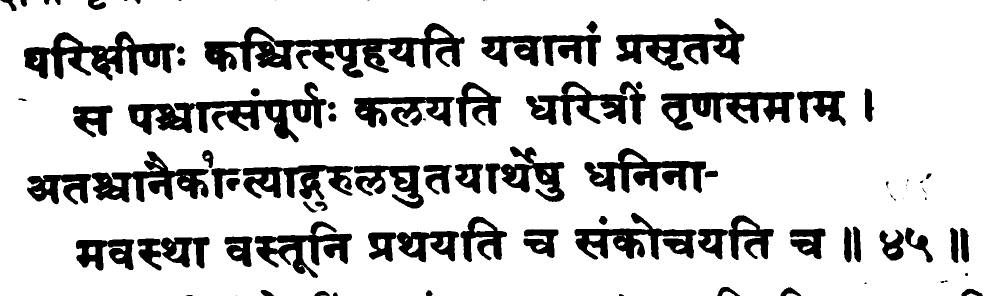
परिक्षीणः कश्चित्स्पृहयति यवानां प्रसृतये
स पश्चात्संपूर्णः कलयति धरित्रीं तृणसमाम् ।
अतश्चानैकान्त्याद्गुरुलघुतयार्थेषु धनिना-
मवस्था वस्तूनि प्रथयति च संकोचयति च ॥ ४५ ॥
Translation
45. When poor, a man longs for a handful of rice; when afterwards he is full ( of wealth ) he regards the whole earth as straw. Hence we must say that for want of fixity as regards the smallness or largeness of the objects of desire the position of the wealthy magnifies or lessens things ( i. e. their value ).


Notes
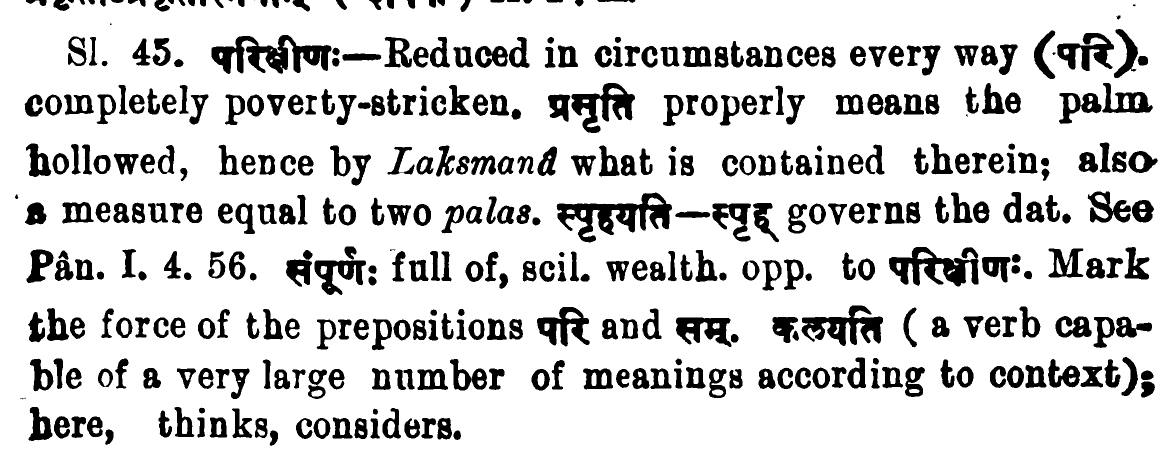
Sl. 45. परिक्षीणः—Reduced in circumstances every way (परि). completely poverty-stricken. प्रसृति properly means the palm hollowed, hence by Laksmaná what is contained therein; also a measure equal to two palas. स्पृहयति—स्पृह् governs the dat. See Pân. I. 4. 56. संपूर्णः full of, scil. wealth. opp. to परिक्षीणः. Mark the force of the prepositions परि and सम्. कलयति ( a verb capable of a very large number of meanings according to context); here, thinks, considers. अतः—hence; i. e. because of the fact mentioned above. अनैकान्त्यं—The state of having no fixity, uncertainity. न एकान्तमनेकान्तं तस्य भावः । The last two lines are somewhat puzzling and have been differently interpreted. For construction see com. The meaning is that since there is variability with regard to the greatness or smallness of the same thing it must be concluded that it is the state of life of those possessed of wealth that causes the things so to appear.
Gopinath1914
all
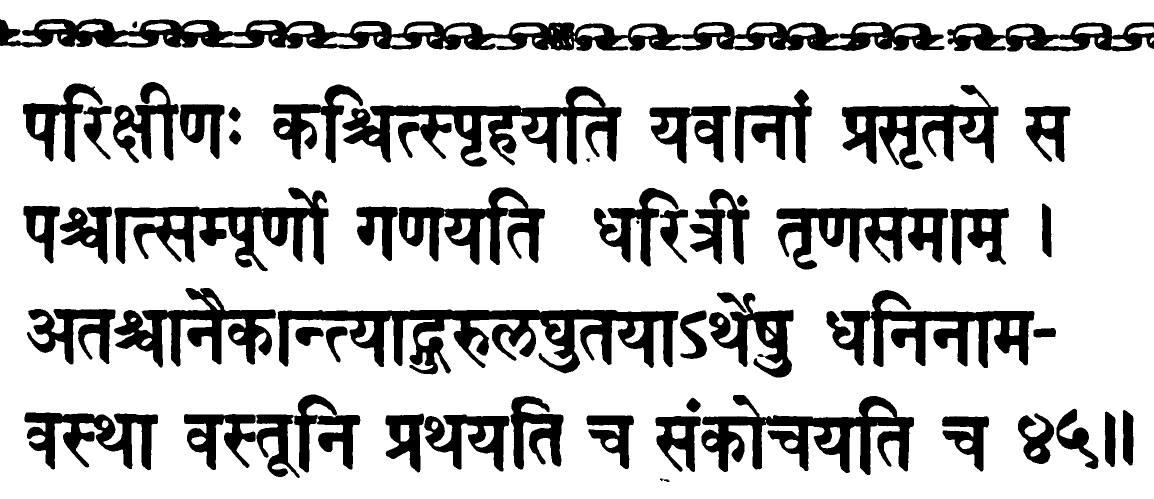
परिक्षीणः कश्चित्स्पृहयति यवानां प्रसृतये स
पश्चात्सम्पूर्णो गणयति धरित्रीं तृणसमाम् ।
अतश्चानैकान्त्याद्गुरुलघुतयाऽर्थेषु धनिनाम-
वस्था वस्तूनि प्रथयति च संकोचयति च ४५॥
दरिद्री होनेपर जो मनुष्य यव ( जौ ) के तुसोंका संग्रह करनेकी वांछा किया करता है, वह धनाढ्य हो जाने पर संपूर्ण पृथ्वीको भी तृणसमान समझने लगजाता है । इससे सिद्ध होता है कि सारे पदार्थोंका लघुत्व और महत्त्व मनुष्योंके ऐश्वर्य और दारिद्यपर निर्भर है ॥ ४५ ॥
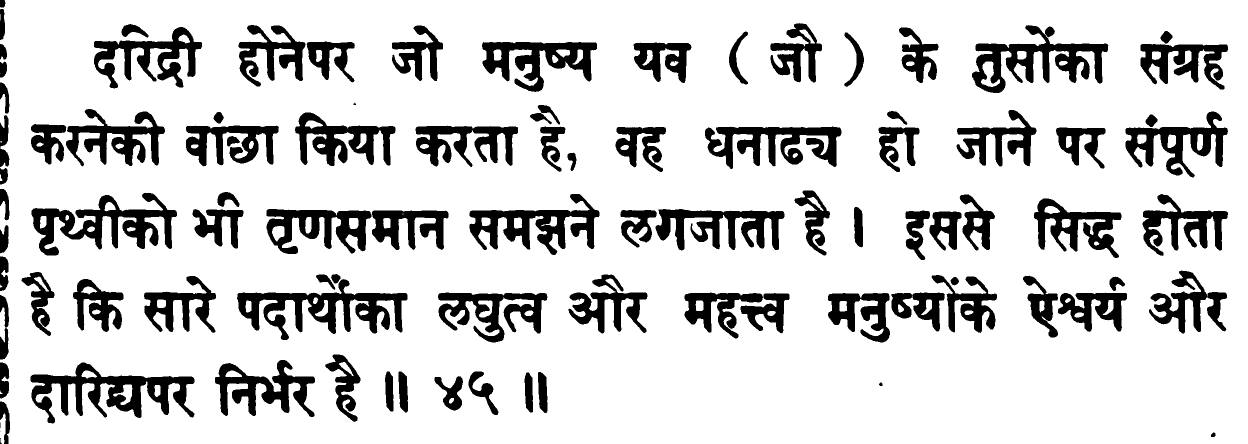
In straitened circumstances a man is even anxious to collect the empty husks, but afterwards when he is master of enormous wealth he will attach no more importance to the whole earth than to a piece of dry straw. It is, therefore, quite clear that the value of a thing is altogether dependent upon the wealthy or penurious condition of man.

Gopinath1896
all
परिक्षीणः कश्चित्स्पृहयति यवानां प्रसृतये स
पश्चात्सम्पूर्णो गणयति धरित्रीं तृणसमाम् ।
अतश्चानैकान्त्या गुरुलघुतयाऽर्थेषु धनिनाम-
वस्था वस्तूनि प्रथयति च संकोचयति च४५
दरिद्री होनेपर जो मनुष्य यव (जौ) के तुसोंका संग्रह करनेकी वांछा किया करता है, वह धनाढ्य हो जाने पर संपूर्ण पृथ्वीको भी तृणसमान समझने लगजाता है । इससे सिद्ध होता है कि सारे पदार्थोंका लघुत्व और महत्व मनुष्योंके ऐश्वर्य और दारिद्र्यपर निर्भर है ४५
In straitened circumstances a man is even anxious to collect the empty husks, but afterwards when he is master of enormous wealth he will attach no more importance to the whole earth than to a piece of dry straw. It is, therefore, quite clear that the value of a thing is altogether dependent upon the wealthy or penurious condition of man.

Kosambi
all
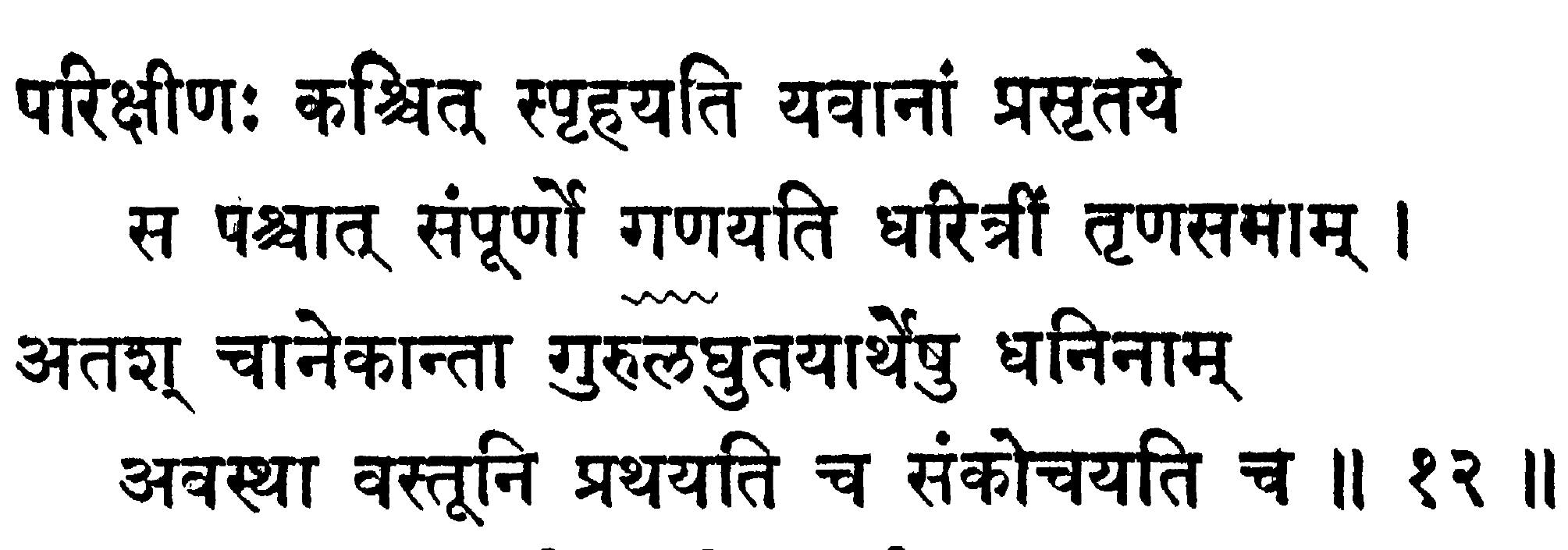
परिक्षीणः कश्चित् स्पृहयति यवानां प्रसृतये
स पश्चात् संपूर्णो गणयति धरित्रीं तृणसमाम् ।
अतश् चानेकान्ता गुरुलघुतयार्थेषु धनिनाम्
अवस्था वस्तूनि प्रथयति च संकोचयति च ॥ १२ ॥
Footnote
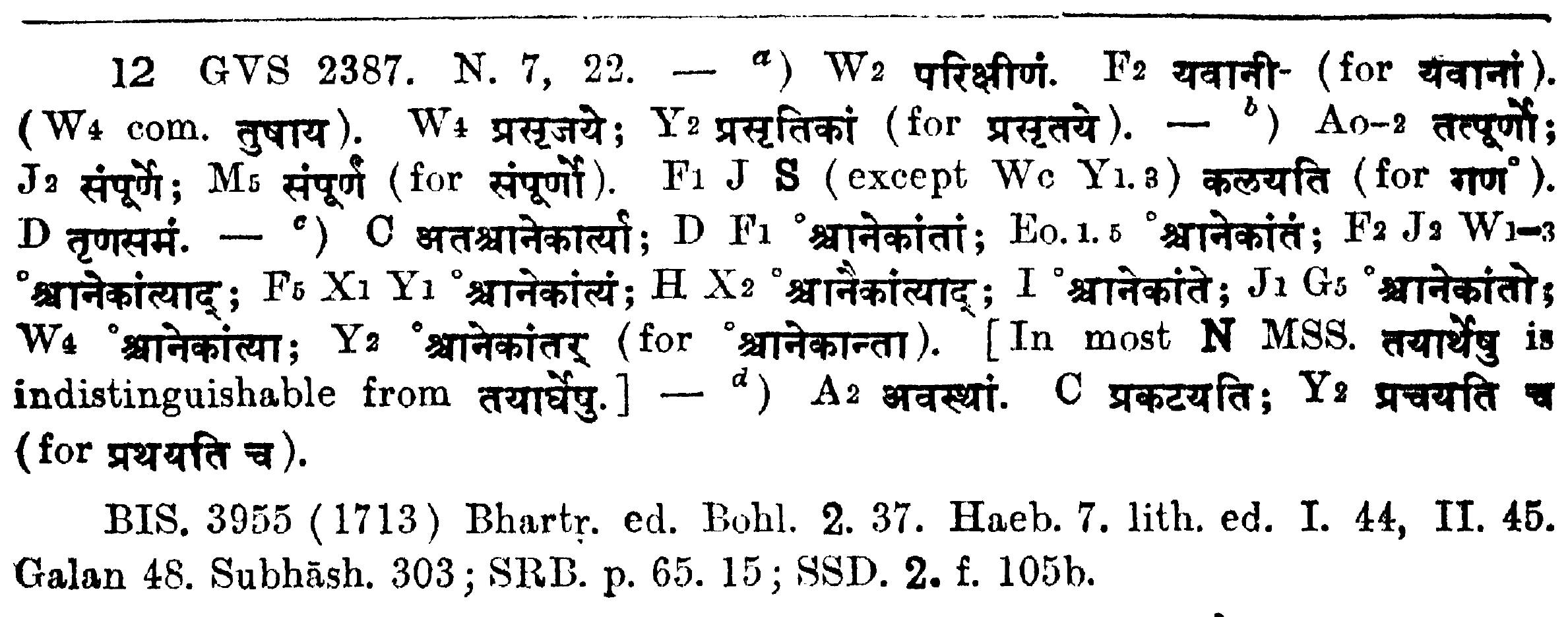
12 GVS 2387. N. 7 , 22 . a ) W2 परिक्षीणं . F2 यवानी ( for यवानां ) .
( W4 com . तुषाय ) . W 1 प्रसृजये ; Y 2 प्रकृतिकां ( for प्रसृतये ) . 8 ) An - 2 तत्पूर्णो ;
J2 संपूर्ण ; Ms संपूर्ण ( for संपूर्णा ) . F1J S ( except We X1 . 8 ) कलयति ( for गण ) .
D तृणसमं . P ● ) C अतश्चानेकार्त्या ; D F1 श्रानेकांतां O ; Eo.1.5 श्वानेकांतं ; F2 Js W 1-3
' वानेकांत्याद ; Po X 1 X 1 ° श्चानेकांयं ; H X 2 श्रानैकांत्याद् ; I श्वानेकांते ; J1 Go आनेकांतो • ;
W4 वनेकांत्या ; Y2 ' वानेकांतर् ( for ' चानेकान्ता ) . [ In most N MSS . तयार्थेषु is
indistinguishable from तयार्घेषु . ] d ) A2 अवस्थां . C प्रकटयति ; Y2 प्रचयति
( for प्रथयति च ) .
BIS . 3955 ( 1713 ) Bhartr ed . Bohl . 2. 37. Haeb . 7. lith ed . I. 44 , II . 45 .
Galan 48. Subhāsh . 303 ; SRB . p . 65.15 ; SSD . 2. f . 105b .
Commentary