Tawney
Less in size the polished jewel, but its rays far brighter gleam,
Who regrets the dwindling sandbanks when boon autumn swells the stream?
Glorious we hold the victor, though his life-blood gild the plain,
Such the generous soul's undoing, that which seemeth loss is gain.
Telang
all
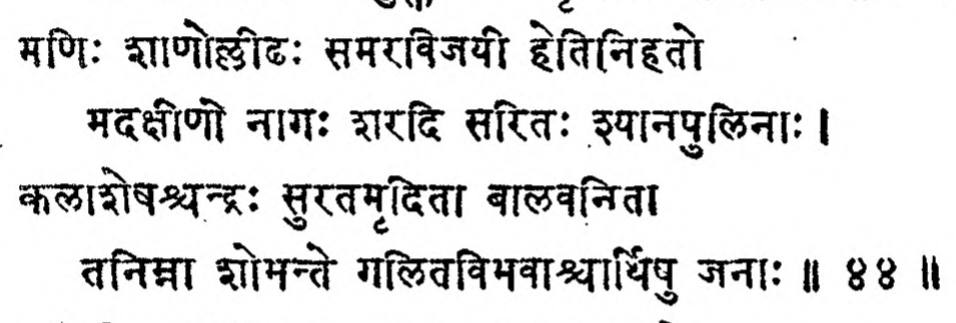
मणिः शाणोल्लीढः समरविजयी हेतिनिहतो
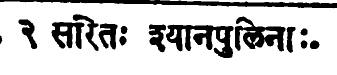
मदक्षीणो नागः शरदि सरितः श्यानपुलिनाः ।
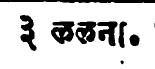
कलाशेषश्चन्द्रः सुरतमृदिता बालवनिता
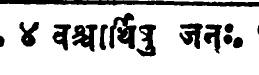
तनिम्ना शोभन्ते गलितविभवाश्चार्थिषु जनाः ॥ ४४ ॥
Notes
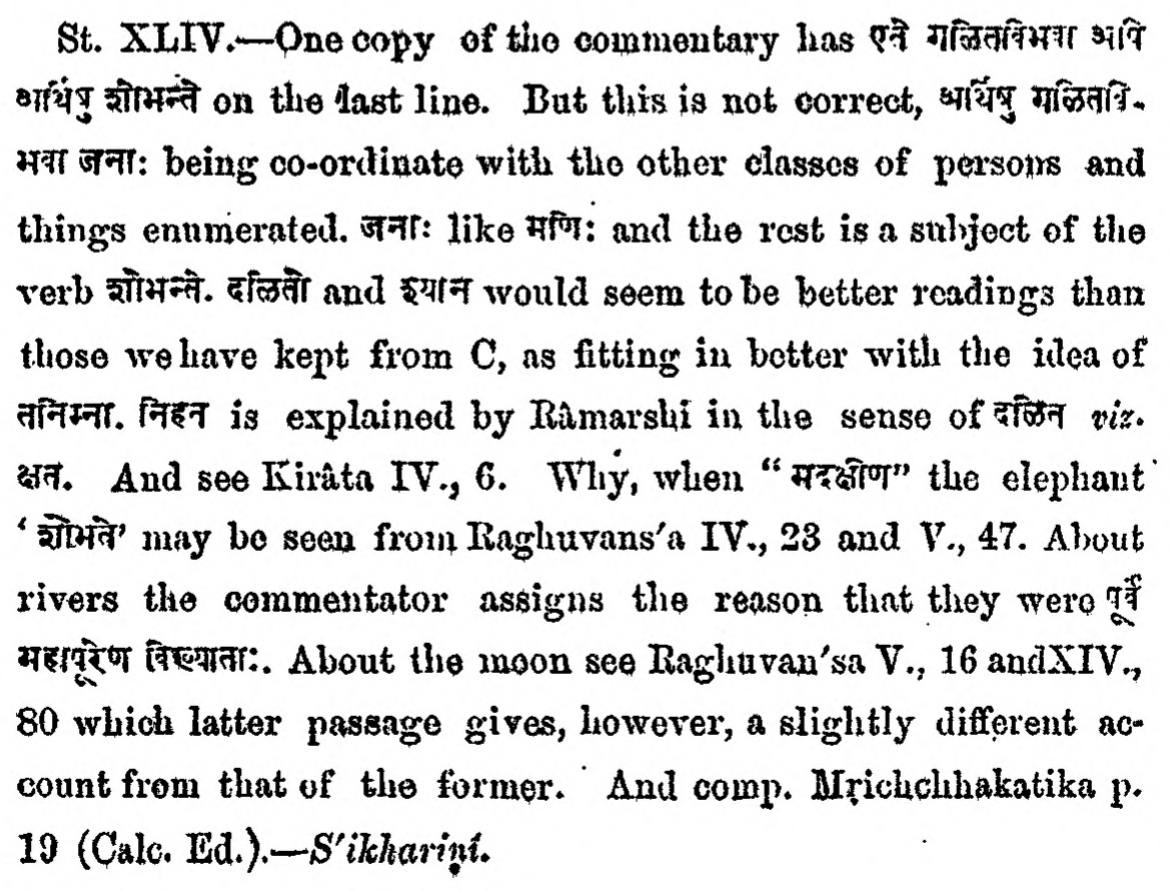
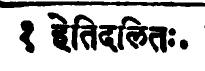
St. XLIV.—One copy of the commentary has एते गलितविभवा अपि अर्थिषु शोभन्ते on the last line. But this is not correct, अर्थिषु गलितविभवा जनाः being co-ordinate with the other classes of persons and things enumerated. जनाः like मणिः and the rest is a subject of the verb शोभन्ते. दलितो and श्यान would seem to be better readings than those we have kept from C, as fitting in better with the idea of तनिम्ना. निहत is explained by Râmarshi in the sense of दलित viz. क्षत. And see Kirâta IV., 6. Why, when “मदक्षीण” the elephant ‘शोभते’ may be seen from Raghuvans'a IV., 23 and V., 47. About rivers the commentator assigns the reason that they were पूर्वं महापूरेण विख्याताः. About the moon see Raghuvan'sa V., 16 and XIV., 80 which latter passage gives, however, a slightly different account from that of the former. And comp. Mṛichchhakatika p. 19 (Calc. Ed.).—S'ikhariṇî.

Kale
all

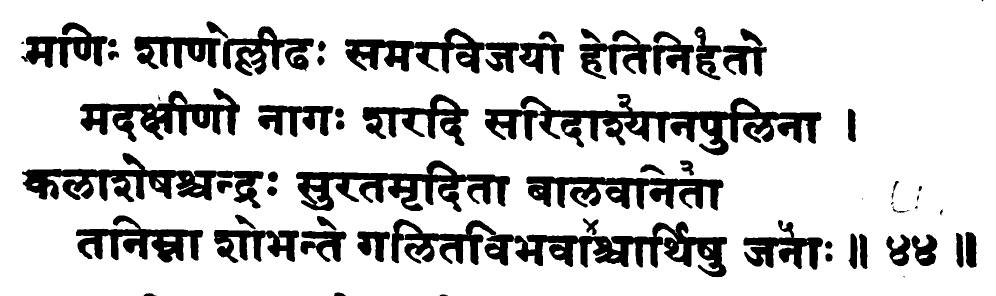
मणिः शाणोल्लीढः समरविजयी हेतिनिहतो
मदक्षीणो नागः शरदि सरिदाश्यानपुलिना ।
कलाशेषश्चन्द्रः सुरतमृदिता बालवनिता
तनिम्ना शोभन्ते गलितविभवाश्चार्थिषु जनाः ॥ ४४ ॥
Translation
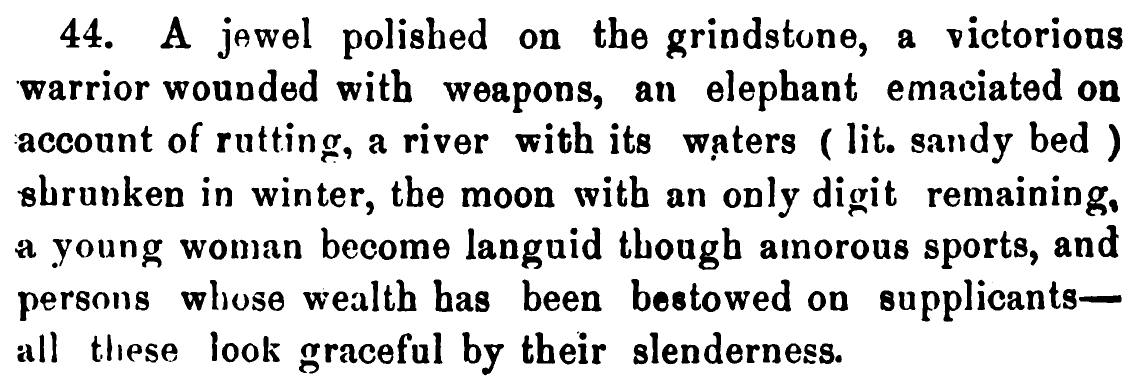
44. A jewel polished on the grindstone, a victorious warrior wounded with weapons, an elephant emaciated on account of rutting, a river with its waters ( lit. sandy bed ) shrunken in winter, the moon with an only digit remaining, a young woman become languid though amorous sports, and persons whose wealth has been bestowed on supplicants—all these look graceful by their slenderness.
Notes
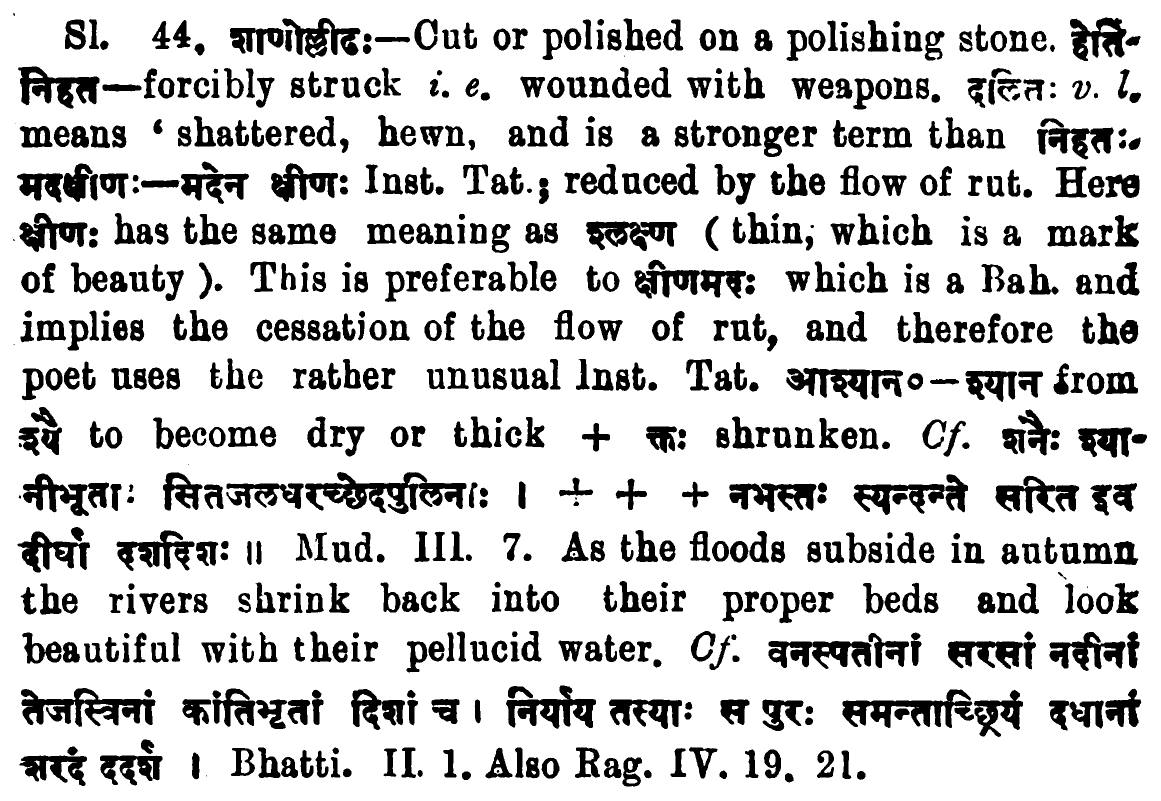
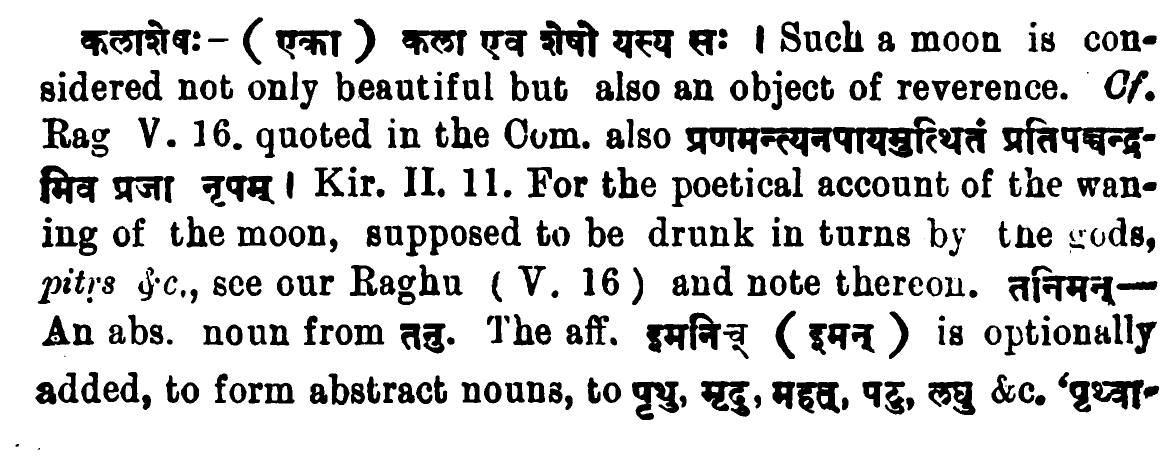
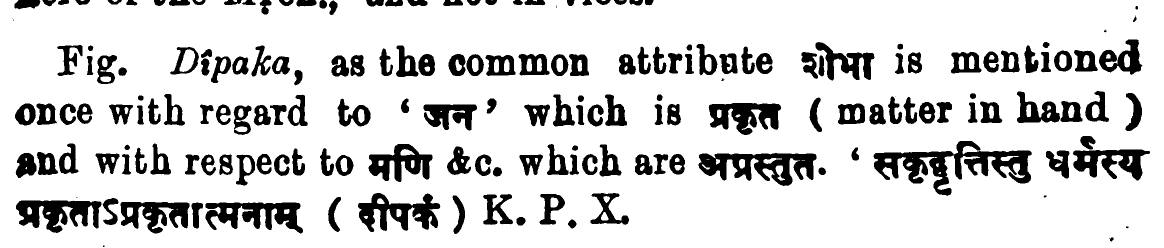
Sl. 44. शाणोल्लीढः—Cut or polished on a polishing stone. हेतिनिहत—forcibly struck i. e. wounded with weapons. दलितः v. l. means ' shattered, hewn, and is a stronger term than निहतः. मदक्षीणः—मदेन क्षीणः Inst. Tat.; reduced by the flow of rut. Here क्षीणः has the same meaning as श्लक्ष्ण ( thin, which is a mark of beauty ). This is preferable to क्षीणमदः which is a Bah. and implies the cessation of the flow of rut, and therefore the poet uses the rather unusual Inst. Tat. आश्यान०—श्यान from श्यै to become dry or thick + क्तः shrunken. Cf. शनैः श्यानीभूताः सितजलधरच्छेदपुलिनाः । + + + नभस्तः स्यन्दन्ते सरित इव दीर्घा दशदिशः ॥ Mud. III. 7. As the floods subside in autumn the rivers shrink back into their proper beds and look beautiful with their pellucid water. Cf. वनस्पतीनां सरसां नदीनां तेजस्विनां कांतिभृतां दिशां च । निर्याय तस्याः स पुरः समन्ताच्छ्रियं दधानां शरदं ददर्श । Bhatti. II. 1. Also Rag. IV. 19. 21. कलाशेषः—( एका ) कला एव शेषो यस्य सः । Such a moon is considered not only beautiful but also an object of reverence. Cf. Rag V. 16. quoted in the Com. also प्रणमन्त्यनपायमुत्थितं प्रतिपच्चन्द्रमिव प्रजा नृपम् । Kir. II. 11. For the poetical account of the waning of the moon, supposed to be drunk in turns by the gods, pitṛs &c., see our Raghu ( V. 16 ) and note thereon. तनिमन्— An abs. noun from तनु. The aff. इमनिच् ( इमन् ) is optionally added, to form abstract nouns, to पृथु, मृदु, महत्, पटु, लघु &c. 'पृथ्वादिभ्य इमनिज्वा’ Pán. V. 1. 122. अर्थिषु &c.—as Chârudatta, the hero of the Mṛch.; and not in vices. Fig. Dîpaka, as the common attribute शोभा is mentioned once with regard to ‘जन’ which is प्रकृत ( matter in hand ) and with respect to मणि &c. which are अप्रस्तुत. ‘सकृद्वृत्तिस्तु धर्मस्य प्रकृताऽप्रकृतात्मनाम् ( दीपकं ) K. P. X.

Gopinath1914
all
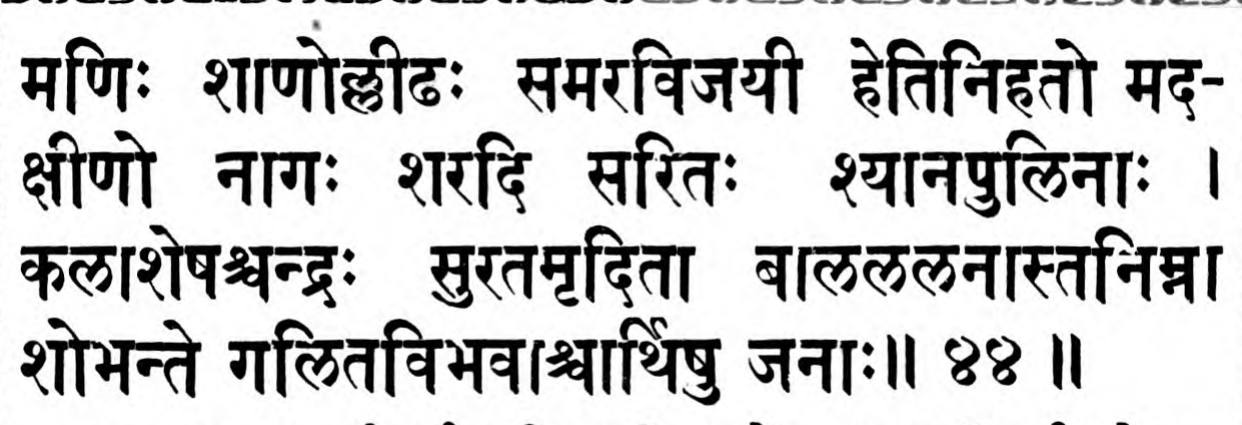
मणिः शाणोल्लीढः समरविजयी हेतिनिहतो मद-
क्षीणो नागः शरदि सरितः श्यानपुलिनाः ।
कलाशेषश्चन्द्रः सुरतमृदिता बालललनास्तनिम्ना
शोभन्ते गलितविभवाश्चार्थिषु जनाः॥ ४४ ॥
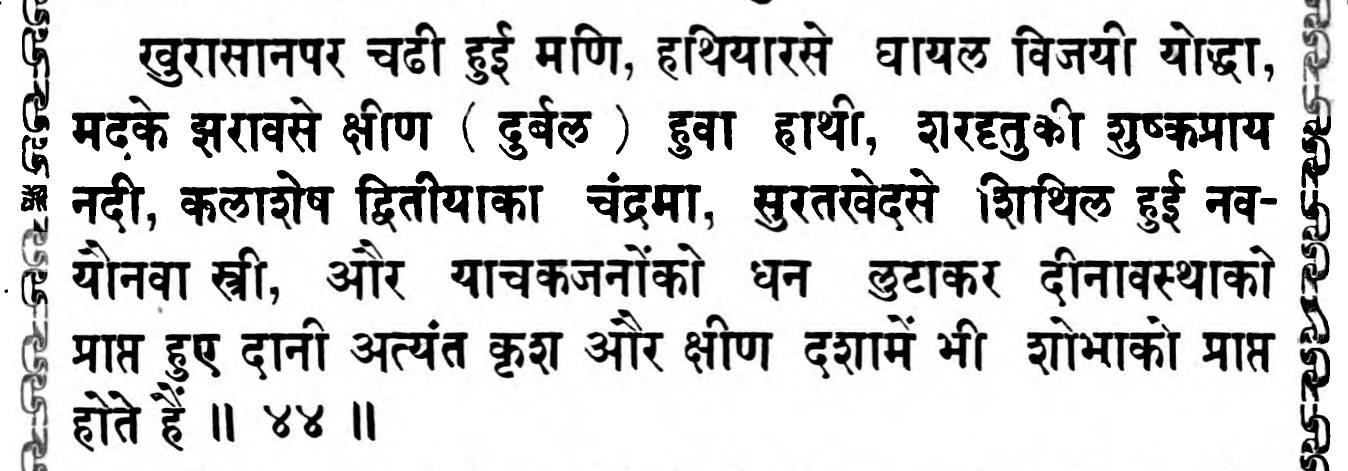
खुरासानपर चढी हुई मणि, हथियारसे घायल विजयी योद्धा, मदके झरावसे क्षीण ( दुर्बल ) हुवा हाथी, शरद्दतुकी शुष्कप्राय नदी, कलाशेष द्वितीयाका चंद्रमा, सुरतखेदसे शिथिल हुई नवयौनवा स्त्री, और याचकजनोंको धन लुटाकर दीनावस्थाको प्राप्त हुए दानी अत्यंत कृश और क्षीण दशामें भी शोभाको प्राप्त होते हैं ॥ ४४ ॥
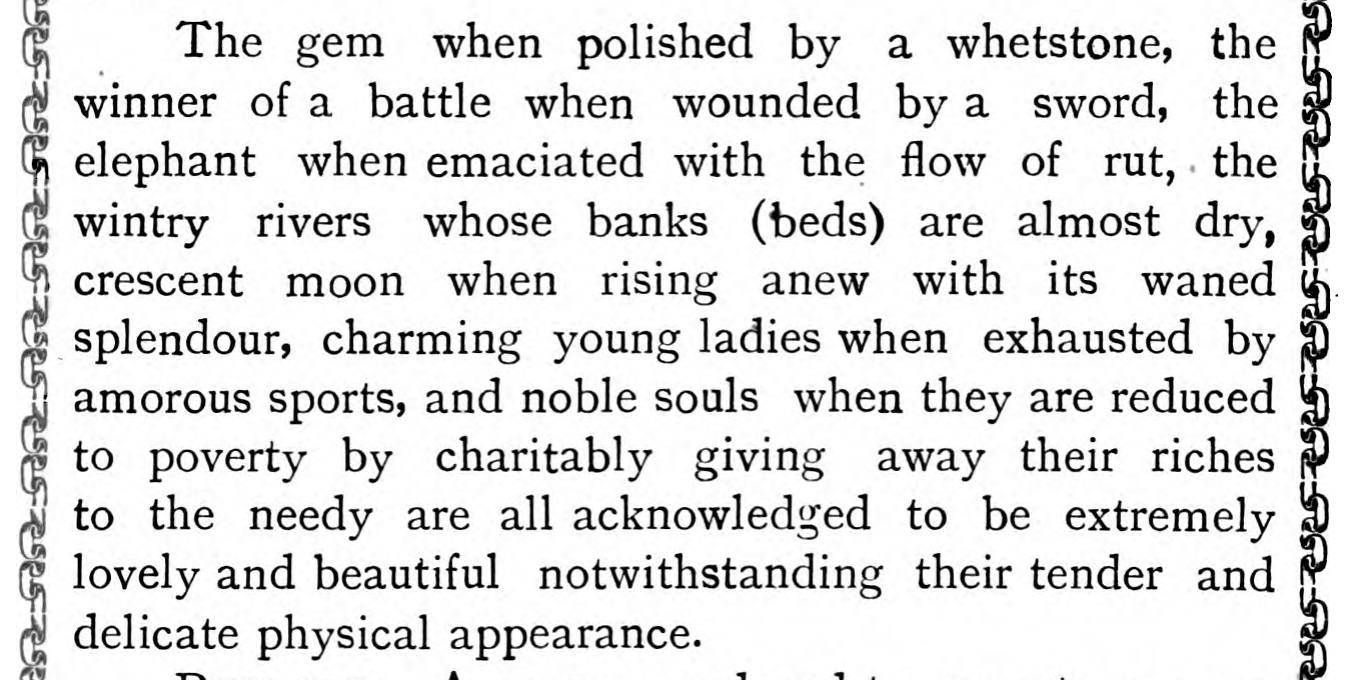
The gem when polished by a whetstone, the winner of a battle when wounded by a sword, the elephant when emaciated with the flow of rut, the wintry rivers whose banks (beds) are almost dry, crescent moon when rising anew with its waned splendour, charming young ladies when exhausted by amorous sports, and noble souls when they are reduced to poverty by charitably giving away their riches to the needy are all acknowledged to be extremely lovely and beautiful notwithstanding their tender and delicate physical appearance.
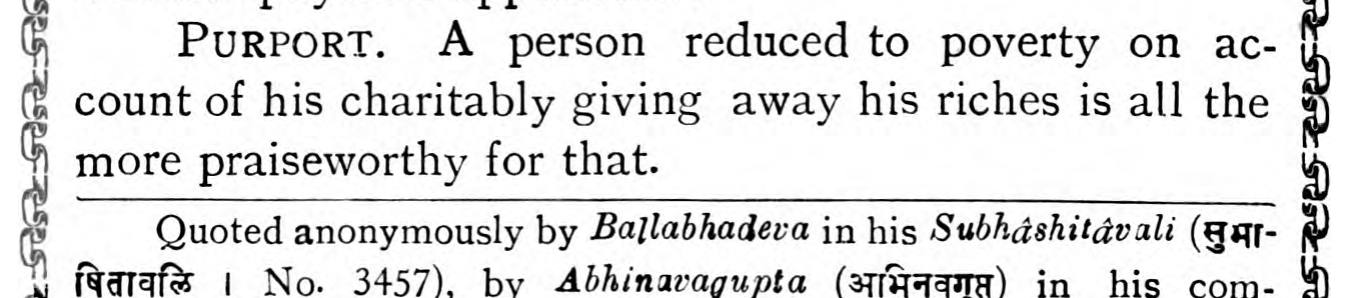
PURPORT. A person reduced to poverty on account of his charitably giving away his riches is all the more praiseworthy for that.

Gopinath1896
all
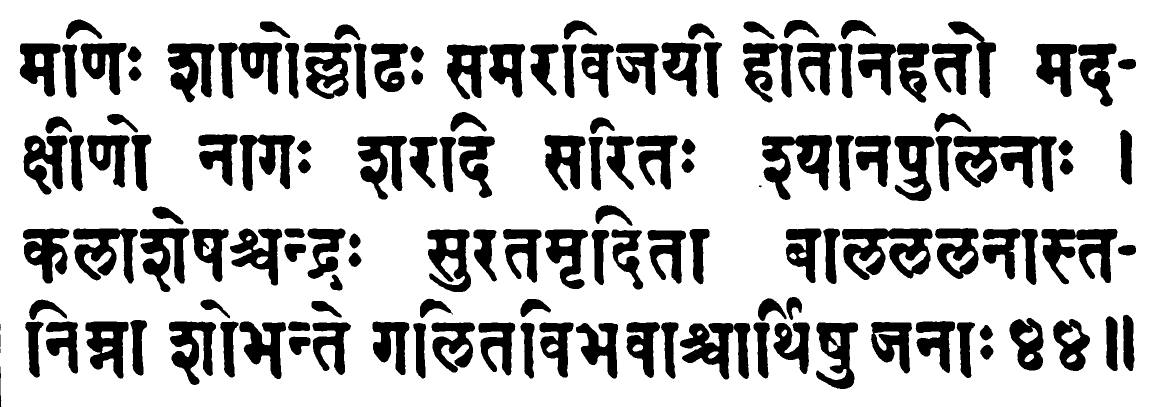
मणिः शाणोलीढः समरविजयी हेतिनिहतो मद-
क्षीणो नागः शरदि सरितः श्यानपुलिनाः ।
कलाशेषश्चन्द्रः सुरतमृदिता बालललनास्त-
निम्ना शोभन्ते गलितविभवाश्वार्थिषु जनाः ४४ ॥
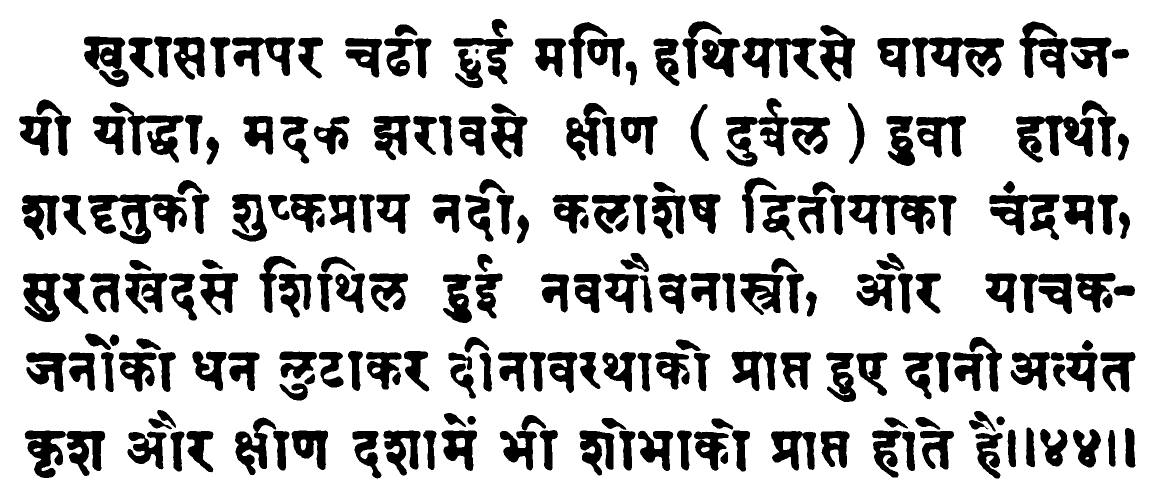
खुरासानपर चढी हुई मणि, हथियार से घायल विजयी योद्धा, मदक झरावसे क्षीण (दुर्बल) हुवा हाथी, शरदृतुकी शुष्कप्राय नदी, कलाशेष द्वितीयाका चंद्रमा, सुरतखेद से शिथिल हुई नवयौवनास्त्री, और याचकजनोंको धन लुटाकर दीनावस्थाको प्राप्त हुए दानी अत्यंत कृश और क्षीण दशा में भी शोभाको प्राप्त होते हैं । । ४४ ॥
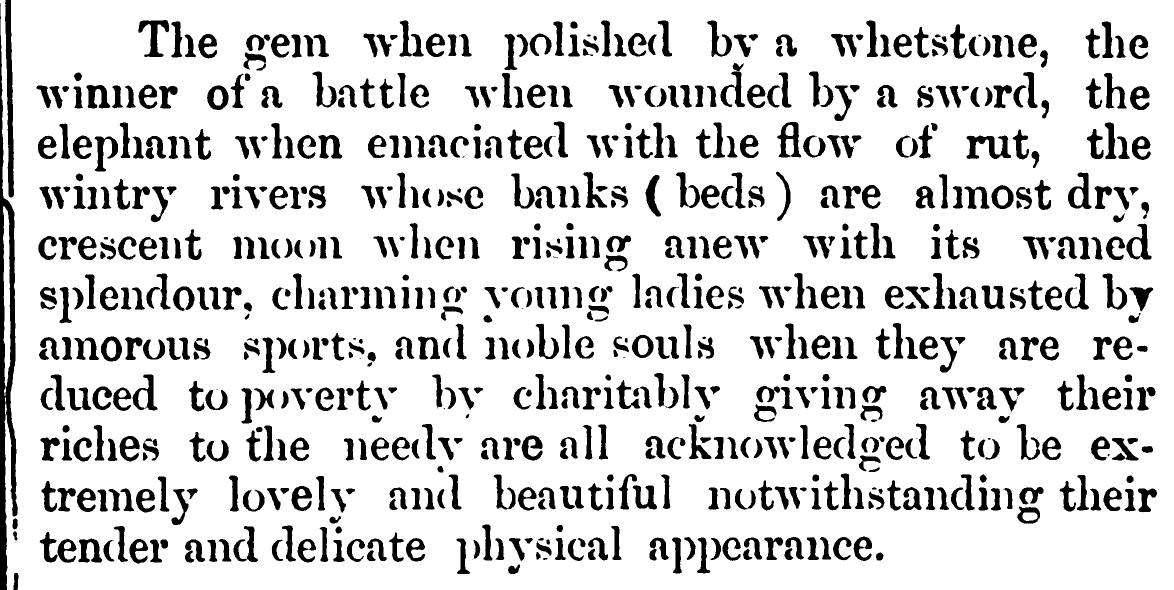
The gem when polished by a whetstone, the winner of a battle when wounded by a sword, the elephant when emaciated with the flow of rut, the wintry rivers whose banks ( beds) are almost dry, crescent moon when rising anew with its waned splendour, charming young ladies when exhausted by amorous sports, and noble souls when they are reduced to poverty by charitably giving away their riches to the needy are all acknowledged to be extremely lovely and beautiful notwithstanding their tender and delicate physical appearance.
PURPORT. A person reduced to poverty on account of his charitably giving away his riches is all the more praiseworthy for that.

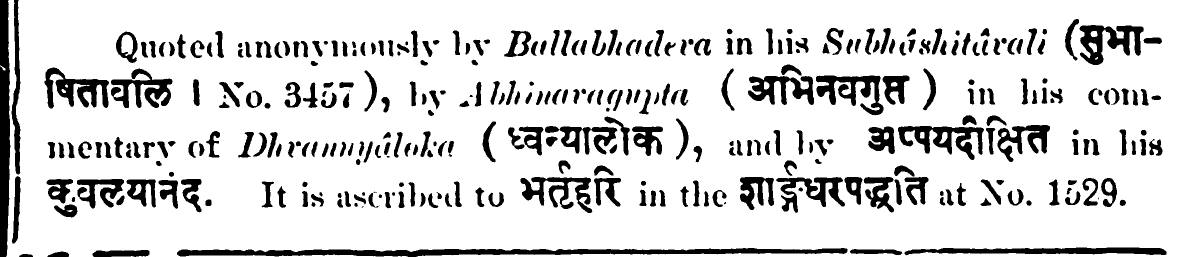
Kosambi
all
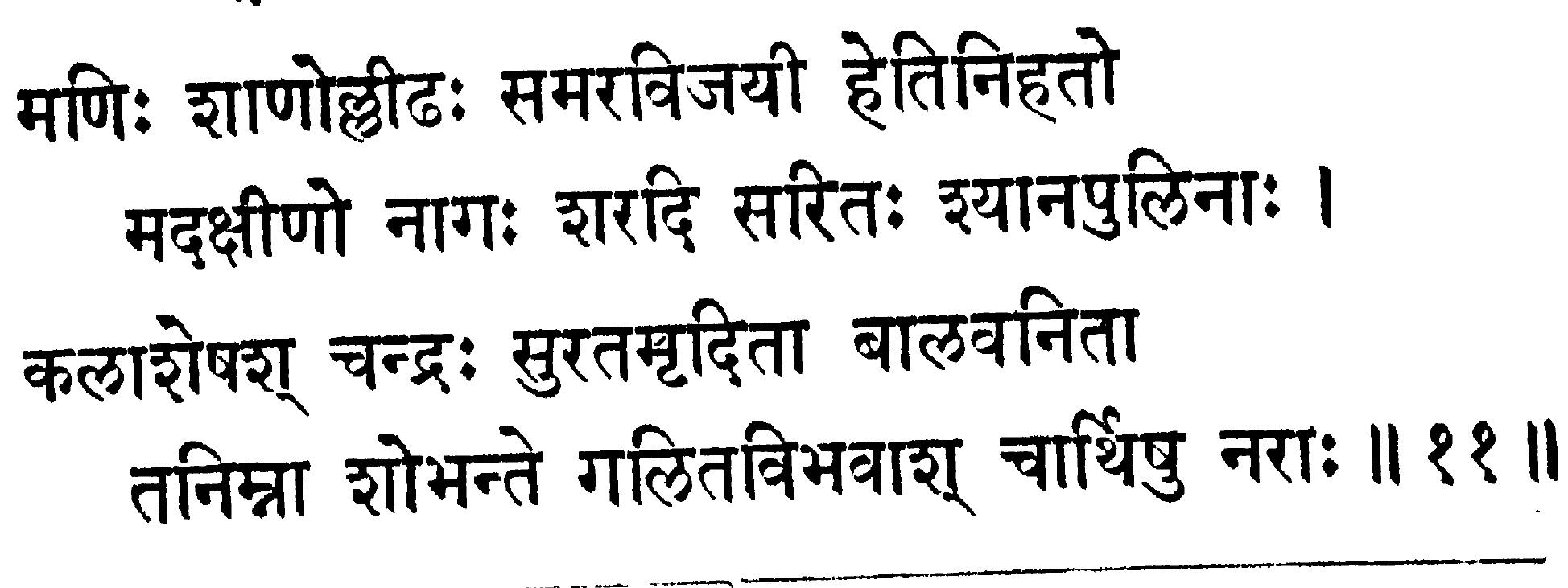
मणिः शाणोल्लीढः समरविजयी हेतिनिहतो
मदक्षीणो नागः शरदि सरितः श्यानपुलिनाः ।
कलाशेषश् चन्द्रः सुरतमृदिता बालवनिता
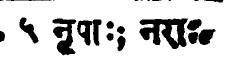
तनिम्ना शोभन्ते गलितविभवाश् चार्थिषु नराः ॥ ११ ॥
Footnote
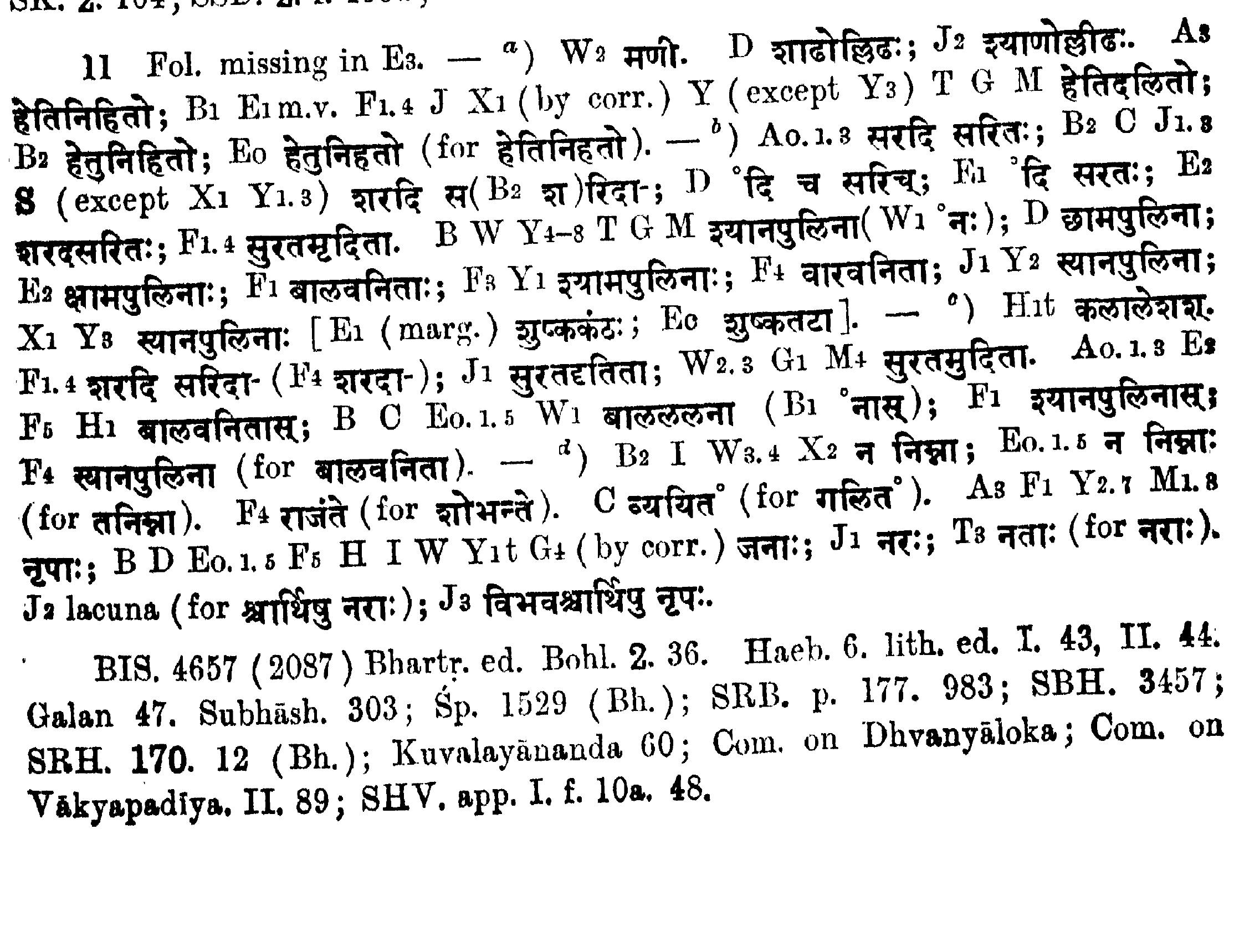
हेतिनिहितो B2 शरदसरितः 8 X1 Es F1 Fs F4 ( नृपाः E2 for . ( क्षामपुलिनाः हेतुनिहितो 4 स्थानपुलिना Y3 except H1 11 ; शरदि तनिम्ना BDEo बालवनितास स्थान Fol ; ; F1.4 ) B1 X1 सरिदा . . ; पुलिनाः missing ; . Eo F4 ( Eim.v. 1. सुरतमृदिता F1 - for Y 6 5 ( 1. राजंते हेतुनिहतो F5 बालवनिताः F4 3 ; [ बालवनिता ) E1 B H in शरदि शरदा F1.4 ( for ( C Es IWYit . - marg . ) ( Eo J ; ; BW शोभन्ते for ) स J1 FY1 . X1 . ( F3 . 1. ) B2 हेतिनिहतो a 5 सुरतहतिता शुष्ककंट ( Y ) G by ) + W . + श्यामपुलिनाः श - 2 W2 8TGM 1 ) ) ( रिदा corr C by बालललना B2 मणी व्ययित ; ) . corr ; ; ) Eo – I W2.3 . ID Y . श्यानपुलिना 1 ) शुष्कतटा D W ( ) ° जना ( दि 3 except A0.1.8 for ( 4 G1 + शाढोल्लिढ B1 :; च X वारवनिता M4 2 गलित J1 ' सरिच ] नास् . न Y3 ( सरदि नरः सुरतमुदिता निम्ना : W1 ) ; ) ) ; . ; ; ° ; J2 T 0 F1 F1 सरितः T3 नः J1 ) A3 ; GM इयाणोल्लीढः ) नताः Eo ; Y Hit Y2 दि F1 D . : श्यानपुलिनास् ; . 1.6 स्यानपुलिना छामपुलिना हेतिदलितो B2 ( Y2.7M1.8 सरतः कलालेशश Ao for न CJ1.8 . . 1.3 नराः निम्नाः ; As E2 Es ; ) ; ; . .
Ja lacuna ( for श्वार्थिषु नरा :) ; J3 विभवश्वार्थिपु नृपः .
Galan BIS 47. . 4657 Subhāsh ( 2087 . ) 303 Bhartr ; Śp . . ed 1529 . Bohl ( Bh . 2. . ) 36. ; SRB Haeb . p . . 6. 177. lith 983 ed . ; I. SBH 43 , . II 3457 . 44 . ;
SRH . 170. 12 ( Bh . ) ; Kuvalayananda 60 ; Com . on Dhvanyaloka ; Com . on
Vakyapadiya . II . 89 ; SHV , app . I. f . 10a . 48 .
Commentary