Ryder
SEVEN ARROWS
Seven arrows pierce my heart:
The moonbeams that by day depart;
The maid whose youthful beauty flies;
The pool wherein the lotus dies;
The handsome man whose lips are dumb
The rich man, miserly and glum;
The good man sunk in suffering;
The rogue in favor with the king.
Tawney
The moon when dimmed by daylight, and a maid whose charms have fled,
A lake with faded lotuses, a good man ill bested,
A speechless mouth, a grasping king, a scoundrel in his train,
Are seven thorns that fret my soul with neverending pain.
Telang
all
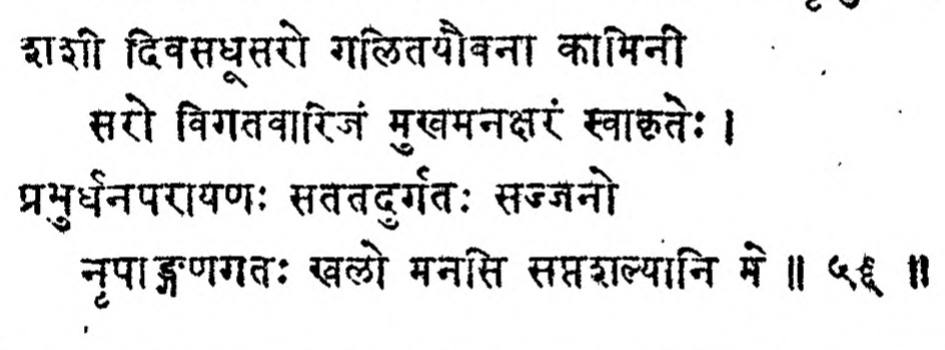
शशी दिवसधूसरो गलितयौवना कामिनी
सरो विगतवारिजं मुखमनक्षरं स्वाकृतेः ।
प्रभुर्धनपरायणः सततदुर्गतः सज्जनो
नृपाङ्गणगतः खलो मनसि सप्तशल्यानि मे ॥ ५६ ॥
Notes
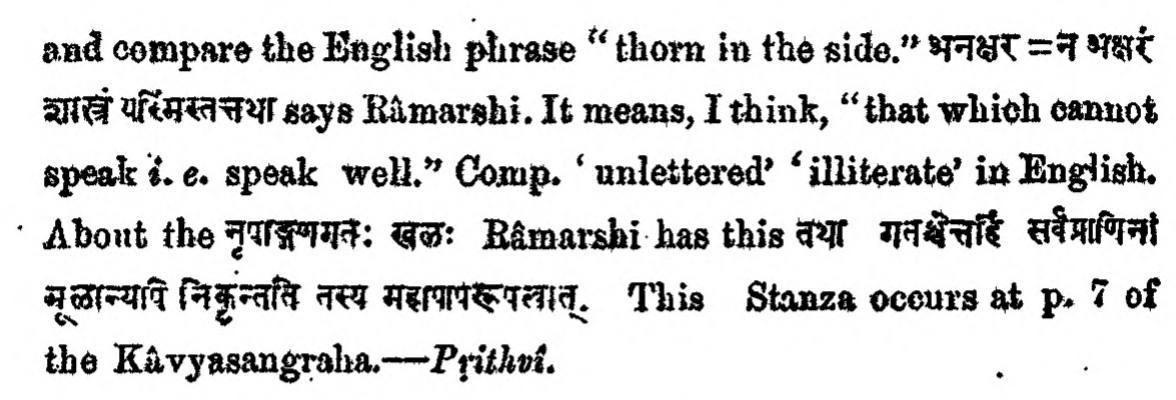
St. LVI.—दुर्गत = unfortunate, distressed. शल्य = this is a very common use of the word. Comp. for one instance Raghu. IX., 75 and compare the English phrase “thorn in the side.” अनक्षर = न अक्षरं शास्त्रं यस्मिंस्तत्तथा says Râmarshi. It means, I think, “that which cannot speak i. e. speak well.” Comp. ‘unlettered’ ‘illiterate’ in English. About the नृपाङ्गणगतः खलः Râmarshi has this तथा गतश्चेत्तर्हि सर्वप्राणिनां मूलान्यपि निकृन्तति तस्य महापापरूपत्वात्. This Stanza occurs at p. 7 of the Kâvyasangraha.—Pṛithvî.


Kale
all

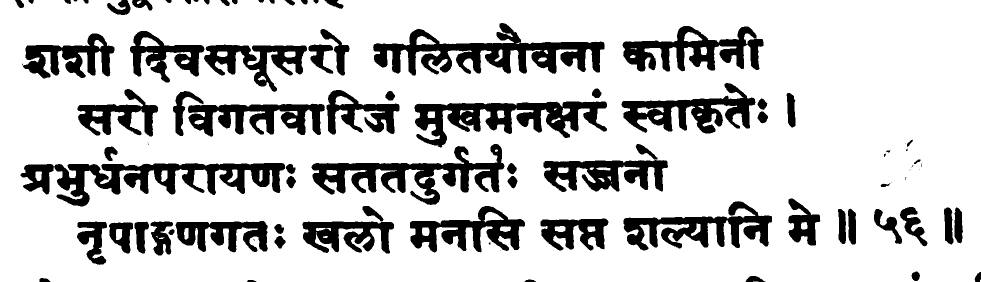
शशी दिवसधूसरो गलितयौवना कामिनी
सरो विगतवारिजं मुखमनक्षरं स्वाकृतेः ।
प्रभुर्धनपरायणः सततदुर्गतः सज्जनो
नृपाङ्गणगतः खलो मनसि सप्त शल्यानि मे ॥ ५६ ॥
Translation
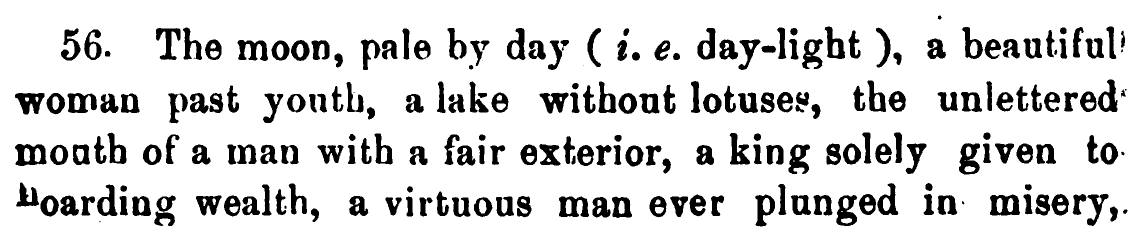
56. The moon, pale by day ( i. e. day-light ), a beautiful woman past youth, a lake without lotuses, the unlettered mouth of a man with a fair exterior, a king solely given to hoarding wealth, a virtuous man ever plunged in misery, and a wicked man having access to a king’s court—these are the seven barbs in my heart.

Notes
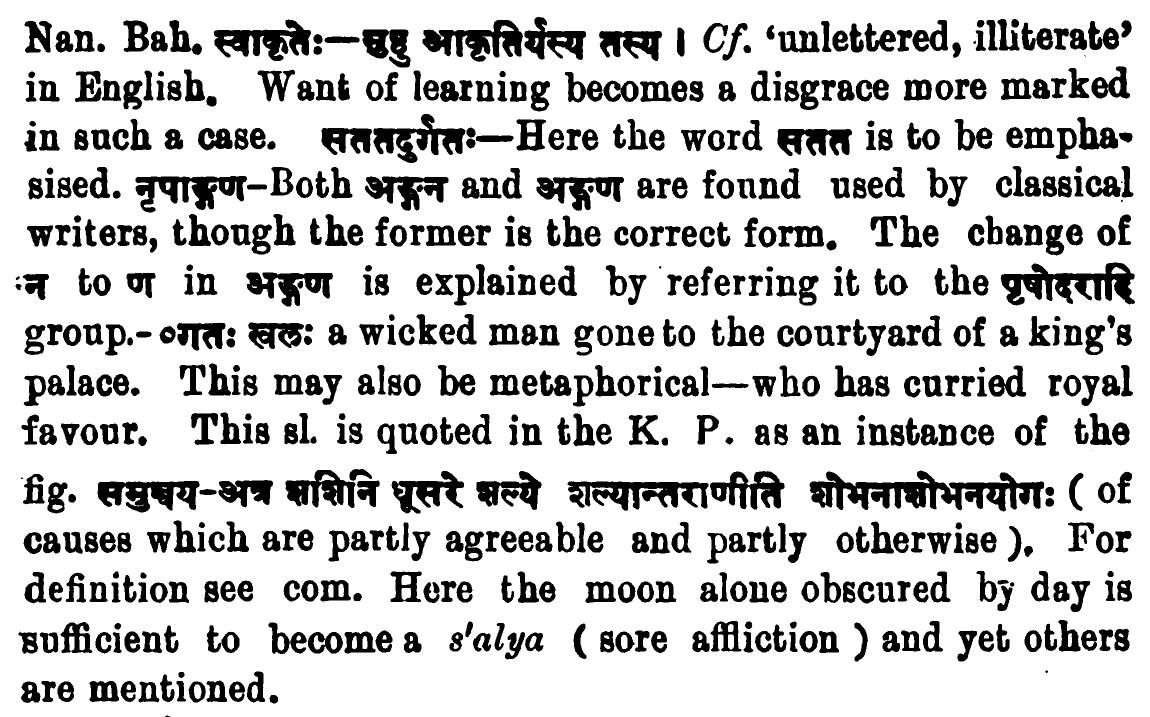
Sl.s 56. दिवसं०—दिवसेन ( Inst. हेतौ ) धूसरः rendered pale by ( the overpowering light of ) day. अनक्षरम्—अविद्यमानमक्षरं यत्र तत् । Nan. Bah. स्वाकृतेः—सुष्ठु आकृतिर्यस्य तस्य । Cf. ‘unlettered, illiterate’ in English. Want of learning becomes a disgrace more marked in such a case. सततदुर्गतः—Here the word सतत is to be emphasised. नृपाङ्गण–Both अङ्गन and अङ्गण are found used by classical writers, though the former is the correct form. The change of न to ण in अङ्गण is explained by referring it to the पृषोदरादि group.–०गतः खलः a wicked man gone to the courtyard of a king's palace. This may also be metaphorical—who has curried royal favour. This sl. is quoted in the K. P. as an instance of the fig. समुच्चय–अत्र शशिनि धूसरे शल्ये शल्यान्तराणीति शोभनाशोभनयोगः ( of causes which are partly agreeable and partly otherwise ). For definition see com. Here the moon alone obscured by day is sufficient to become a s'alya ( sore affliction ) and yet others are mentioned.

Gopinath1914
all
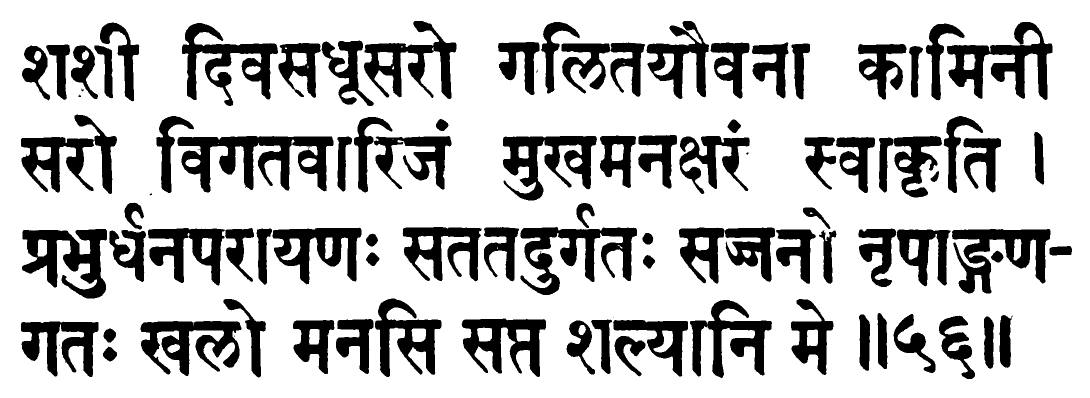
शशी दिवसधूसरो गलितयौवना कामिनी
सरो विगतवारिजं मुखमनक्षरं स्वाकृति ।
प्रभुर्धनपरायणः सततदुर्गतः सज्जनो नृपाङ्गण-
गतः खलो मनसि सप्त शल्यानि मे ॥ ५६ ॥
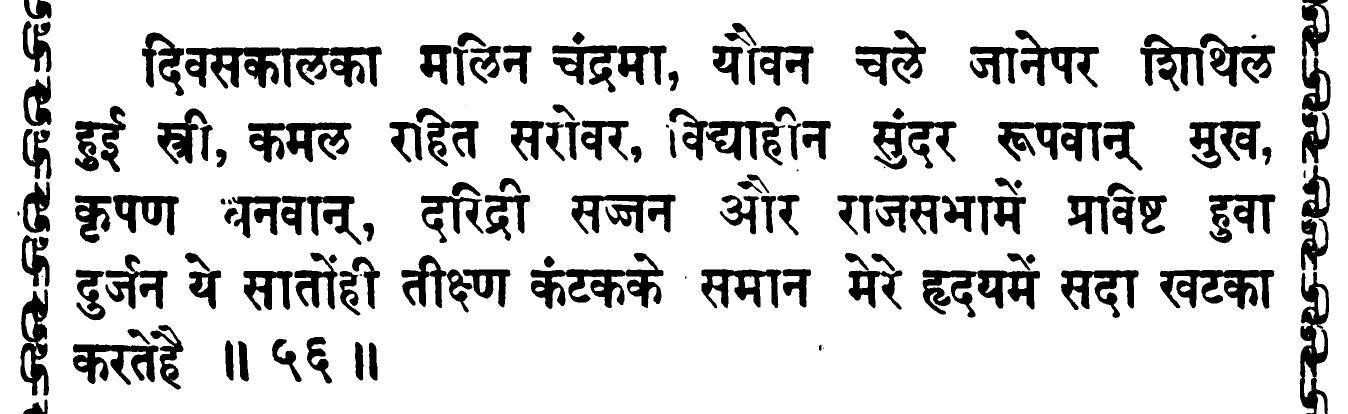
दिवसकालका मलिन चंद्रमा, यौवन चले जानेपर शिथिल हुई स्त्री, कमल रहित सरोवर, विद्याहीन सुंदर रूपवान् मुख, कृपण धनवान्, दरिद्री सज्जन और राजसभामें प्रविष्ट हुवा दुर्जन ये सातोंही तीक्ष्ण कंटकके समान मेरे हृदयमें सदा खटका करते है ॥ ५६ ॥
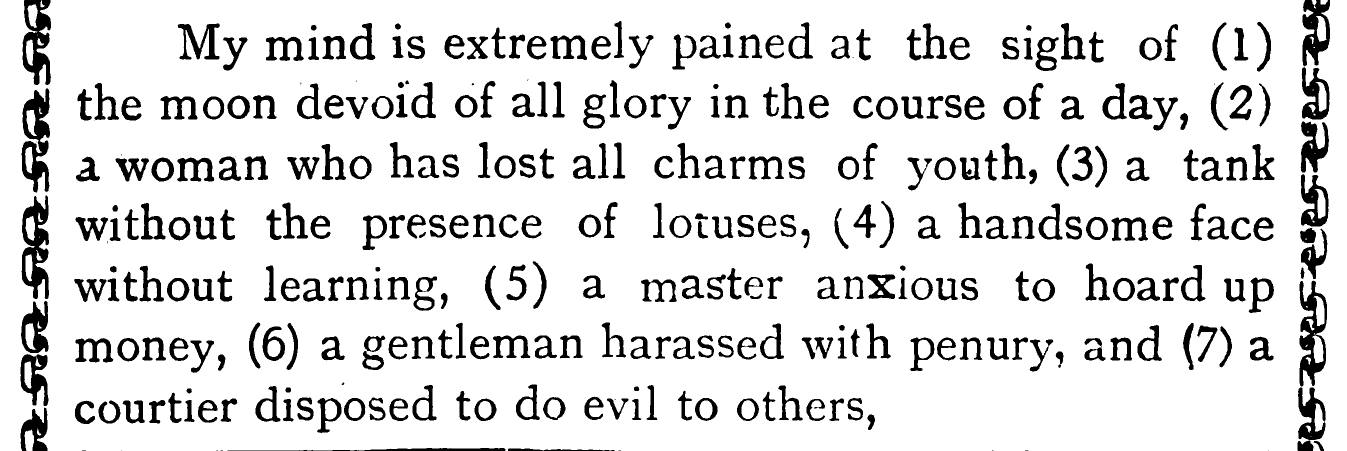
My mind is extremely pained at the sight of (1) the moon devoid of all glory in the course of a day, (2) a woman who has lost all charms of youth, (3) a tank without the presence of lotuses, (4) a handsome face. without learning, (5) a master anxious to hoard up money, (6) a gentleman harassed with penury, and (7) a courtier disposed to do evil to others,
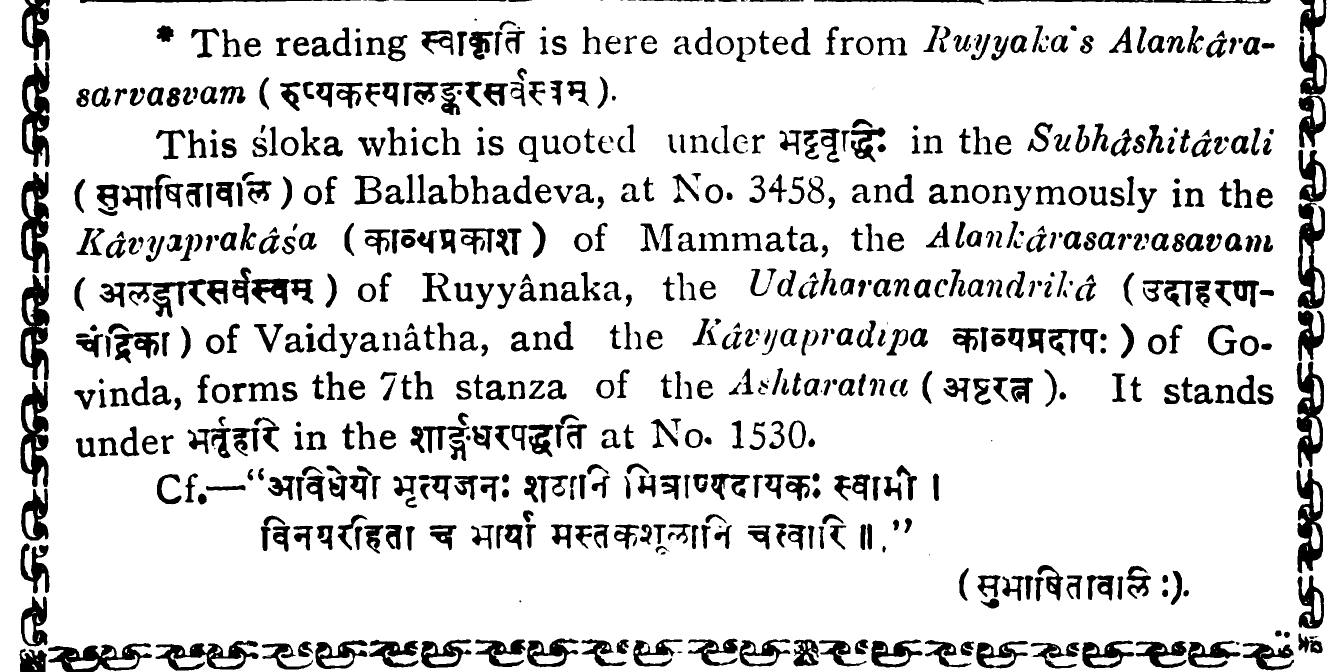
Footnote
* The reading is here adopted from Ruyyaka's Alankarasarvasvam ( रूप्यकस्यालङ्कर सर्वस्वम् ). This sloka which is quoted under in the Subhashitâvali ( सुभाषितावलि ) of Ballabhadeva, at No. 3458, and anonymously in the Kávyaprakāśa ( काव्यप्रकाश ) of Mammata, the Alankarasarvasavam ( अलङ्कार सर्वस्वम् ) of Ruyyánaka, the Udāharanachandrika ( उदाहरणचंद्रिका) of Vaidyanatha, and the Kávyapradipa काव्यप्रदापः ) of Go vinda, forms the 7th stanza of the Ashtaratna (अटरत्न ). It stands under भर्तृहरि in the शार्ङ्गधरपद्धति at No. 1530. Cf. - " अविधेयो भृत्यजनः शठानि मित्राण्यदायकः स्वामी । विनयरहिता च भार्या मस्तकशूलानि चत्वारि ॥." ( सुभाषितावलि :).
Gopinath1896
all
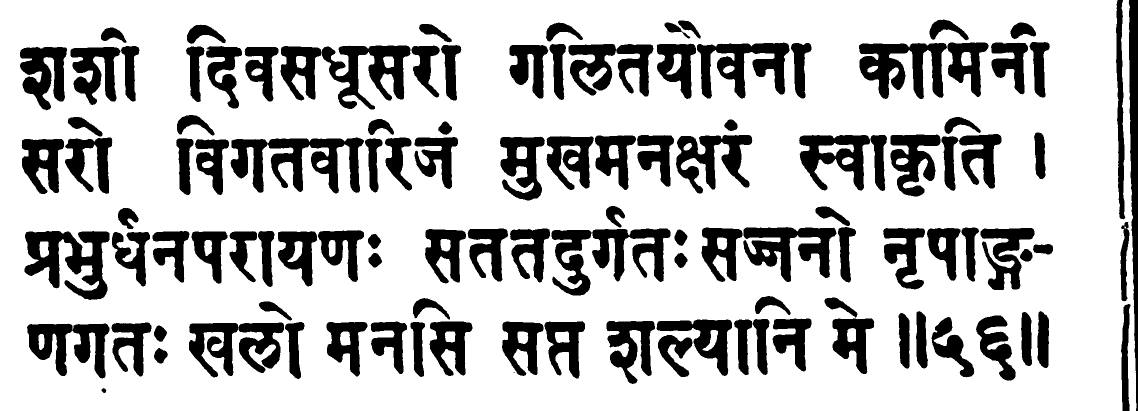
शशी दिवसधूसरो गलितयौवना कामिनी
सरो विगतवारिजं मुखमनक्षरं स्वाकृति ।
प्रभुर्धनपरायणः सततदुर्गतः सज्जनो नृपाङ्ग-
णगतः खलो मनसि सप्त शल्यानि मे ॥ ५६ ॥
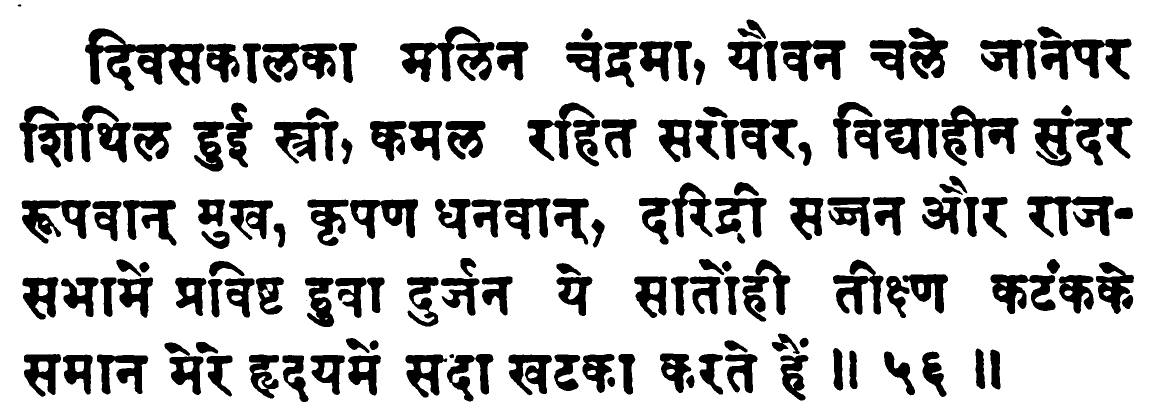
दिवसकालका मलिन चंद्रमा, यौवन चले जानेपर शिथिल हुई स्त्री, कमल रहित सरोवर, विद्याहीन सुंदर रूपवान् मुख, कृपण धनवान्, दरिद्री सज्जन और राजसभामें प्रविष्ट हुवा दुर्जन ये सातोंही तीक्ष्ण कटंकके समान मेरे हृदय में सदा खटका करते हैं ॥ ५६ ॥
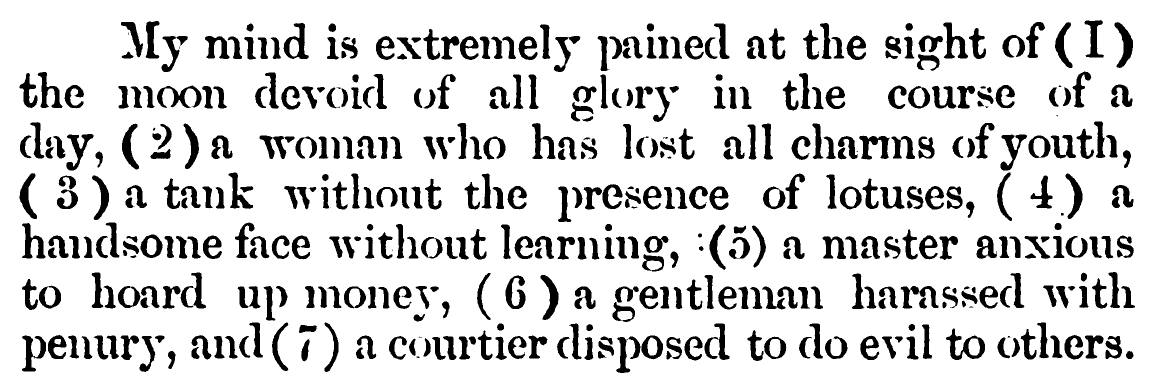
My mind is extremely pained at the sight of (I) the moon devoid of all glory in the course of a day, (2)a woman who has lost all charms of youth, ( 3 ) a tank without the presence of lotuses, ( 4 ) a handsome face without learning, (5) a master anxious to hoard up money, (6) a gentleman harassed with penury, and(7) a courtier disposed to do evil to others.

Footnote
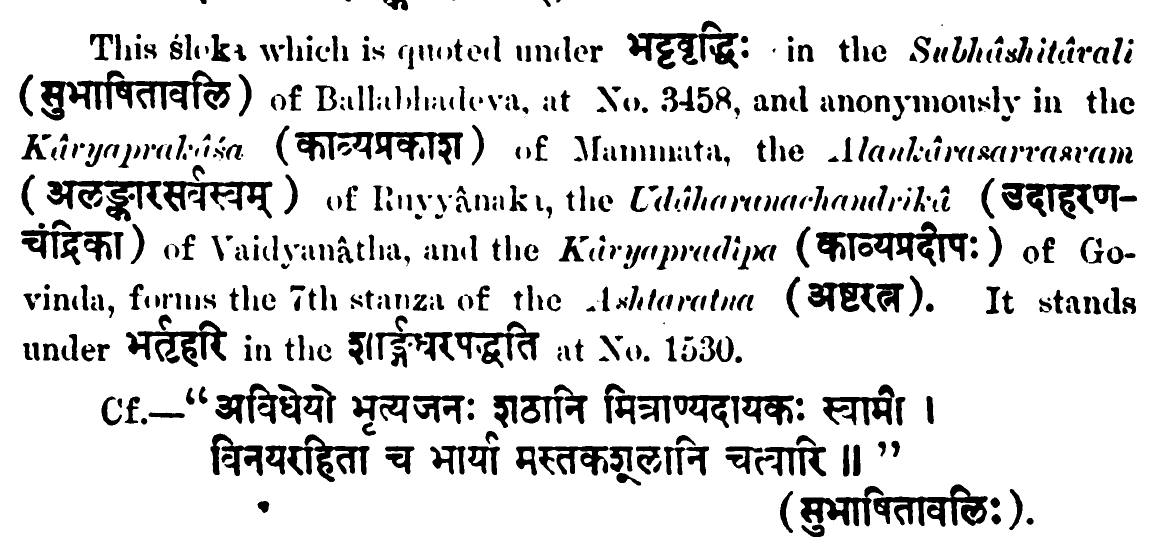
This sloka 1 which is quoted under in the Subhashitûrali ( सुभाषितावलि) of Ballabhudeva, at No. 3458, and anonymously in the Karyapralisa ( काव्यप्रकाश) of Mammmnata, the Alankarasarrasram ( अलङ्कार सर्वस्वम् ) of Euyyānaki, the Ldähavanachandrika ( उदाहरणचंद्रिका) of Vaidyanatha, and the Kåryapraadiya ( काव्यप्रदीपः ) of Govinda, forms the 7th stanza of the Ashtaratna (अष्टरल). It stands under भर्तृहरि in the शार्ङ्गवरपद्धति at No. 1530. CE. - " अविधेयो भृत्यजनः शठानि मित्राण्यदायकः स्वामी । विनयरहिता च भार्या मस्तकशूलानि चत्वारि ॥ ” (सुभाषितावलिः).
Kosambi
all
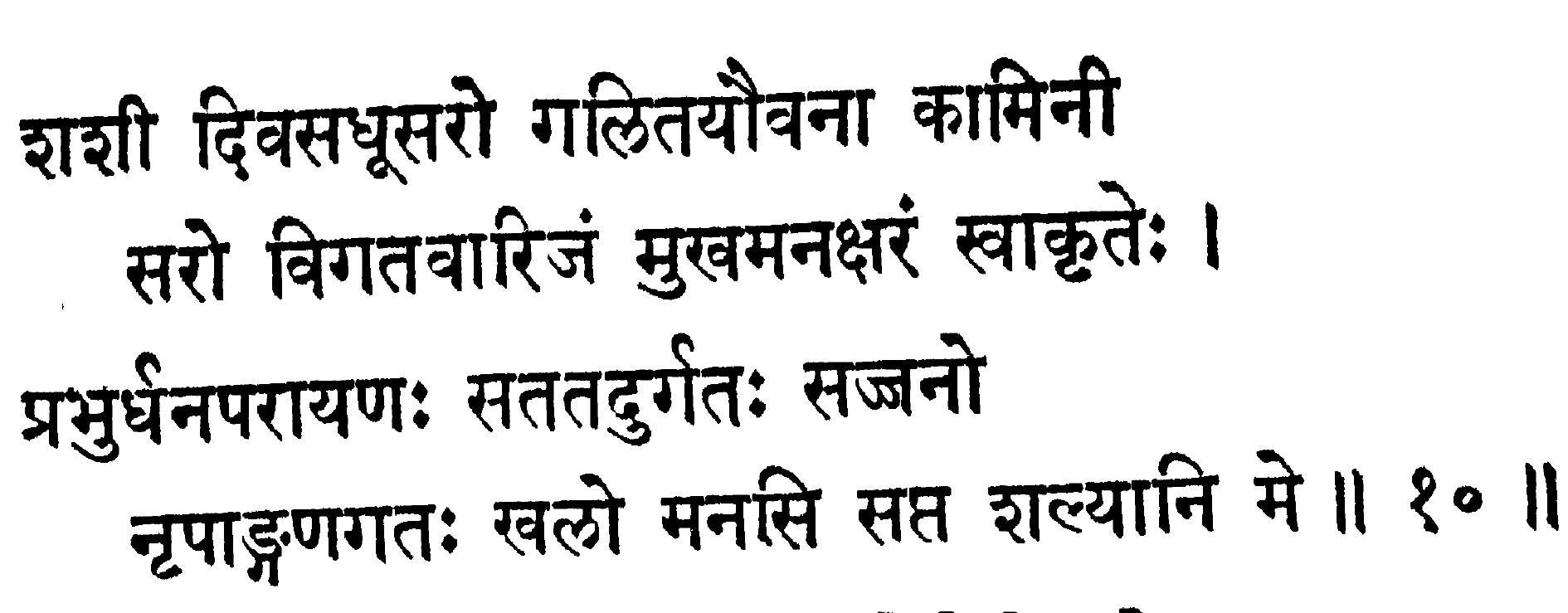
शशी दिवसधूसरो गलितयौवना कामिनी
सरो विगतवारिजं मुखमनक्षरं वाकृतेः ।
प्रभुर्घनपरायणः सतत दुर्गतः सज्जनो
नृपाङ्गणगतः खलो मनसि सप्त शल्यानि मे ॥ १० ॥
Footnote
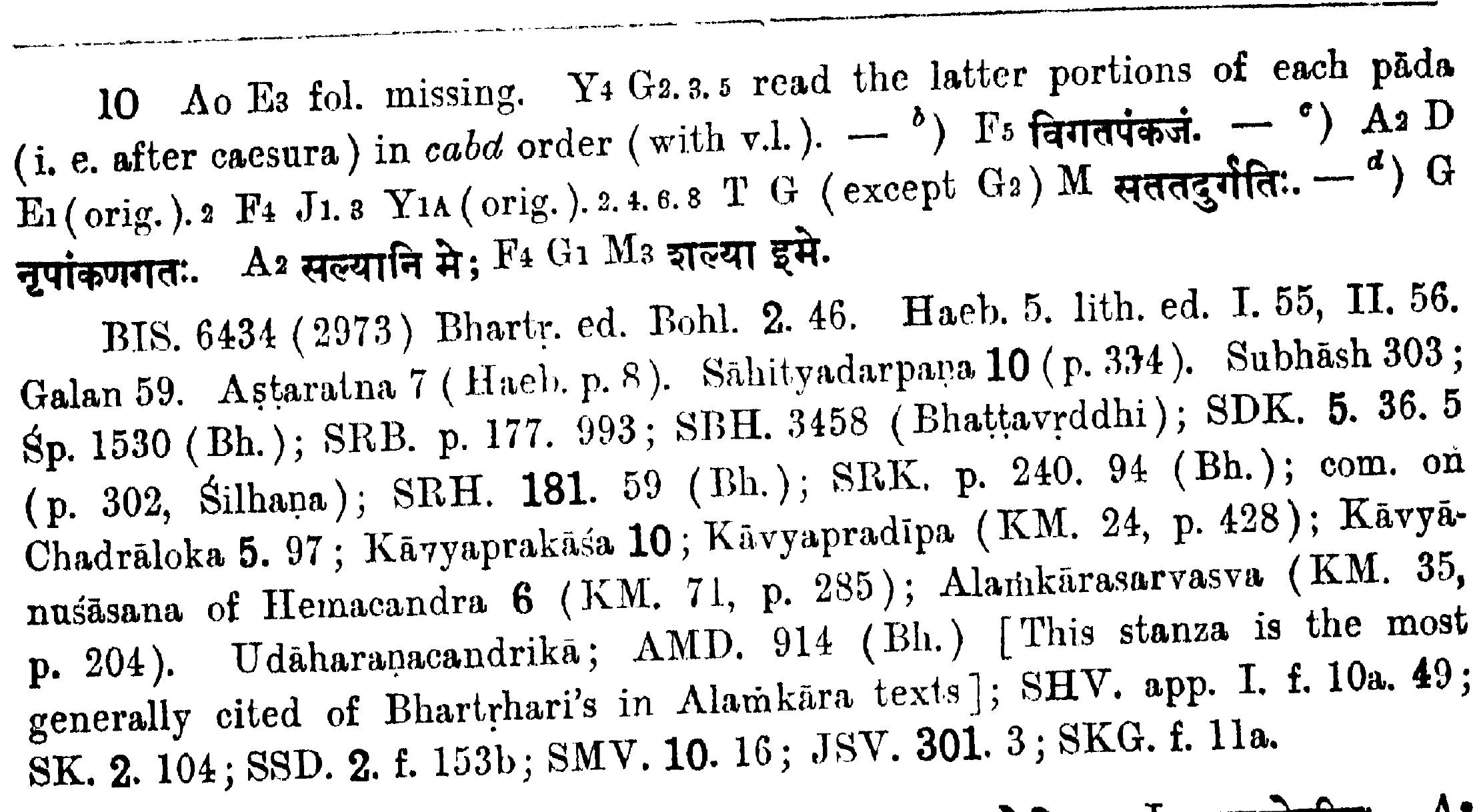
( E1 i . ( e orig . 10 after . ) Ao . 2 caesura F1 E3 J1 fol . ) 3 . in Y1A missing cabd ( orig order . . ) Y4 . 2. 4. ( G2.3.5 with 6.8 TG v.l. read ) . ( except – the . 8 latter ) F5s G2 विगतपंकजं ) portions M सततदुर्गतिः . of each * - ) . A2 4 pada ) D G
नृपांकणगतः . A2 सल्यानि मे ; F4 G1 M3 शल्या इमे .
BIS . 6434 ( 2973 ) Bhartr . ed . Bohl . 2. 46. Haeb 5 lith ed . I. 55 , II . 56 .
Galan Śp ( Chadrāloka p . . 1530 302 59. , ( Bh Silhaņa Astaratna 5. . ) 97 ; SRB ; ) ; Kāvyaprakāśa SRH . 7 p ( . Hae 177. 181.59 ) . 993 p . 8 10 ; ) . SBH ; ( Sahityadarpana Kāvyapradipa Bh . . ) 3458 ; SRK ( Bhattavrddhi . p ( . 10 KM 240. ( p . . 24 334 94 , ) ) p ( ; . . Bh SDK 428 Subhash . ) ; ) .. ; com 5. Kāvyā 36.5 303 . on ;
nuśāsana p generally . 204 ) . of cited Udāharanacandrikā Hemacandra of Bhartrhari's 6 ( KM ; in AMD . Alamkāra 71 , . p 914 . 285 ( texts ) Bh ; . Alahkārasarvasva ) ] ; [ This SHV . stanza app . I. is ( f . the KM 10a . most . 49 35 , ;
SK . 2. 104 ; SSD . 2. f . 153b ; SMV . 10. 16 ; JSV . 301. 3 ; SKG . f . 11a .
Commentary