Ryder
WHEN I KNEW A LITTLE BIT
When I knew a little bit,
Then my silly, blinded wit,
Mad as elephants in rut,
Thought it was omniscient; but
When I learned a little more
From the scholar's hoarded store,
Madness' fever soon grew cool,
And I knew I was a fool.
Brough
When I knew a little, then I was like an elephant blinded with rut, and my mind was infected by the pride of omniscience: but when from wise men I learned and understood a little here and a little there, then I knew I was a fool, and my pride vanished like a fever cured.
Tawney
When but a little I had learned, in my own partial eyes
I seemed a perfect Solon and immeasurably wise;
But when a little higher I had climbed in wisdom's school,
The fever-fit was over and I knew myself a fool.
Telang
all
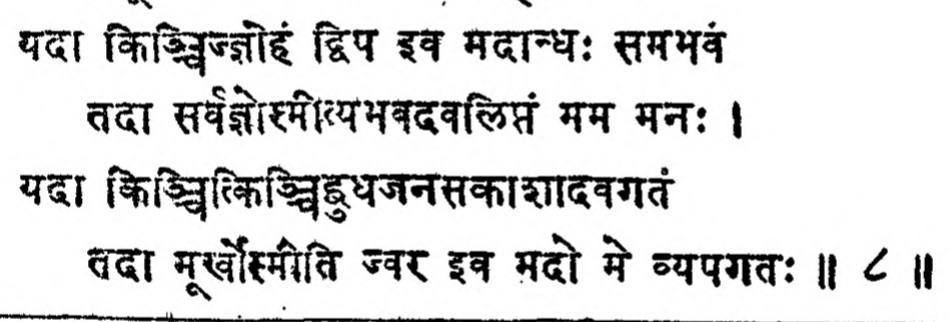
यदा किञ्चिज्ज्ञोहं द्विप इव मदान्धः समभवं
तदा सर्वज्ञोस्मीत्यभवदवलिप्तं मम मनः ।
यदा किञ्चित्किञ्चिद्बुधजनसकाशादवगतं
तदा मूर्खोस्मीति ज्वर इव मदो मे व्यपगतः ॥ ८ ॥
Notes
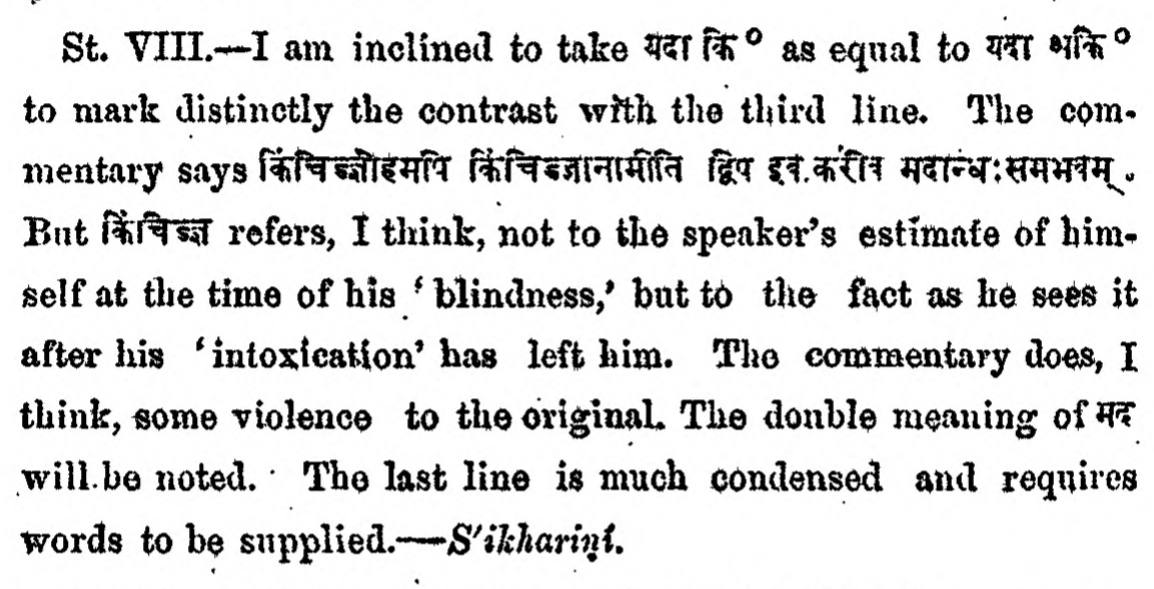
St. VIII.—I am inclined to take यदा कि° as equal to यदा अकि° to mark distinctly the contrast with the third line. The commentary says किंचिज्ज्ञोहमपि किंचिञ्जानामीति द्विप इव करीव मदान्धःसमभवम्. But किंचिज्ज्ञ refers, I think, not to the speaker’s estimate of himself at the time of his ‘blindness,’ but to the fact as he sees it after his ‘intoxication’ has left him. The commentary does, I think, some violence to the original. The double meaning of मद will be noted. The last line is much condensed and requires words to be supplied.—S′ikhariṇî.

Telang
all
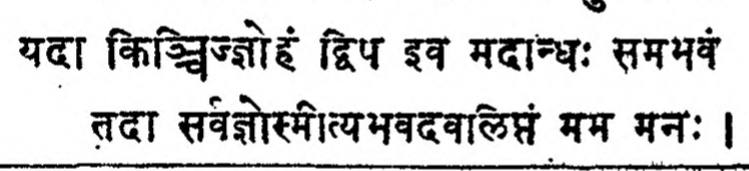
यदा किञ्चिज्ज्ञोहं द्विप इव मदान्धः समभवं
तदा सर्वज्ञोस्मीत्यभवदवलिप्तं मम मनः ।
यदा किञ्चित्किञ्चिद्बुधजनसकाशादवगतं
तदा मूर्खोस्मीति ज्वर इव मदो मे व्यपगतः ॥ ३१ ॥

Notes
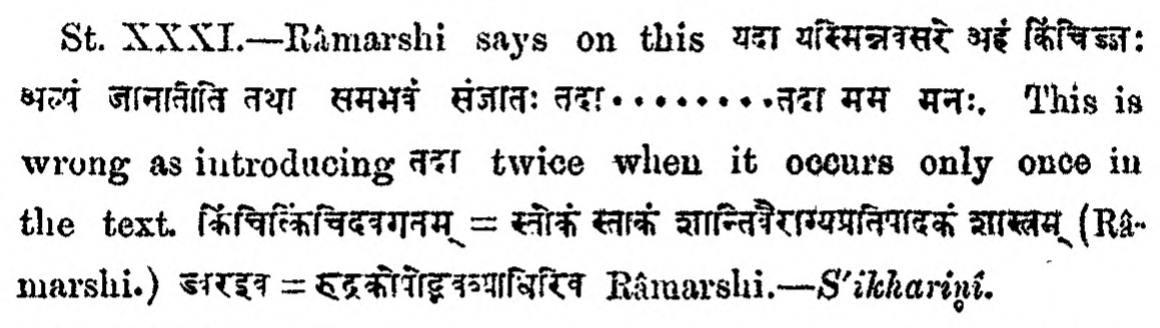
St. XXXI.—Râmarshi says on this यदा यस्मिन्नवसरे अहं किंचिज्ज्ञः अल्पं जानातीति तथा समभवं संजातः तदा........तदा मम मनः. This is wrong as introducing तदा twice when it occurs only once in the text. किंचित्किंचिदवगतम् = स्तोकं स्तोकं शान्तिवैराग्यप्रतिपादकं शास्त्रम् (Râmarshi.) ज्वरइव = रुद्रकोपोद्भवव्याधिरिव Râmarshi.—S'ikhariṇî.

Kale
all
Introduction
अथाल्पज्ञेन दृप्तेन न भाव्यं सति विशेषज्ञाने दर्पः सद्य एवापोह्यते इति दर्शयितुं कस्यचिदनुभवमाह ॥

यदा किंचिज्ज्ञोहं द्विप इव मदान्धः समभवं
तदा सर्वज्ञोस्मीत्यभवदवलिप्तं मम मनः ।
यदा किंचित्किंचिद्बुधजनसकाशादवगतं
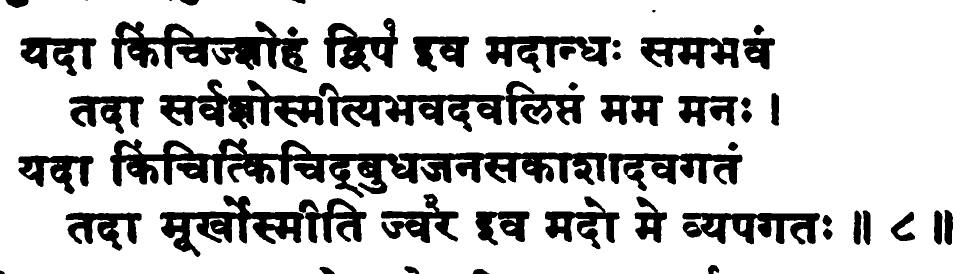
तदा मूर्खोस्मीति ज्वर इव मदो मे व्यपगतः ॥ ८ ॥
Translation
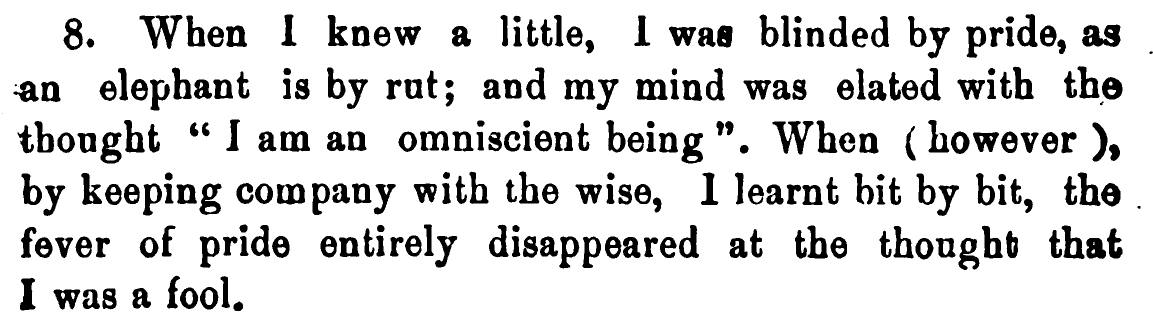
8. When I knew a little, I was blinded by pride, as an elephant is by rut; and my mind was elated with the thought " I am an omniscient being ". When ( however ), by keeping company with the wise, I learnt bit by bit, the fever of pride entirely disappeared at the thought that I was a fool.
Notes
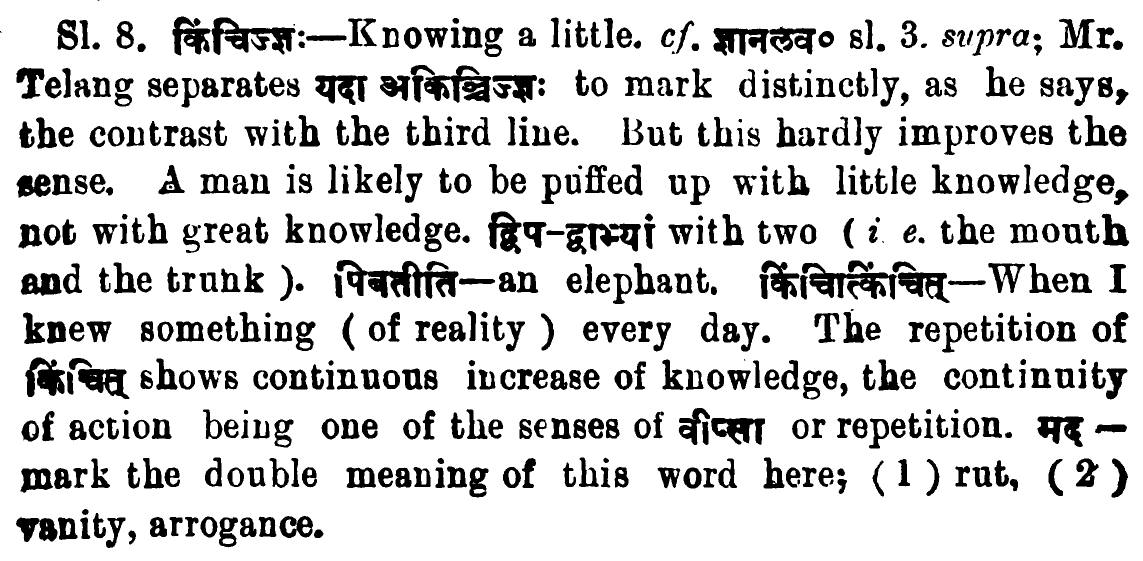
Sl. 8. किंचिज्ज्ञः—Knowing a little. cf. ज्ञानलव० sl. 3. supra; Mr. Telang separates यदा अकिञ्चिज्ज्ञः to mark distinctly, as he says, the contrast with the third line. But this hardly improves the sense. A man is likely to be puffed up with little knowledge, not with great knowledge. द्विप–द्वाभ्यां with two ( i. e. the mouth and the trunk ). पिवतीति—an elephant. किंचित्किंचित्—When I knew something ( of reality ) every day. The repetition of किंचित् shows continuous increase of knowledge, the continuity of action being one of the senses of वीप्सा or repetition. मद — mark the double meaning of this word here; ( 1 ) rut, ( 2 ) vanity, arrogance.

Gopinath1914
all
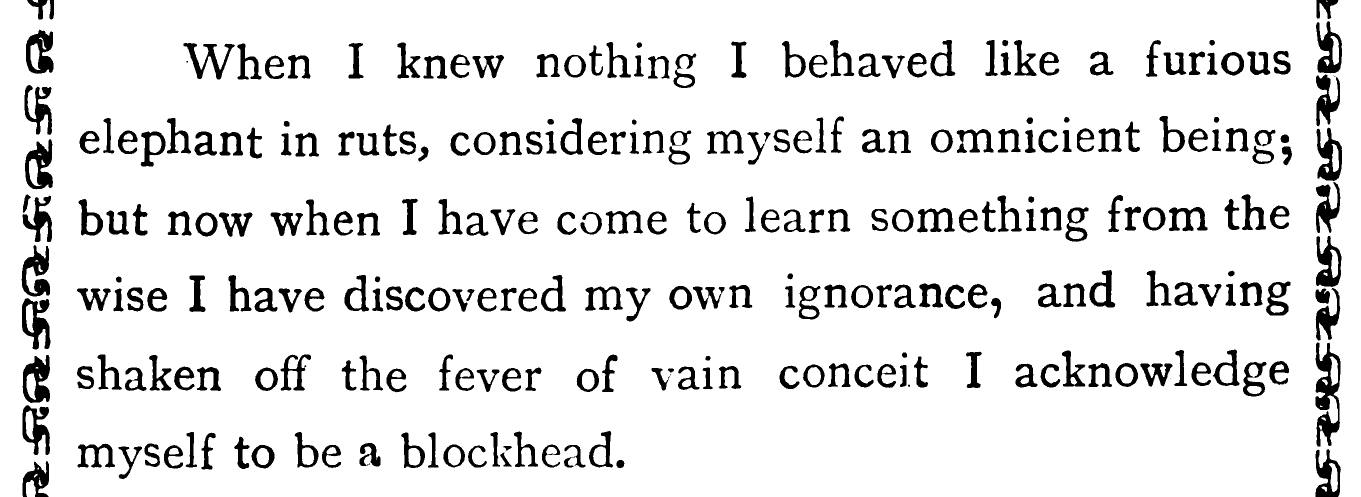
यदाऽकिञ्चिज्ज्ञोऽहं द्विप इव मदान्धः समभवं
तदा सर्वज्ञोऽस्मीत्यभवदवलिप्तं मम मनः ।
यदा किञ्चित्किञ्चिदुधजनसकाशादवगतं
तदा मूर्खोऽस्मीति ज्वर इव मदो मे व्यपगतः ८ ॥
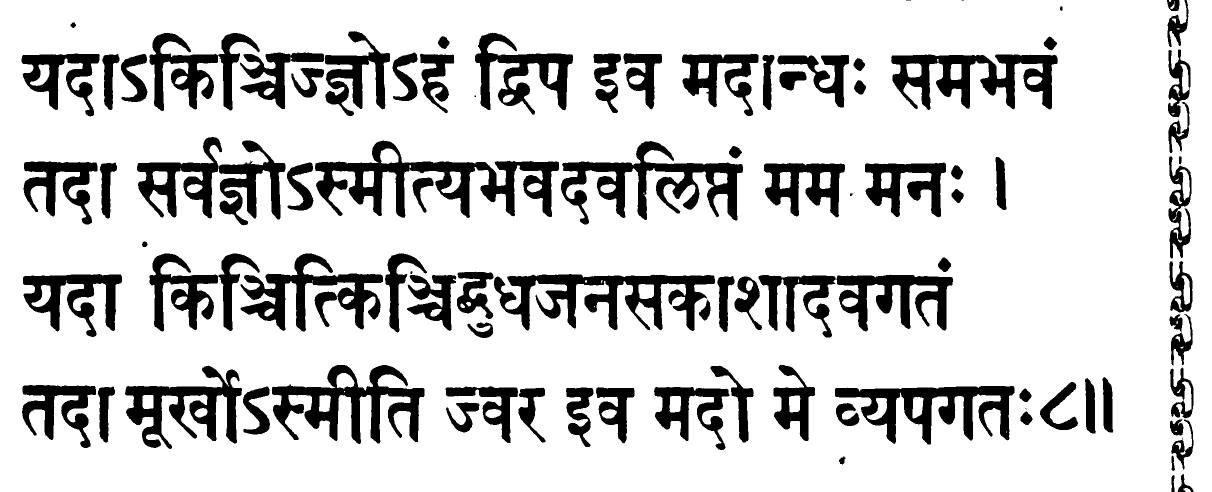
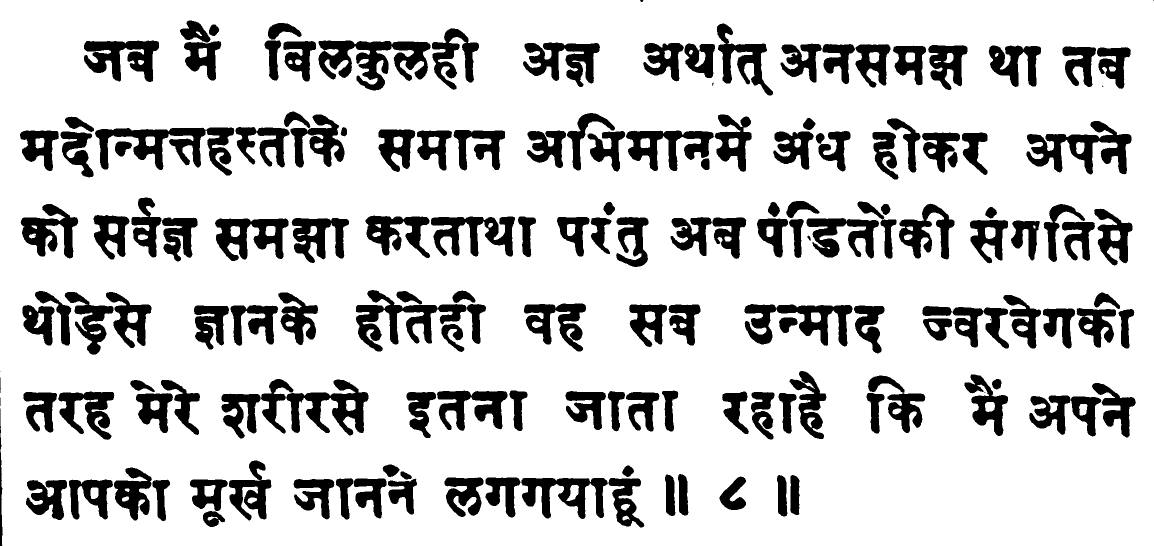
जब मैं बिलकुलही अज्ञ अर्थात् अनसमझ था तब मदोन्मत्त हस्ती के समान अभिमानमें अंध होकर अपने को सर्वज्ञ समझा करताथा परंतु अब पंडितोंकी संगतिसे थोडेसे ज्ञानके होतेही वह सब उन्माद ज्वरवेगकी तरह मेरे शरीरसे इतना जाता रहाहै कि मैं अपने आपको मूर्ख जानने लगगयाहूं ॥ ८ ॥
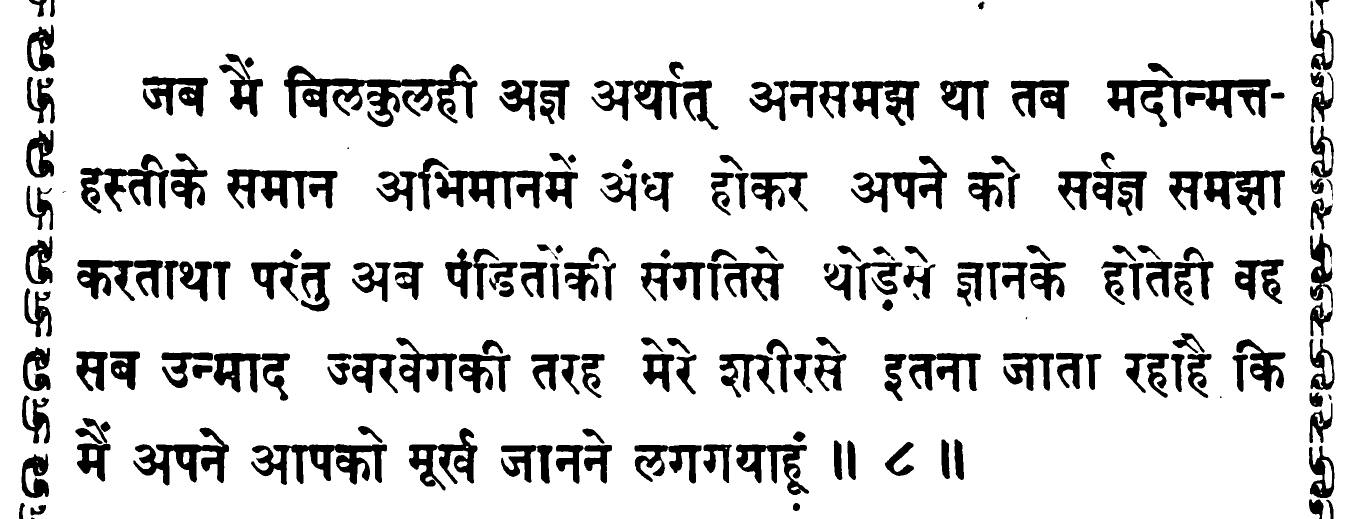
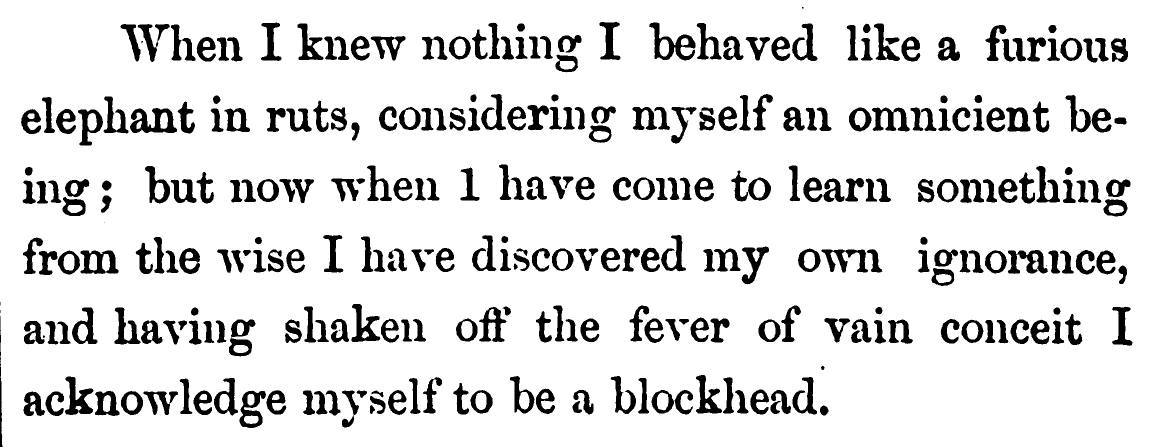
When I knew nothing I behaved like a furious elephant in ruts, considering myself an omnicient being; but now when I have come to learn something from the wise I have discovered my own ignorance, and having shaken off the fever of vain conceit I acknowledge myself to be a blockhead.
Footnote
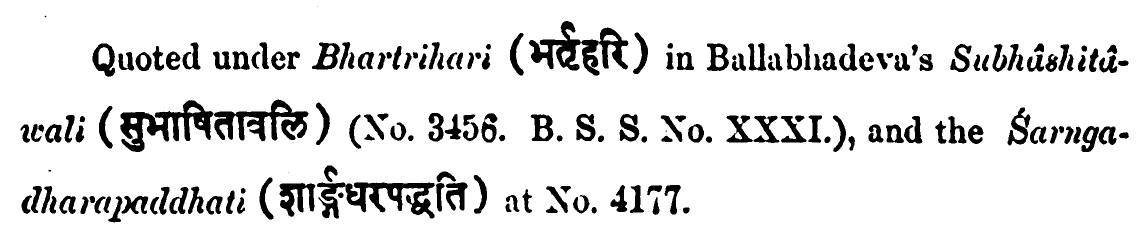
Quoted under Bhartrihari (1) No. in Ballabhadeva's Subhashitawali (सुभाषितावलि) (No. 3456. B. S. S. XXXI.), and the Sarngadharapaddhati ( शार्ङ्गधरपद्धति) at No. 4177.


Gopinath1896
all
यदाऽकिञ्चिज्ज्ञोऽहं द्विप इव मदान्धः समभवं
तदा सर्वज्ञोऽस्मीत्यभवदवलिप्तं मम मनः ।
यदा किञ्चित्किञ्चिदुधजनसकाशादवगतं
तदा मूर्खोऽस्मीति ज्वर इव मदो मे व्यपगतः ८ ॥
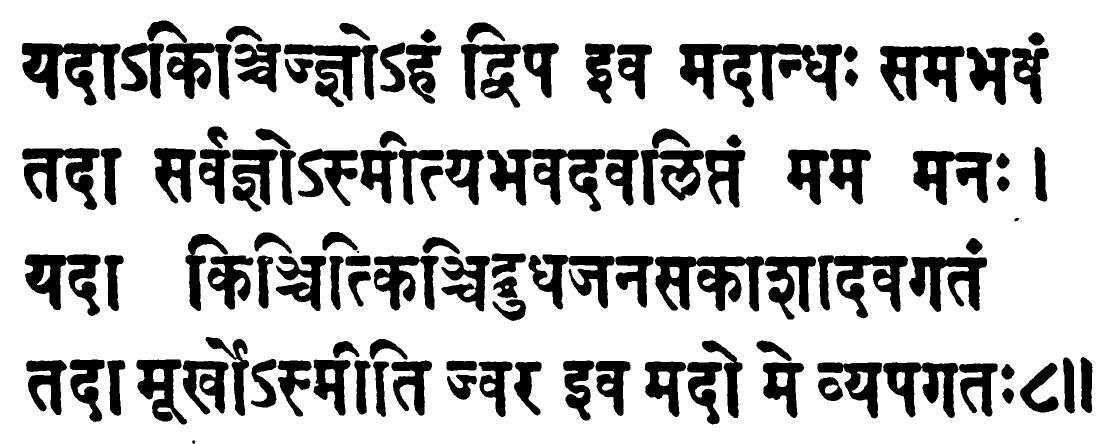
जब मैं बिलकुलही अज्ञ अर्थात् अनसमझ था तब मदोन्मत्तहस्तीके समान अभिमानमें अंध होकर अपने को सर्वज्ञ समझा करताथा परंतु अब पंडितोंकी संगतिसे थोड़ेसे ज्ञानके होतेही वह सब उन्माद ज्वरवेगकी तरह मेरे शरीर से इतना जाता रहा है कि मैं अपने आपको मूर्ख जानने लगगयाहूं ॥ ८ ॥
When I knew nothing I behaved like a furious elephant in ruts, considering myself an omnicient being; but now when 1 have come to learn something from the wise I have discovered my own ignorance, and having shaken off the fever of vain conceit I acknowledge myself to be a blockhead.
Footnote
Quoted under Bhartrihari ( भर्तृहरि) in Ballabhadeva's Subhashitdreali ( सुभाषितावलि) ( No. 3456. B. S. S. No. XXXI.), and the Sarngadharapaddhati (शार्ङ्गधरपद्धति) at No. 4177.

Kosambi
all
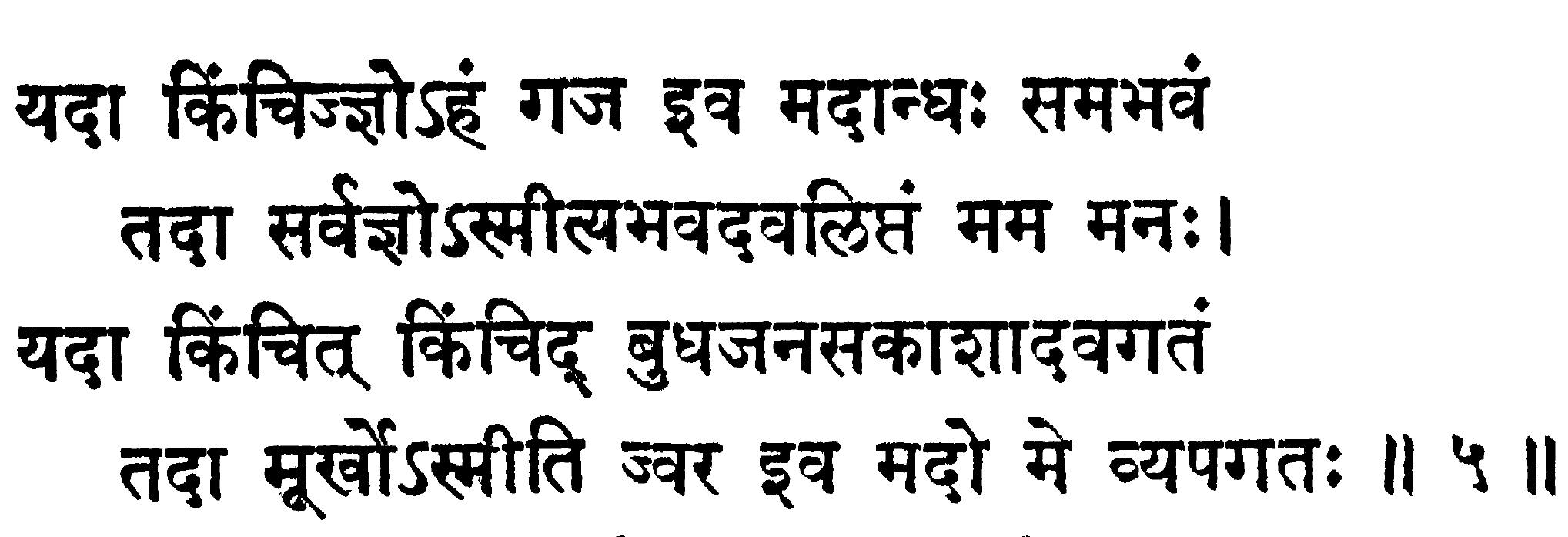
यदा किंचिज्ज्ञोऽहं गज इव मदान्धः समभवं
तदा सर्वज्ञोऽस्मीत्यभववलिप्तं मम मनः ।
यदा किंचित् किंचिद् बुधजनसकाशादवगतं
तदा मूर्खोऽस्मीति ज्वर इव मदो मे व्यपगतः ॥ ५ ५ ॥ ॥
Footnote
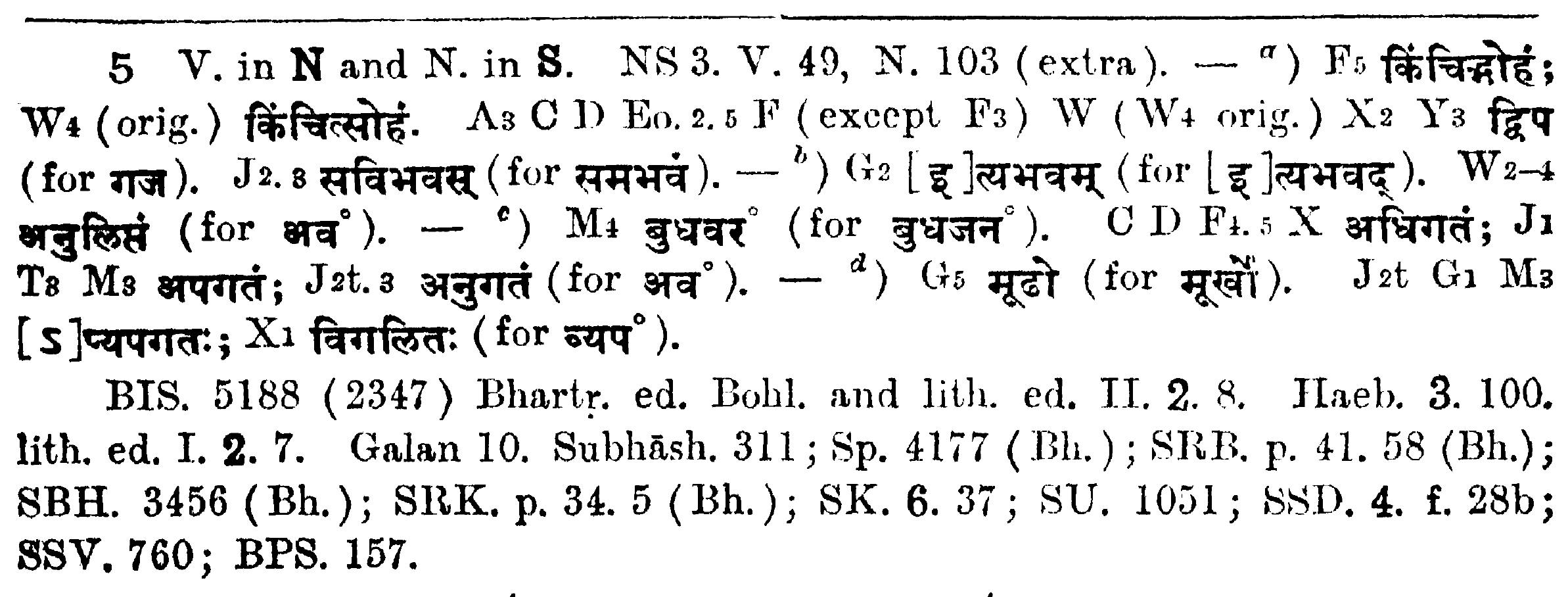
5 V. in N and N. in S. NS 3. V. 49 , N. 103 ( extra ) . a ) Fs किंचिद्रोहं ;
W4 ( orig . ) किंचित्सोहं . A3 C D Eo . 2. 5 IF ( except F 3 ) W ( W + orig . ) X 2 Y3 द्विप
( for गज ) . J2.8 सविभवस् ( for समभवं ) . – 4 ) ( G2 [ इ ] त्यभवम् ( for [ इ ] त्यभवद् ) . W2 +
अनुलिप्तं ( for भव ) . c ) M + बुधवर ( for बुधजन C ) . CDF 1.5 X अधिगतं ; J1
T8 M3 अपगतं ; J2t . 3 अनुगतं ( for अव ) . a ) ( G5 मूढो ( for मूर्खों ) . J2t G1 M3
[ s प्यपगतः ] ; X 1 विगलितः ( for व्यप ) .
BIS . 5188 ( 2347 ) Bhartr ed . Bohl . and lith ed . II . 2. 8. IIaeb . 3. 100 .
lith ed . I. 2.7 . Galan 10. Subhāsh 311 ; Sp . 4177 ( Bb ) ; SRE . p . 41.58 ( Bh . ) ;
SBH . 3456 ( Bh . ) ; SRK . p . 34. 5 ( Bh . ) ; SK . 6. 37 ; SU . 1051 ; SSD . 4. f . 28b ;
SSV . 760 ; BPS . 157 .
Commentary