Telang
all
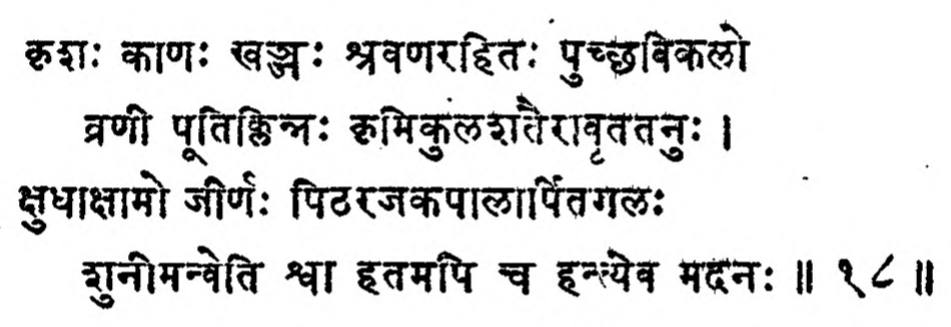
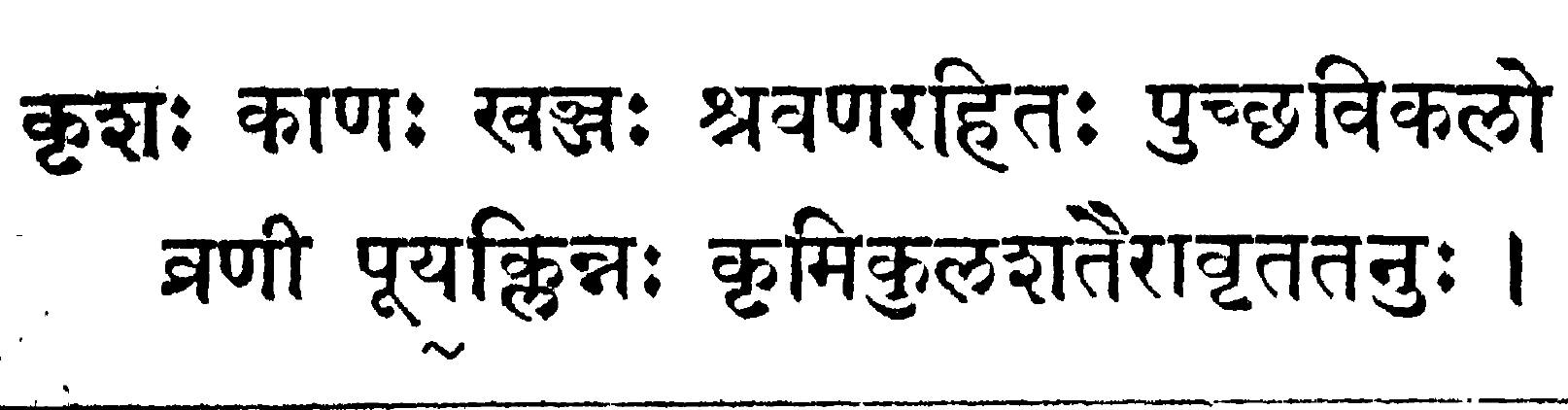
कृशः काणः खञ्जः श्रवणरहितः पुच्छविकलो
व्रणी पूतिक्लिन्नः कृमिकुलशतैरावृततनुः ।
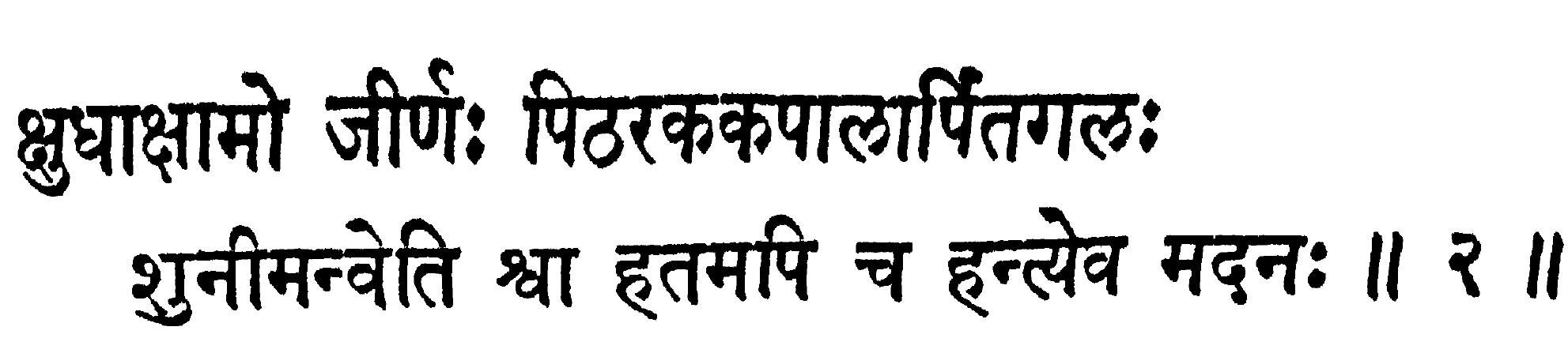
क्षुधाक्षामो जीर्णः पिठरजकपालार्पितगलः
शुनीमन्वेति श्वा हतमपि च हन्त्येव मदनः ॥ १८ ॥
Notes
St. XVIII.—पिठरजकपाल = a fragment produced from (i. e. of) a jar. Râmarshi says कपालं अर्पितं गले यस्य which is unauthorised. The usual method gives quite good enough sense—“whose neck is tied to a fragment of a pot.”—S'ikhariṇî.

Kale
all
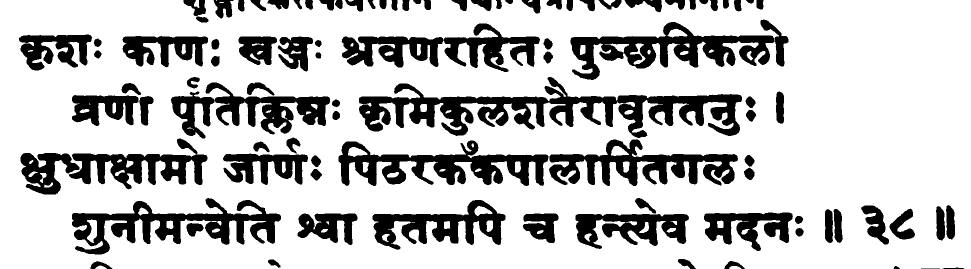
कृशः काणः खञ्जः श्रवणरहितः पुच्छविकलो
व्रणी पूतिक्लिन्नः कृमिकुलशतैरावृततनुः ।
क्षुधाक्षामो जीर्णः पिठरककपालार्पितगलः
शुनीमन्वेति श्वा हतमपि च हन्त्येव मदनः ॥ ३८ ॥
Translation
38. A dog, lean, blind of an eye, lame, crop-eared and tail-less (through disease), suffering from abscesses, clammed with pus, and with his body covered with hundreds of worms, exhausted through starvation, decayed with age, and having the brim of an earthen jar placed round its neck, follows a bitch. Madana scruples not to smite even one that has already been smitten.

Gopinath1914
all
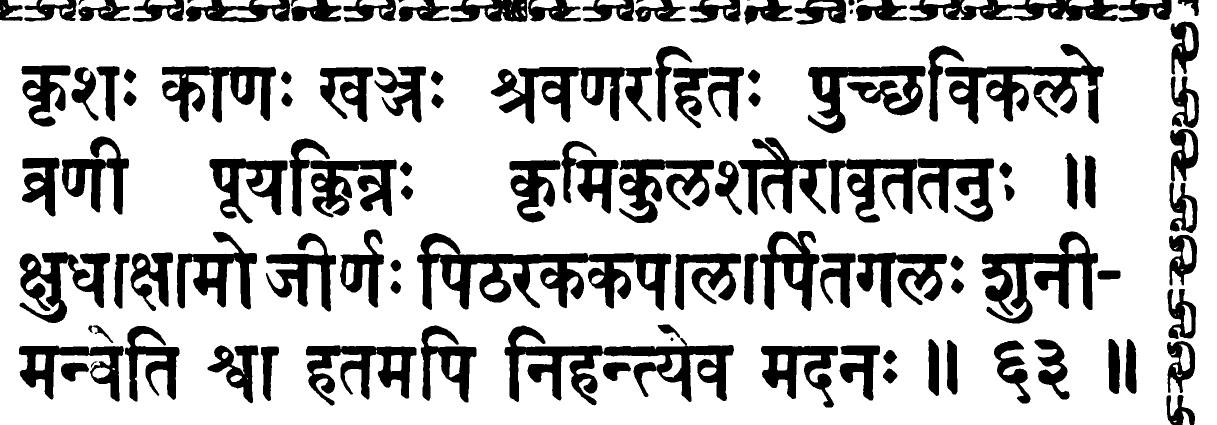
कृशः काणः खञ्जः श्रवणरहितः पुच्छविकलो
व्रणी पूयक्किन्नः कृमिकुलशतैरावृततनुः ॥
क्षुधाक्षामोजीर्णः पिठरककपालार्पितगलः शुनी-
मन्वेति वा हतमपि निहन्त्येव मदनः ॥ ६३ ॥ 5
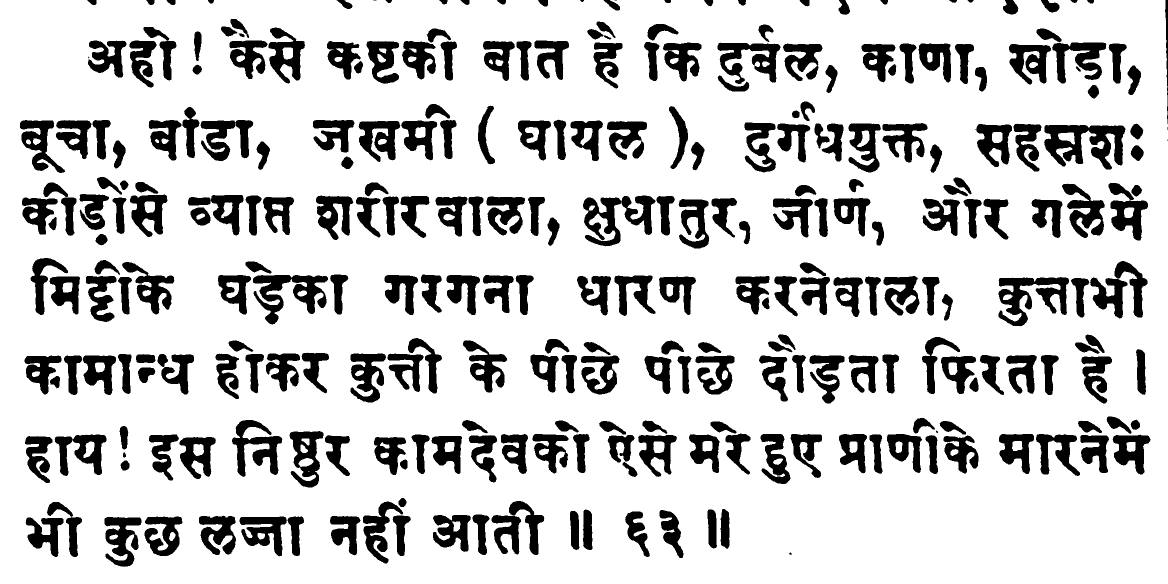
अहो ! कैसे कष्टकी बात है कि दुर्बल, काणा, खोड़ा, बूचा, बांडा, जुखमी ( घायल ), दुर्गंधयुक्त, सहस्रशः कीड़ोंसे व्याप्त शरीखाला, क्षुधातुर, जीर्ण ओर गले में मिट्टी के घड़ेका गरगना धारण करनेवाला कुत्ता भी कामान्य होकर कुतीके पीछे पीछे दोड़ता फिरता है । हाय ! इस निठुर कामदेवको ऐसे मरे हुए प्राणी के मारने में भी कुछ लंजा नहीं आती ॥ ६३ ॥
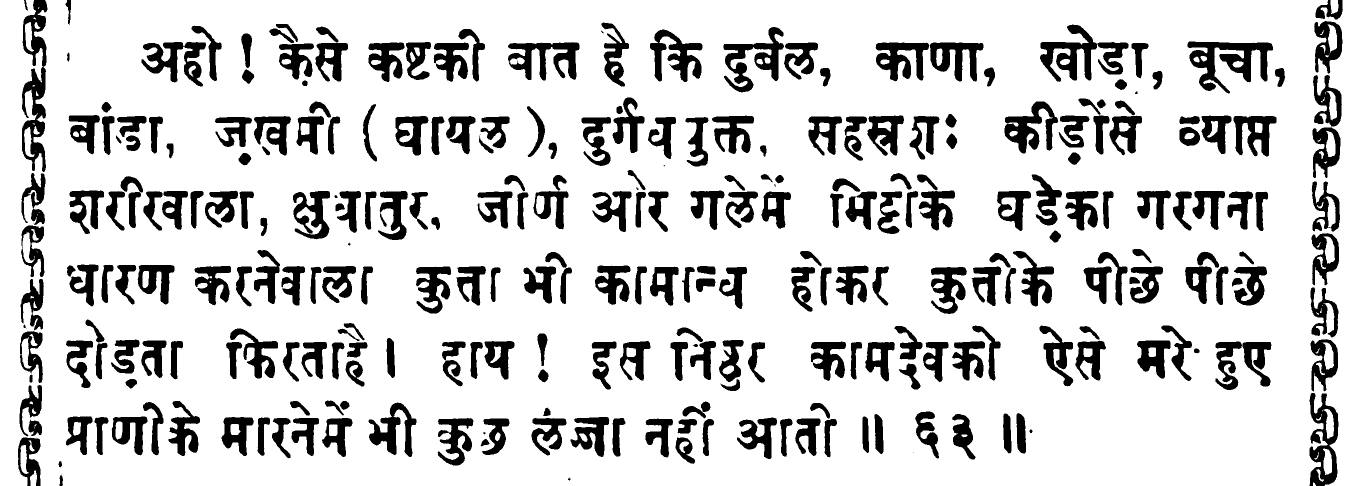
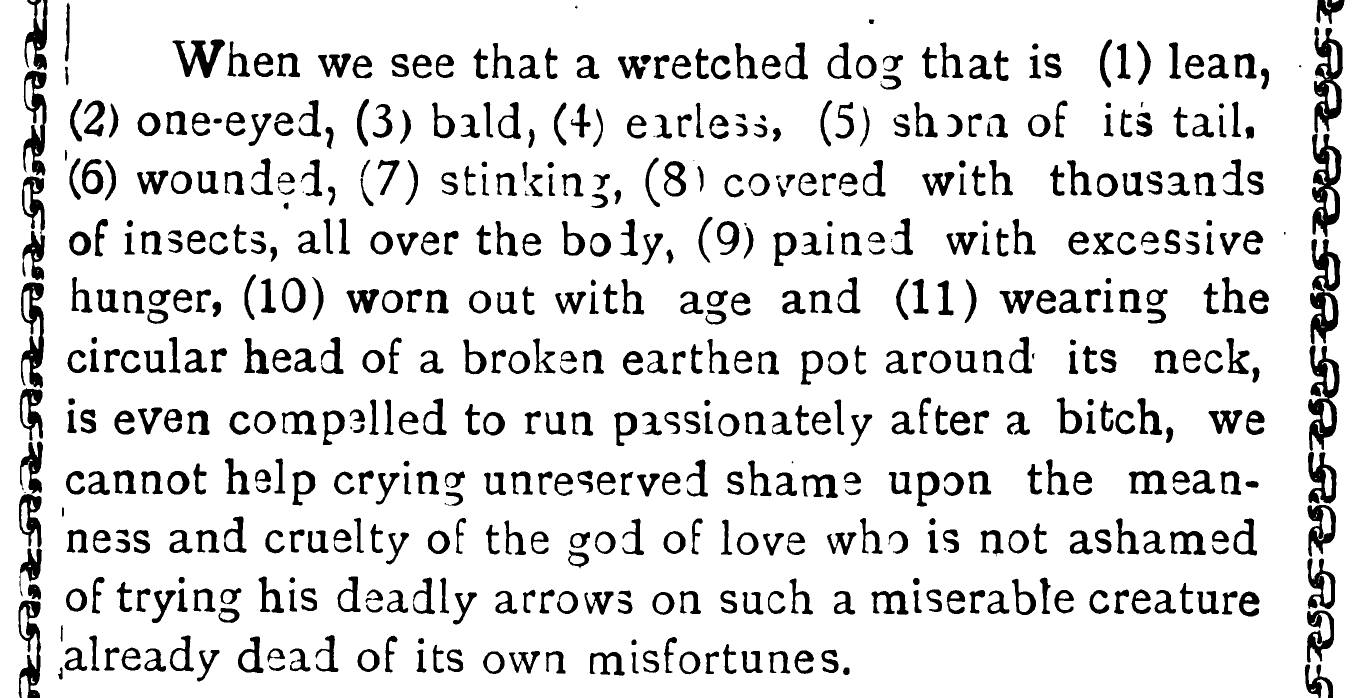
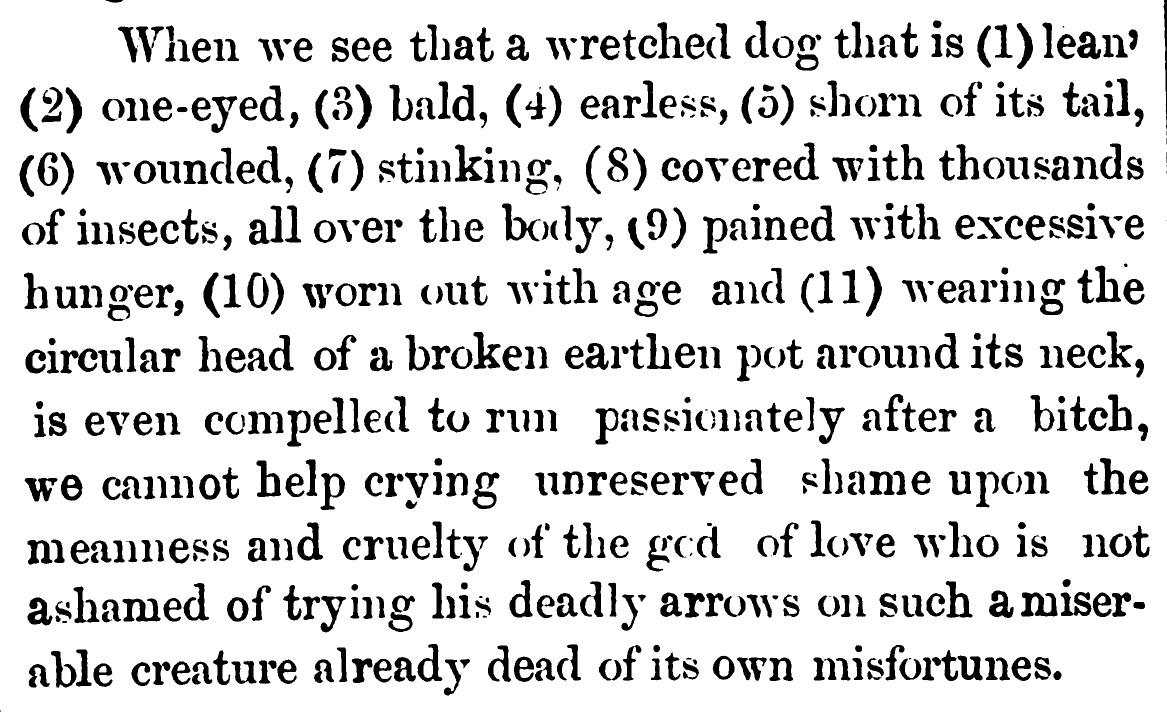
When we see that a wretched dog that is (1) lean, (2) one-eyed, (3) bald, ( 4 ) earless, ( 5 ) shora of its tail, (6) wounded, (7) stinking, (8) covered with thousands of insects, all over the boly, ( 9 ) pained with excessive hunger, (10) worn out with age and ( 11 ) wearing the circular head of a broken earthen pot around its neck, is even compelled to run passionately after a bitch, we cannot help crying unreserved shame upon the meanness and cruelty of the god of love who is not ashamed of trying his deadly arrows on such a miserable creature already dead of its own misfortunes.
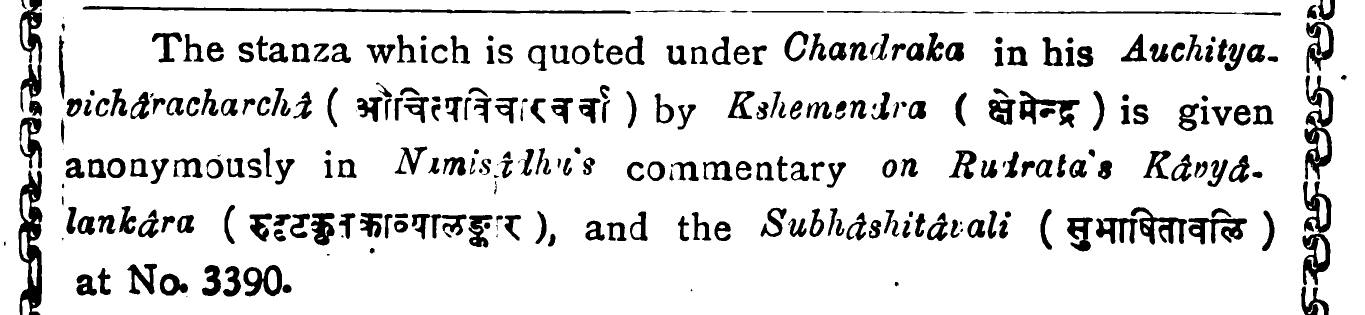
Gopinath1896
all
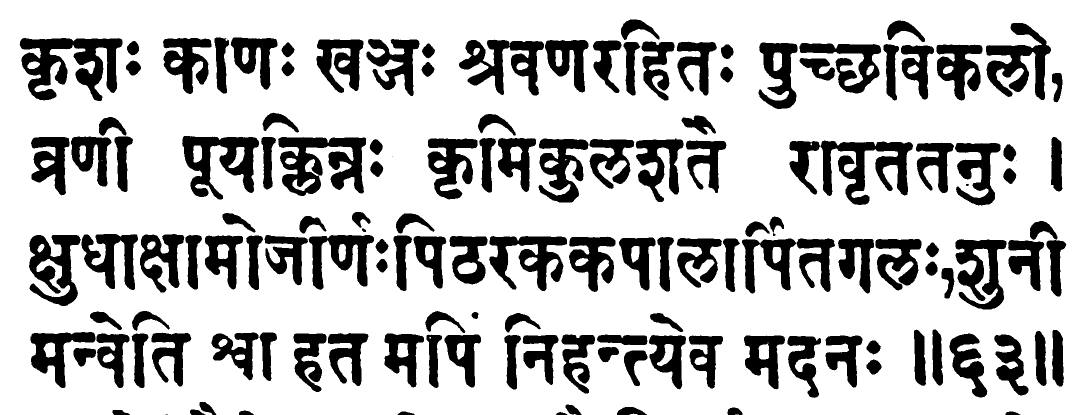
कृशः काणः खञ्जः श्रवणरहितः पुच्छविकलो,
व्रणी पूयक्किन्नः कृमिकुलशतै रावृततनुः ।
क्षुधाक्षामोजीर्णः पिठरककपालार्पितगलः, शुनी
मन्वेति श्वा हत मपिं निहन्त्येव मदनः ॥६३ ॥
अहो ! कैसे कष्टकी बात है कि दुर्बल, काणा, खोड़ा, बूचा, बांडा, जखमी ( घायल ), दुर्गंधयुक्त, सहस्रशः कीड़ोंसे व्याप्त शरीर वाला, क्षुधातुर, जीर्ण, और गले में मिट्टी के घड़ेका गरगना धारण करनेवाला, कुत्ताभी कामान्ध होकर कुत्ती के पीछे पीछे दौड़ता फिरता है । हाय ! इस निष्ठुर कामदेवको ऐसे मरे हुए प्राणीके मारने में भी कुछ लज्जा नहीं आती ॥ ६३ ॥
When we see that a wretched dog that is (1) lean' (2) one-eyed, (3) bald, (4) earless, (5) shorn of its tail, (6) wounded, (7) stinking, (8) covered with thousands of insects, all over the body, (9) pained with excessive hunger, (10) worn out with age and ( 11 ) wearing the circular head of a broken earthen pot around its neck, is even compelled to run passionately after a bitch, we cannot help crying unreserved shame upon the meanness and cruelty of the god of love who is not ashamed of trying his deadly arrows on such a miserable creature already dead of its own misfortunes.
Kosambi
all
Footnote
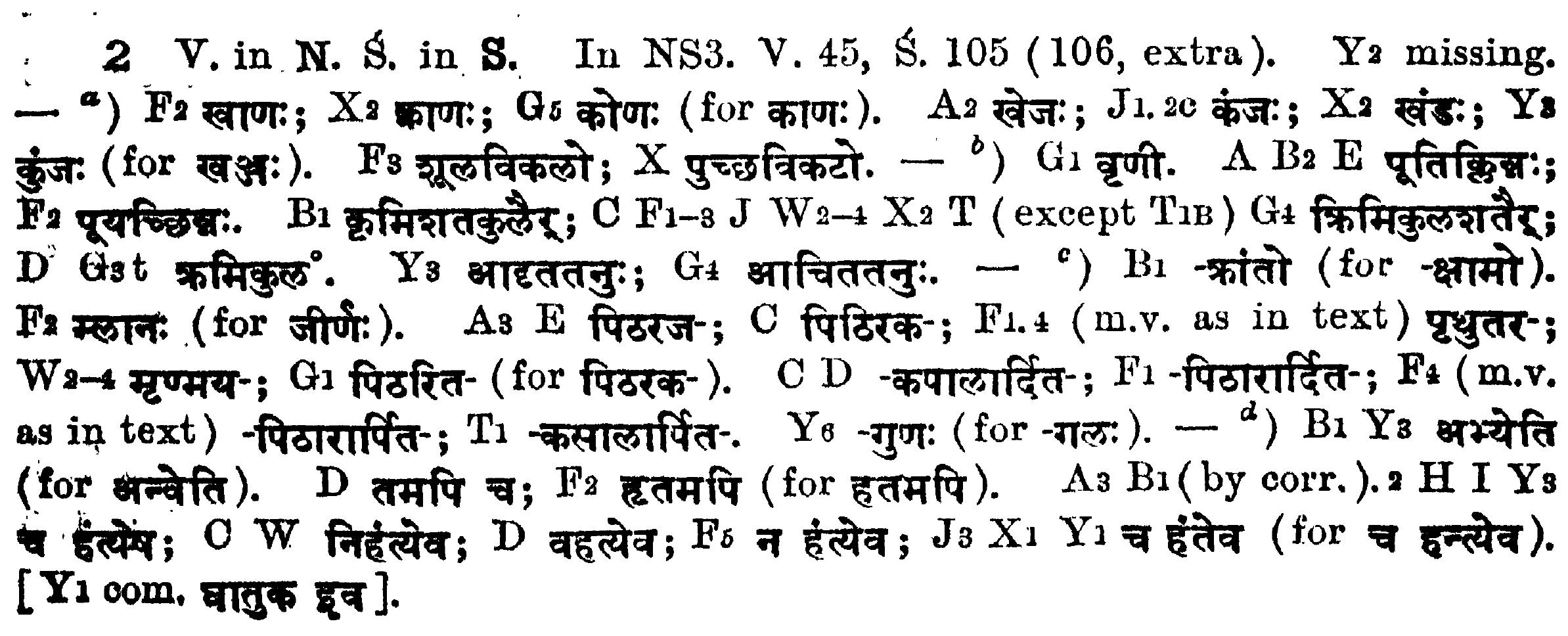
2 V. in N. Ś . in S. In NS3 . V. 45 , S. 105 ( 106 , extra ) . Ya missing .
" ) F₂ खाणः ; X8 काण : ; Gs कोण : ( for काण : ) . A2 खेज : ; J1.20 कंज : ; X 2 खंड :; Ys
कुंज : ( for खलः ) . F3 शूलविकलो ; X पुच्छविकटो . - ) 6 G1 वृणी . AB2 E पूतिक्लिङ्गः ;
F2 पूयच्छित : B1 कृमिशतकुलैर् ; C F1-3 J W2−4 X2 T ( except T1B ) G + क्रिमिकुलशतैर् ;
D Gst क्रमिकुल . Y3 आदृततनुः ; G4 आचिततनुः c ) B1 ( for क्षामो ) .
Fa म्लान : ( for जीर्ण :) . A3 E पिठरज- ; C पिठिरक- ; F14 ( m.v as in text ) पृथुतर- ;
W2 - मृण्मय- ; G1 पिठरित - ( for पिठरक ) . C D -कपालार्दित ; F1 -पिठारार्दित- ; F ( m.v.
as in text ) पिठारार्पित- ; T1 -कसालार्पित . Yo - गुण : ( for -गलः ) . 2 ) B1 Y3 अभ्येति
( for अन्वेति ) . D तमपि च ; F3 हृतमपि ( for हतमपि ) . A3 B1 ( by corr . ) 2 H I Ys
व इत्येष ; 0 W निर्हत्येव ; D वहत्येव ; F6 न हंत्येव ; J3 X1 Y1 च हंतेव ( for च हन्त्येव ) .
[ Y1oom , धातुक इव ] .

Commentary