Tawney
Siva's a guiding lamp, that burns in hermits' hearts.
Dispels delusion's gloom and light and heat imparts,
He shrivelled like a moth the frivolous god of Love,
His flame's the moon's white streak that gleams his crest above.
Mādhavānanda
चूडोत्तंसितचन्द्र्रचारुकलिकाचञ्चच्छिखाभास्वरो
लीलादग्धविलोलकामशलभ: श्रेयोदशाग्रे स्फुरन् ।
अन्त:स्फूर्जदपारमोहतिमिरप्राग्भारमुच्चाटयन्-
श्चेत:सद्मनि योगिनां विजयते ज्ञानप्रदीपो हर: ।।१।।
1. All glory to Śiva, the Light of Knowledge, residing in the temple of the yogīs’ heart, who smites away (like the rising sun) the massive front of the endless night of ignorance overcasting human minds, in whose wake follow all auspiciousness and prosperity, who burnt up gay lust as a moth, as if in sport, and who appears beaming with the lambent rays of the crescent adorning his forehead—rays that look pleasing like soft half-blooming buds!
[चूडोत्तंसित—made an ornament for the head. चारुकलिकाचञ्चच्छिखा—lambent beams like beautiful half-blooming buds. लीलादग्ध—burnt up at ease or in sport. श्रेयोदशाग्रे—in front of all circumstances of prosperity. स्फुरन्—appearing. अन्त:स्फूर्जत्—spreading forth in the heart. प्राग्भारं—heavy mass at the front.
As is customary with Sanskrit poets, this opening verse is dedicatory (to Śiva in this instance), as forming an auspicious introduction.]
Telang
all
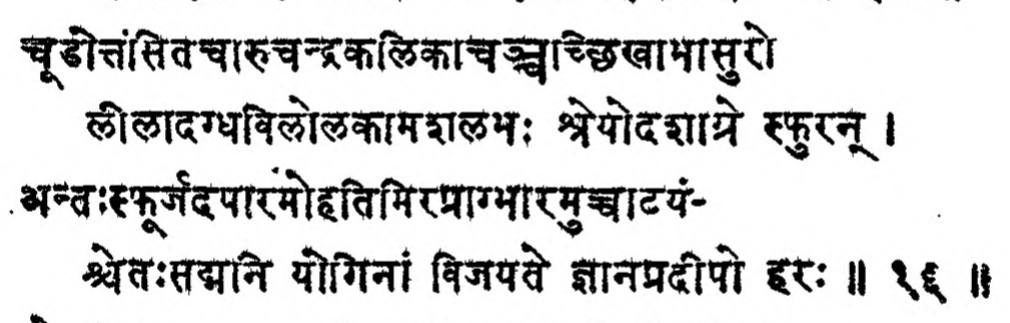
चूडोत्तंसितचारुचन्द्रकलिकाचञ्चच्छिखाभासुरो
लीलादग्धविलोलकामशलभः श्रेयोदशाग्रे स्फुरन् ।
अन्तःस्फूर्जदपारमोहतिमिरप्राग्भारमुच्चाटयं-
श्चेतःसद्मनि योगिनां विजयते ज्ञानप्रदीपो हरः ॥ १६ ॥
Notes
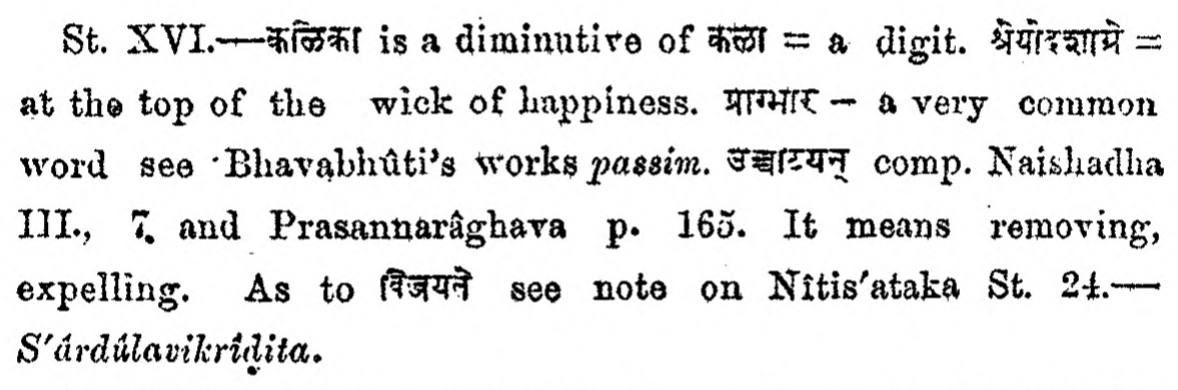
St. XVI.—कलिका is a diminutive of कला = a digit. श्रेयोदशाग्रे = at the top of the wick of happiness. प्राग्भार — a very common word see Bhavabhûti's works passim. उच्चाटयन् comp. Naishadha III., 7. and Prasannarâghava p. 165. It means removing, expelling. As to विजयते see note on Nîtis'ataka St. 24.—S'ârdûlavikrîḍita.

Kale
all
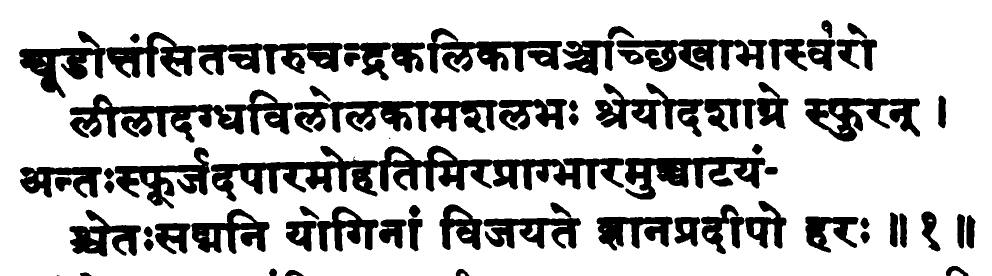
चूडोत्तंसितचारुचन्द्रकलिकाचञ्चच्छिखाभास्वरो
लीलादग्धविलोलकामशलभः श्रेयोदशाग्रे स्फुरन् ।
अन्तःस्फूर्जदपारमोहतिमिरप्राग्भारमुच्चाटयं-
श्चेतःसद्मनि योगिनां विजयते ज्ञानप्रदीपो हरः ॥ १ ॥
Translation
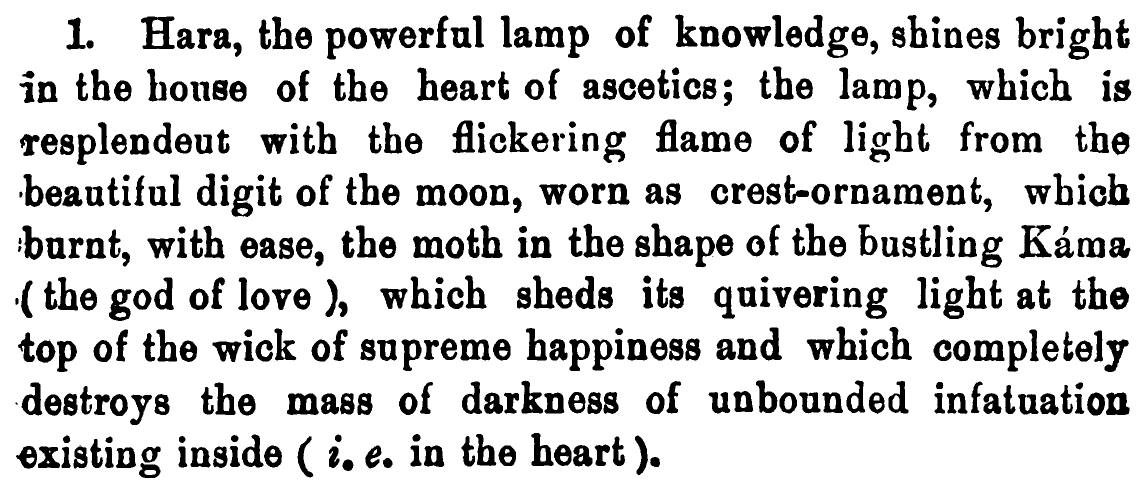
1. Hara, the powerful lamp of knowledge, shines bright in the house of the heart of ascetics; the lamp, which is resplendeut with the flickering flame of light from the beautiful digit of the moon, worn as crest-ornament, which burnt, with ease, the moth in the shape of the bustling Káma ( the god of love ), which sheds its quivering light at the top of the wick of supreme happiness and which completely destroys the mass of darkness of unbounded infatuation existing inside ( i. e. in the heart ).
Notes
Sl. 1. चूडोत्तंसित &c.—In this Sl. Hara is described as a lamp having for its flame the crescent moon, burning the moth of Káma, and dispelling the darkness in the form of मोह. उत्तंसित worn as a head-ornament. चञ्चन्ती-moving, quivering. लीलादग्ध०- see Kum. III. 72. दशा-(1) a wick; (2) the condition of. प्राग्भार- a mass or heap of; (an uncommon word; see Mál. Mád. V. 29.) उच्चाटयन्—removing, entirely dispelling. Cf. Nai. III. 7. विजयते— सर्वोत्कर्षेण वर्तते-shines pre-eminently. Fig. Rûpaka.
Gopinath1914
all
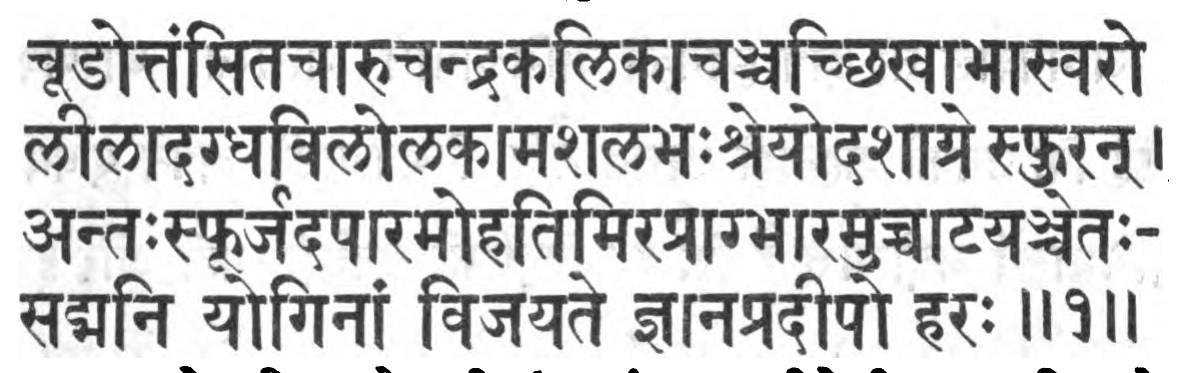
चूडोत्तंसितचारुचन्द्रकलिकाचञ्चच्छिखाभास्वरो
लीलादग्धविलोलक मशलभः श्रेयोदशाये स्फुरन् ।
अन्तःस्फूर्जदपारमोहतिमिरप्राग्भारमुच्चाटयञ्चेतः-
सद्मनि योगिनां विजयते ज्ञानप्रदीपो हरः ॥ १ ॥
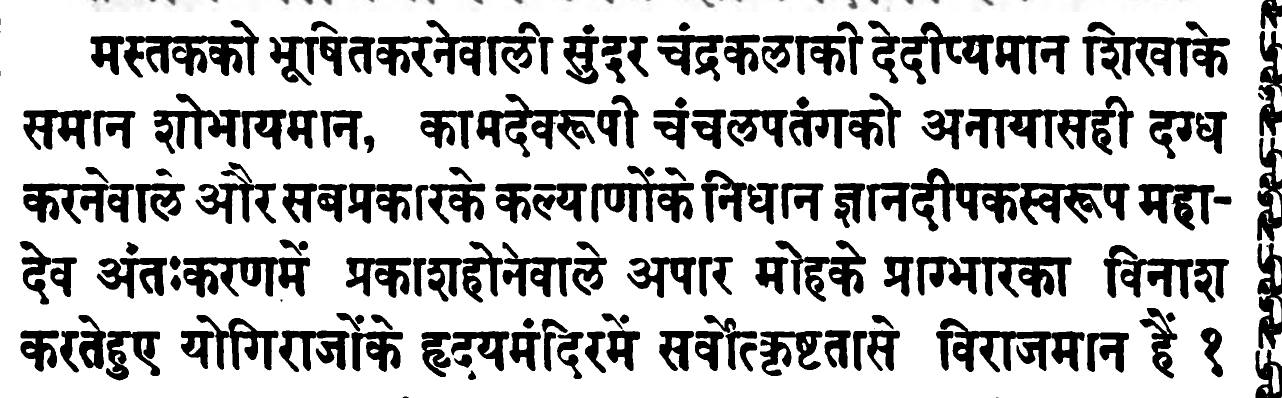
मस्तकको भूषित करनेवाली सुंदर चंद्रकलाकी देदीप्यमान शिखाके समान शोभायमान, कामदेवरूपी चंचलपतंगको अनायासही दग्ध करनेवाले और सब प्रकारके कल्याणोंके निधान ज्ञानदीपकस्वरूप महादेव अंतःकरण में प्रकाशहोनेवाले अपार मोहके प्राग्भारका विनाश करते हुए योगिराजोंके हृदयमंदिरमें सर्वोत्कृष्टता से विराजमान हैं ?
Footnote
Mark the appropriateness of the author's bow to Siva before commencing his Thoughts on Asceticism. It is an established fact beyond controversy that Siva is the father, propagator and master of the Yoga philosophy" .


Gopinath1896
all
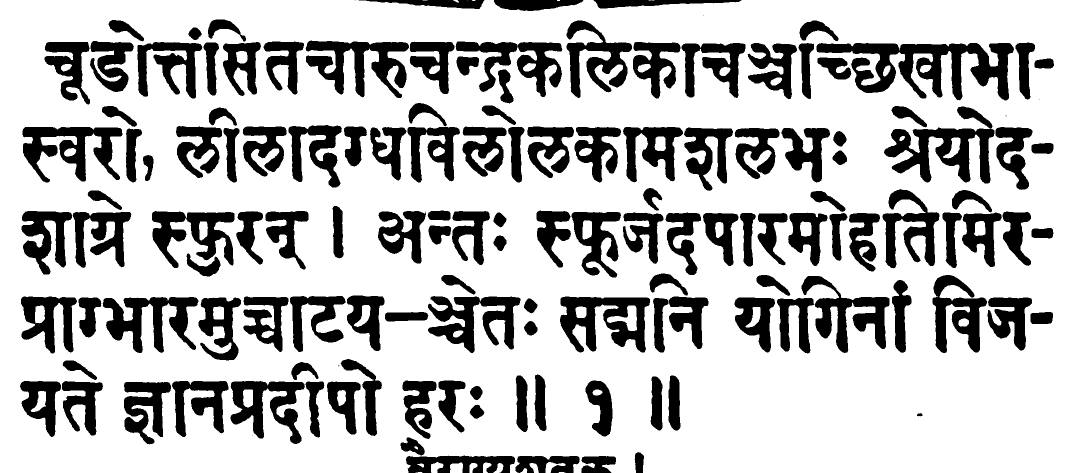
चूडोत्तंसितचारुचन्द्रकलिकाचञ्चच्छिखाभा-
स्वरो, लीलादग्धविलोलकामशलभः श्रेयोद-
शाये स्फुरन् । अन्तः स्फूर्जदपारमोहतिमिर-
प्राग्भारमुच्चाटयश्चेतः सद्मनि योगिनां विज-
यते ज्ञानप्रदीपो हरः ॥ १ ॥
Footnote
Mark the appropriateness of the author's bow to Śiva before commencing his Thoughts on Asceticism. It is an established fact beyond controversy that Siva is the father, propagator and master of the Yogu philosophy.


Kosambi
all
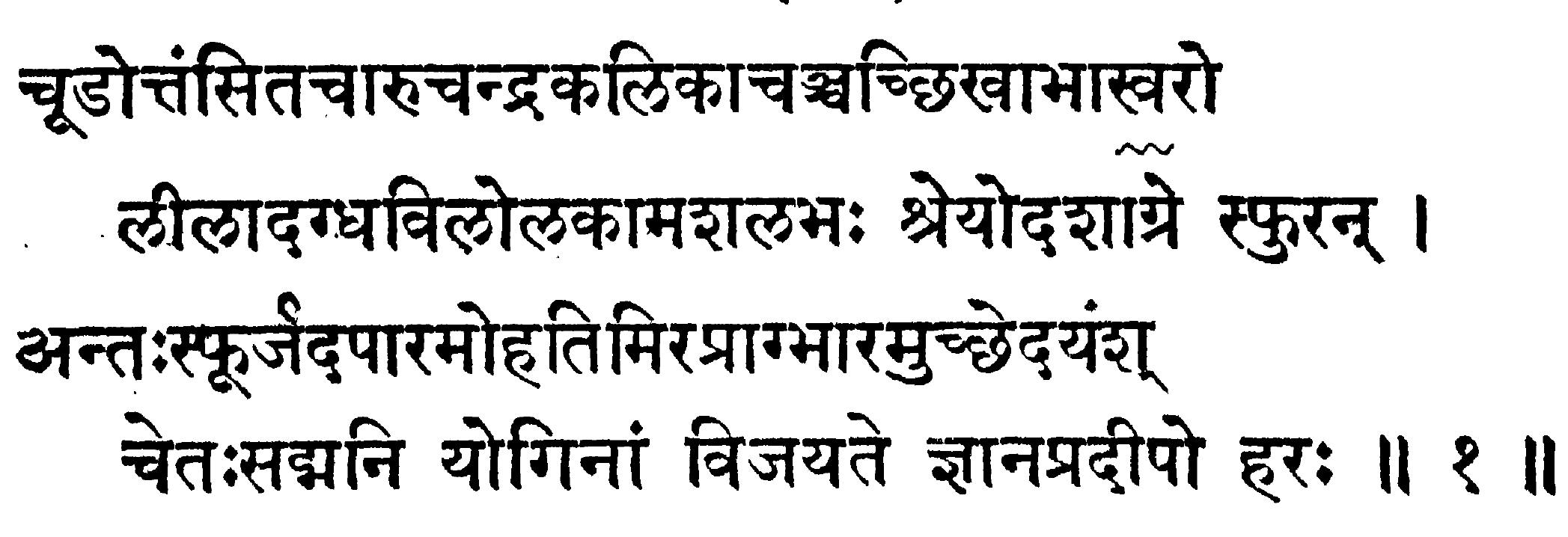
चूडोत्तंसितचारुचन्द्रकलिकाचञ्चच्छिखाभास्वरो
लीलादग्धविलोलकामशलभः श्रेयोदशाग्रे स्फुरन् ।
अन्तःस्फूर्जदपारमोहति मिरप्राग्भारमुच्छेदयंश्
चेतःसद्मनि योगिनां विजयते ज्ञानप्रदीपो हरः ॥ १ ॥
Footnote
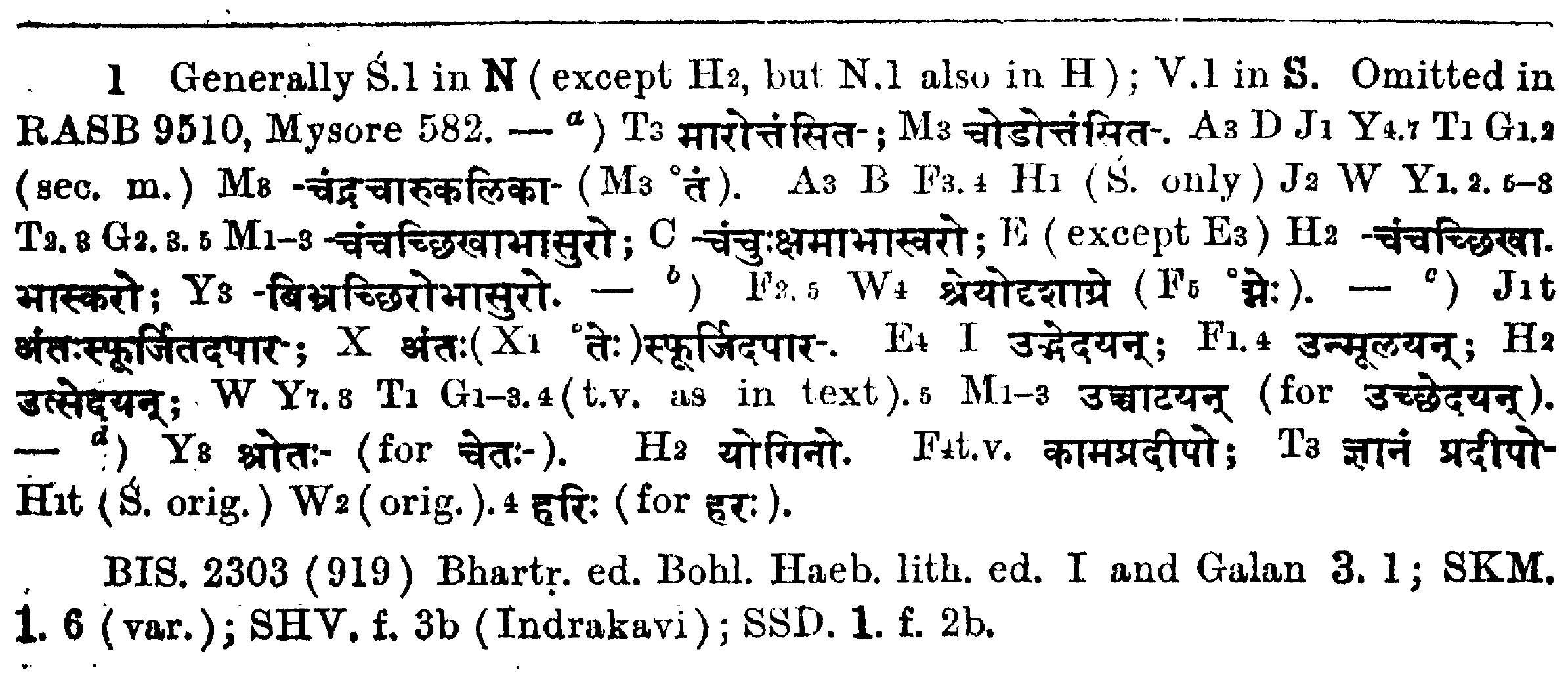
1 Generally Ś.1 in N ( except H2 , but N.1 also in H ) ; V.1 in S. Omitted in
RASB 9510 , Mysore 582. W . ^ a ) T3 मारोत्तंसित - ; M3 चोडोत्तंसित - - A3 D J1 Y4.7T1G1.2
( sec . m . ) Ms चंद्रचारुकलिका ( M 3 ° तं ) . A3 BF 3 4 H1 ( 15 only ) J2 W Y1 . 2.6 – 8
T2 . 8 Q2 . 3. 6 M1–3 -चंचच्छिखाभासुरो ; C चंचुःक्षमाभास्वरो ; F 2 ( except E3 ) H2 -चंचच्छिखा .
भास्करो ; Ys - बिभ्रच्छिरोभासुरो . 6 ) F 2.5 W + श्रेयोहशाग्रे ( 6 ° मे : ) . -- c ) Jit
अंतःस्फूर्जितदपार ; X अंतः ( X 1 ' तेः ) स्फूर्जिदपार E I उद्भेदयन् ; F1.4 उन्मूलयन् ; Ha
उल्सेदयन् ; W_Y7.4 T1G1-4 . 4 ( tv as in text ) 5 6 M1 - 3 उच्चाटयन् ( for उच्छेदयन् ) .
- 4 ) Y & श्रोतः- ( for चेत : - ) . Ha योगिनो . Fst.v. कामप्रदीपो ; T3 ज्ञानं प्रदीपो
Hit ( Ś . orig . ) W2 ( orig . ) . 4 f : ( for gT : ) .
BIS . 2303 ( 919 ) Bhartṛ . ed . Bohl . Haeb . lith . ed . I and Galan 3. 1 ; SKM .
16 ( var . ) ; SEVf 3b ( Indrakavi ) ; SSD . 1. f . 2b
Commentary