Tawney
The Boar's and Râhu's mighty deeds our reverence command;
The one upheld with gleaming tusks the sea-o'erwhelmed land;
The other, sorely maimed in fight, while head and throat remain,
Makes shift to swallow still the foes he must release again.
Telang
all
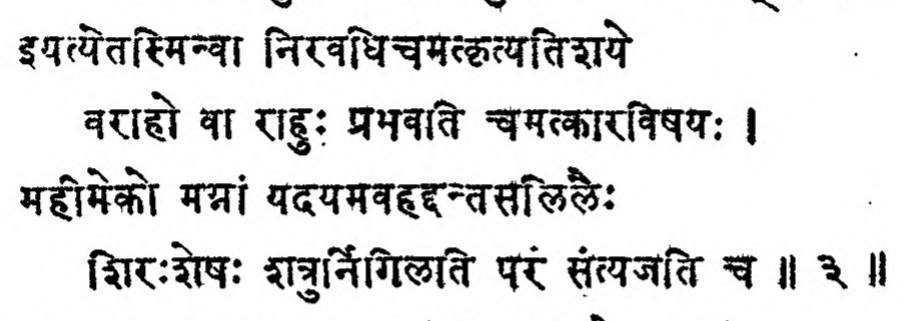
इयत्येतस्मिन्वा निरवधिचमत्कृत्यतिशये
वराहो वा राहुः प्रभवति चमत्कारविषयः ।
महीमेको मग्नां यदयमवहद्दन्तसलिलैः
शिरःशेषः शत्रुर्निगिलति परं संत्यजति च ॥ ३ ॥
Notes
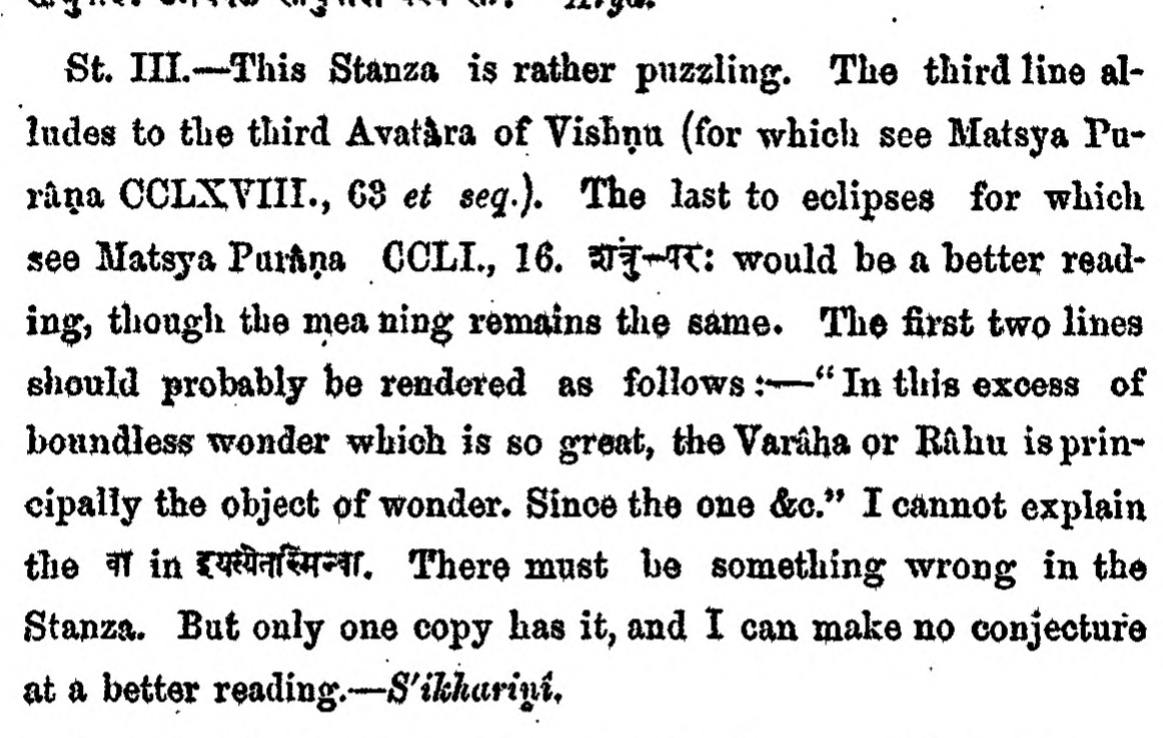
St. III.—This Stanza is rather puzzling. The third line alludes to the third Avatâra of Vishṇu (for which see Matsya Purâṇa CCLXVIII., 63 et seq.). The last to eclipses for which see Matsya Purâṇa CCLI., 16. शत्रुःपरः would be a better reading, though the meaning remains the same. The first two lines should probably be rendered as follows :—“In this excess of boundless wonder which is so great, the Varâha or Râhu is principally the object of wonder. Since the one &c.” I cannot explain the वा in इयत्येतस्मिन्वा. There must be something wrong in the Stanza. But only one copy has it, and I can make no conjecture at a better reading.—S'ikhariṇî.
Kale
all
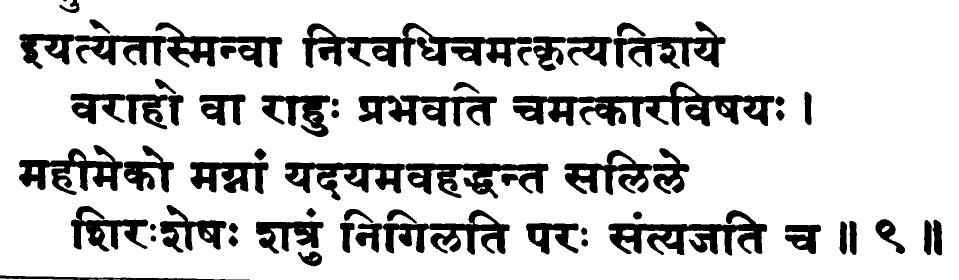
इयत्येतस्मिन्वा निरवधिचमत्कृत्यतिशये
वराहो वा राहुः प्रभवति चमत्कारविषयः ।
महीमेको मग्नां यदयमवहद्दन्त सलिले
शिरःशेषः शत्रुं निगिलति परः संत्यजति च ॥ ९ ॥
Translation
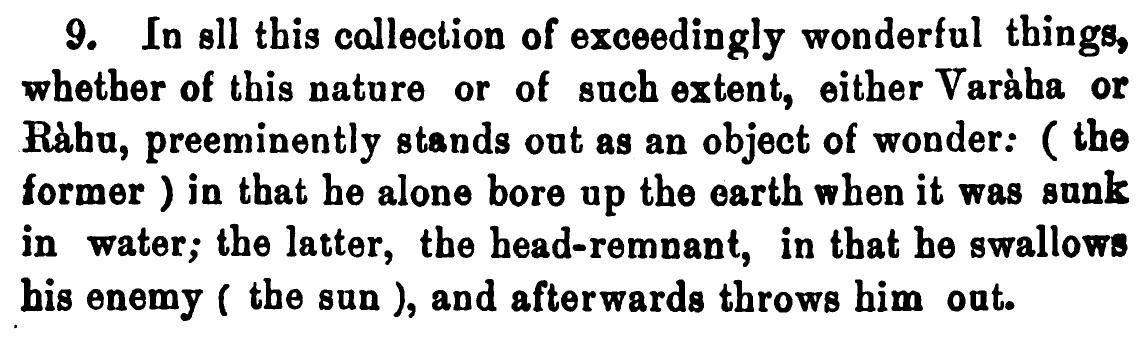
9. In sll this collection of exceedingly wonderful things, whether of this nature or of such extent, either Varàha or Ràhu, preeminently stands out as an object of wonder: ( the former ) in that he alone bore up the earth when it was sunk in water; the latter, the head-remnant, in that he swallows his enemy ( the sun ), and afterwards throws him out.
Notes
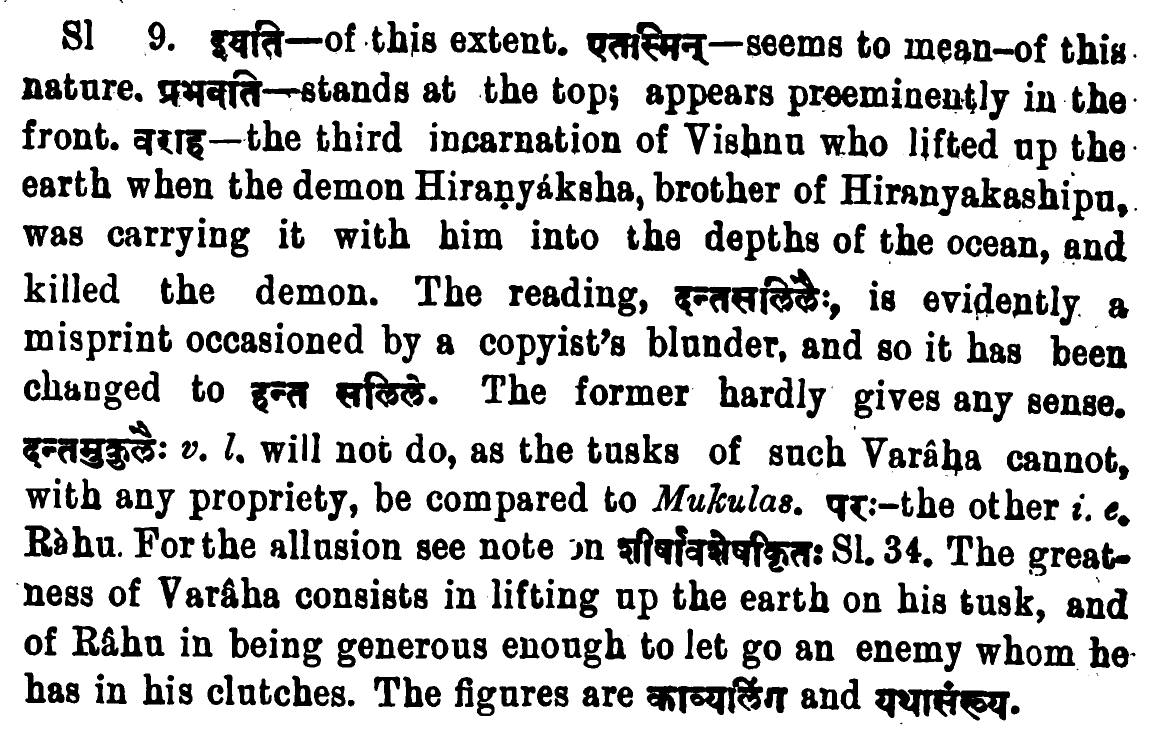
Sl 9. इयति—of this extent. एतस्मिन्—seems to mean–of this nature. प्रभवति—stands at the top; appears preeminently in the front. वराह—the third incarnation of Vishnu who lifted up the earth when the demon Hiraṇyáksha, brother of Hiranyakashipu, was carrying it with him into the depths of the ocean, and killed the demon. The reading, दन्तसलिलैः, is evidently a misprint occasioned by a copyist’s blunder, and so it has been changed to हन्त सलिले. The former hardly gives any sense. दन्तमुकुलैः v. l. will not do, as the tusks of such Varâha cannot, with any propriety, be compared to Mukulas. परः–the other i. e. Ràhu. For the allusion see note on शीर्षावशेषकृतः Sl. 34. The greatness of Varâha consists in lifting up the earth on his tusk, and of Râhu in being generous enough to let go an enemy whom he has in his clutches. The figures are काव्यलिंग and यथासंख्य.
Commentary