Tawney
Better had the mount Mainaka borne the brunt of Indra's ire,
Than thus plunged beneath the ocean severed from his sorrowing sire:
Though he saved unharmed his pinions from the blazing thunder-stone,
Yet he mourns amid the waters for his self-abandoned throne.
Telang
all
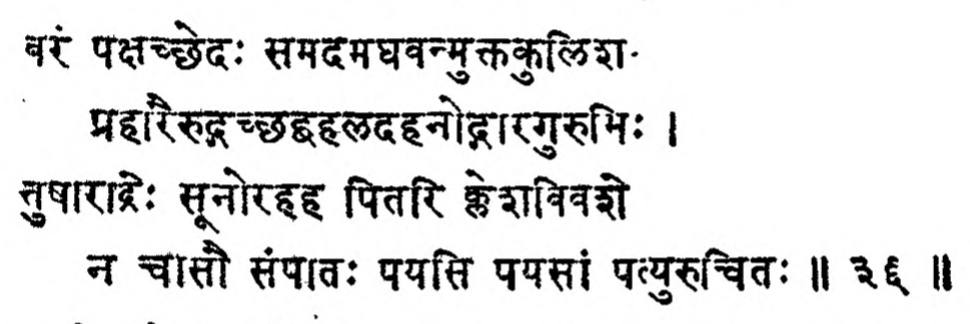
वरं पक्षच्छेदः समदमघवन्मुक्तकुलिश-
प्रहारैरुद्गच्छद्बहलदहनोद्गारगुरुभिः ।
तुषाराद्रेः सूनोरहह पितरि क्लेशविवशे
न चासौ संपातः पयसि पयसां पत्युरुचितः ॥ ३६ ॥
Notes
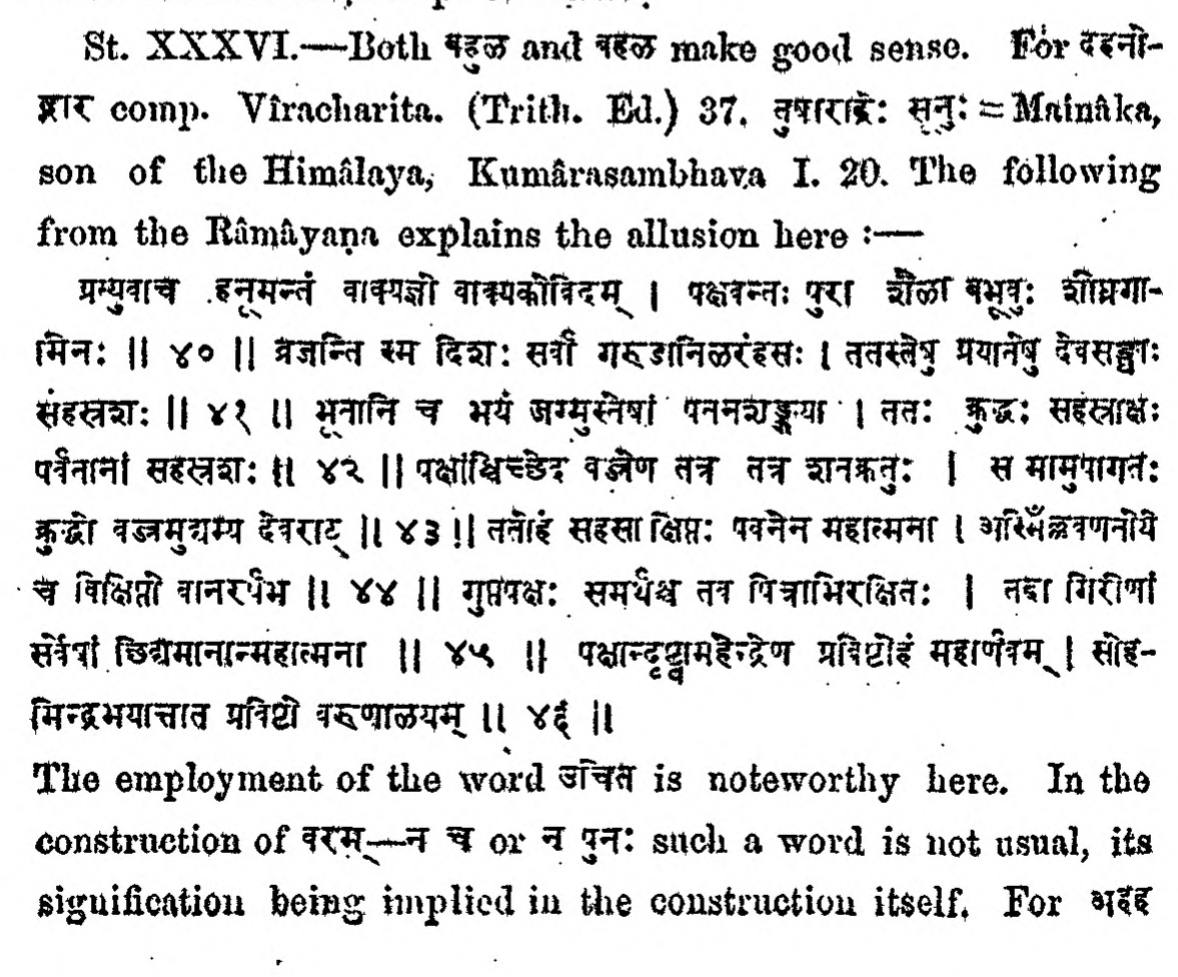
St. XXXVI.—Both बहुल and बहल make good sense. For दहनोद्गार comp. Vîracharita. (Trith. Ed.) 37. तुषाराद्रेः सूनुः = Mainâka, son of the Himâlaya, Kumârasambhava I. 20. The following from the Râmâyaṇa explains the allusion here :—
प्रत्युवाच हनूमन्तं वाक्यज्ञो वाक्यकोविदम् । पक्षवन्तः पुरा शैला बभूवुः शीघ्रगामिनः ॥ ४० ॥ व्रजन्ति स्म दिशः सर्वा गरुडानिलरंहसः । ततस्तेषु प्रयातेषु देवसङ्घाः सहस्रशः ॥ ४१ ॥ भूतानि च भयं जग्मुस्तेषां पतनशङ्कया । ततः क्रुद्धः सहस्राक्षः पर्वतानां सहस्रशः ॥ ४२ ॥ पक्षांश्चिच्छेद वज्रेण तत्र तत्र शतक्रतुः । स मामुपागतः क्रुद्धो वज्रमुद्यम्य देवराट् ॥ ४३ ॥ ततोहं सहसा क्षिप्तः पवनेन महात्मना । अस्मिँल्लवणतोये च विक्षिप्तो वानरर्षभ ॥ ४४ ॥ गुप्तपक्षः समर्थश्च तव पित्राभिरक्षितः । तदा गिरीणां सर्वेषां छिद्यमानान्महात्मना ॥ ४५ ॥ पक्षान्दृष्ट्वामहेन्द्रेण प्रविष्टोहं महार्णवम् । सोहमिन्द्रभयात्तात प्रविष्टो वरुणालयम् ॥ ४६ ॥
The employment of the word उचित is noteworthy here. In the construction of वरम्—न च or न पुनः such a word is not usual, its signification being implied in the construction itself. For अहह see the note to the last Stanza. Here it is used in its second sense.—S'ikhariṇî.


Kale
all
Introduction
मानशौर्यवता पुरुषेण प्राणव्ययेनापि स्वमाहात्म्यमेव रक्षणीयं न तु जीवितहेतोः कश्चिच्छरणं गन्तव्य इत्याह—

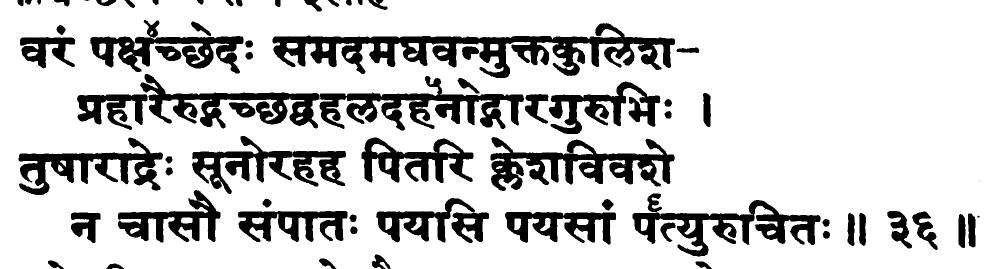
वरं पक्षच्छेदः समदमघवन्मुक्तकुलिश-
प्रहारैरुद्गच्छद्बहलदहनोद्गारगुरुभिः ।
तुषाराद्रेः सूनोरहह पितरि क्लेशविवशे
न चासौ संपातः पयसि पयसां पत्युरुचितः ॥ ३६ ॥
Translation
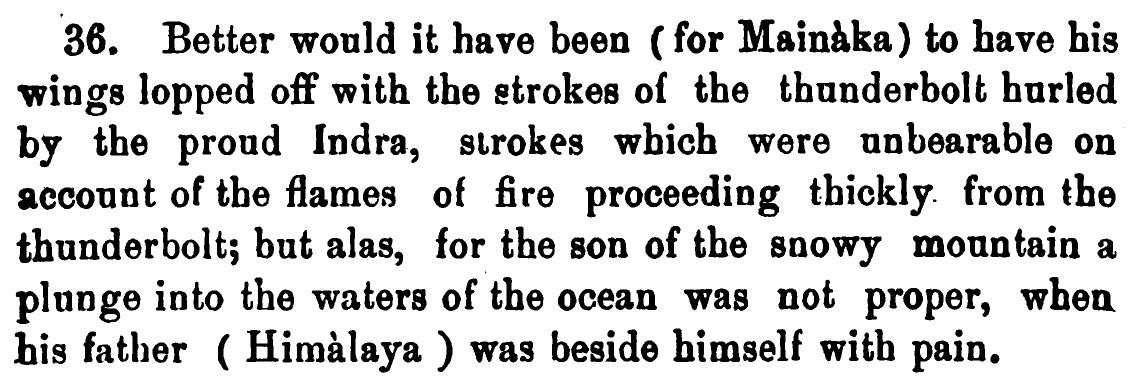
36. Better would it have been ( for Mainàka ) to have his wings lopped off with the strokes of the thunderbolt hurled by the proud Indra, strokes which were unbearable on account of the flames of fire proceeding thickly from the thunderbolt; but alas, for the son of the snowy mountain a plunge into the waters of the ocean was not proper, when his father ( Himàlaya ) was beside himself with pain.
Notes
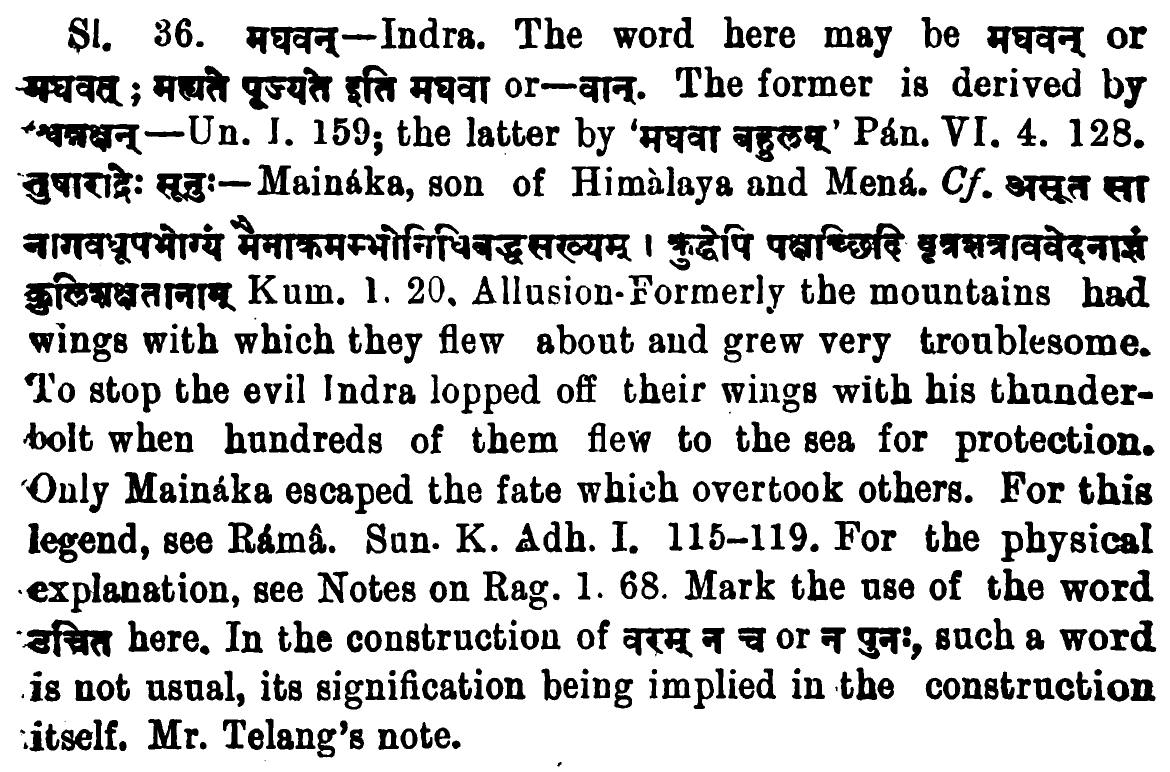
Sl. 36. मघवन्—Indra. The word here may be मघवन् or मघवत्; मंह्यते पूज्यते इति मघवा or—वान्. The former is derived by 'श्वन्नुक्षन्—Un. I. 159; the latter by 'मघवा बहुलम्' Pán. VI. 4. 128. तुषाराद्रेः सूनुः—Maináka, son of Himàlaya and Mená. Cf. असूत सा नागवधूपभोग्यं मैनाकमम्भोनिधिबद्धसख्यम् । क्रुद्धेपि पक्षच्छिदि वृत्रशत्राववेदनाज्ञं कुलिशक्षतानाम् Kum. 1. 20. Allusion-Formerly the mountains had wings with which they flew about and grew very troublesome. To stop the evil Indra lopped off their wings with his thunderbolt when hundreds of them flew to the sea for protection. Only Maináka escaped the fate which overtook others. For this legend, see Rámâ. Sun. K. Adh. I. 115–119. For the physical explanation, see Notes on Rag. 1. 68. Mark the use of the word उचित here. In the construction of वरम् न च or न पुनः, such a word is not usual, its signification being implied in the construction itself. Mr. Telang's note.
Gopinath1914
all
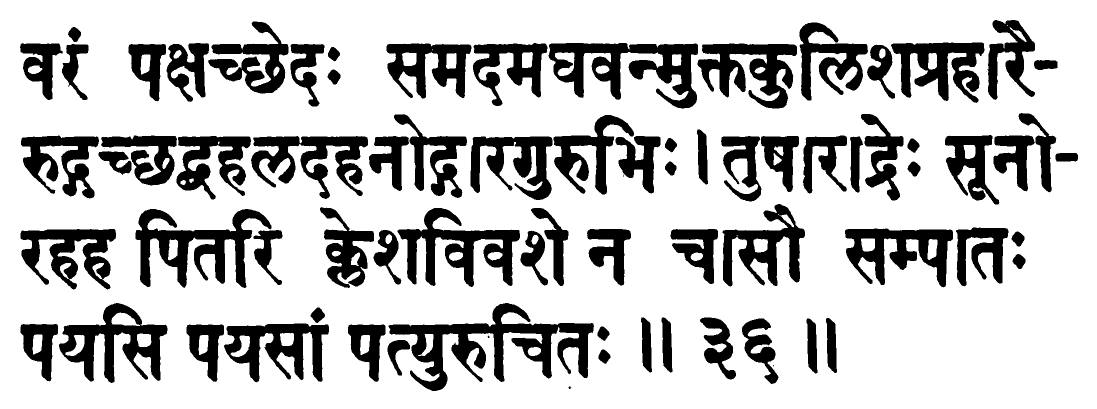
वरं पक्षच्छेदः समदमघवन्मुक्तकुलिशप्रहारै-
रुद्गच्छद्वहलदहनोद्गारगुरुभिः । तुषाराद्रेः सूनो-
रहह पितरि केशविवशे न चासौ सम्पातः
पयसि पयसां पत्युरुचितः ॥ ३६ ॥
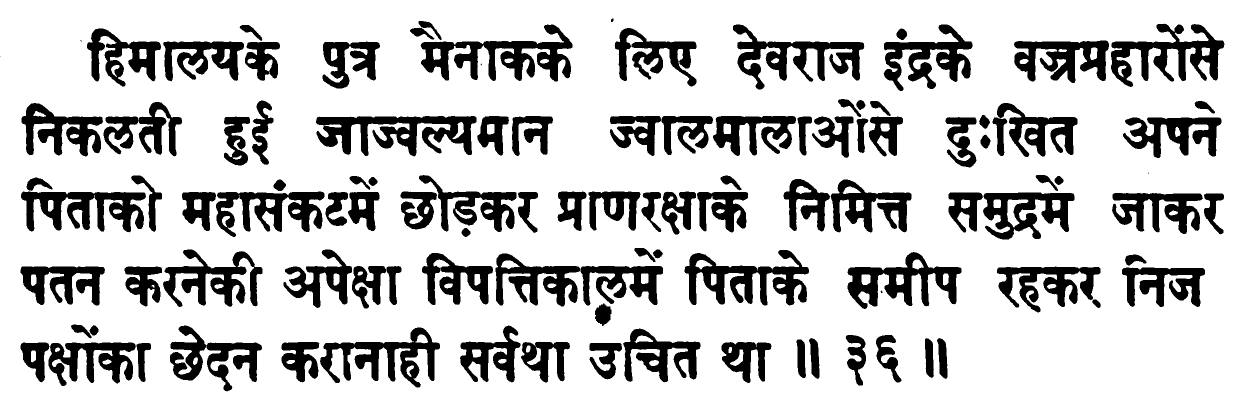
हिमालयके पुत्र मैनाकके लिए देवराज इंद्रके वज्रप्रहारोंसे निकलती हुई जाज्वल्यमान ज्वालमालाओंसे दुःखित अपने पिताको महासंकटमें छोड़कर प्राणरक्षाके निमित्त समुद्रमें जाकर पतन करनेकी अपेक्षा विपत्तिकालमें पिताके समीप रहकर निज पक्षोंका छेदन करानाही सर्वथा उचित था ॥ ३६ ॥
Footnote
Cf,—(a) 66 “ क्रौंचं विमुच्य पुत्रं च पितरं च हिमालयम् । प्रविश्य जलधिं पक्षौ रक्षताऽनेन किं कृतम् ॥ " ( मुरारिकृतानर्धराघवे ).


Gopinath1896
all
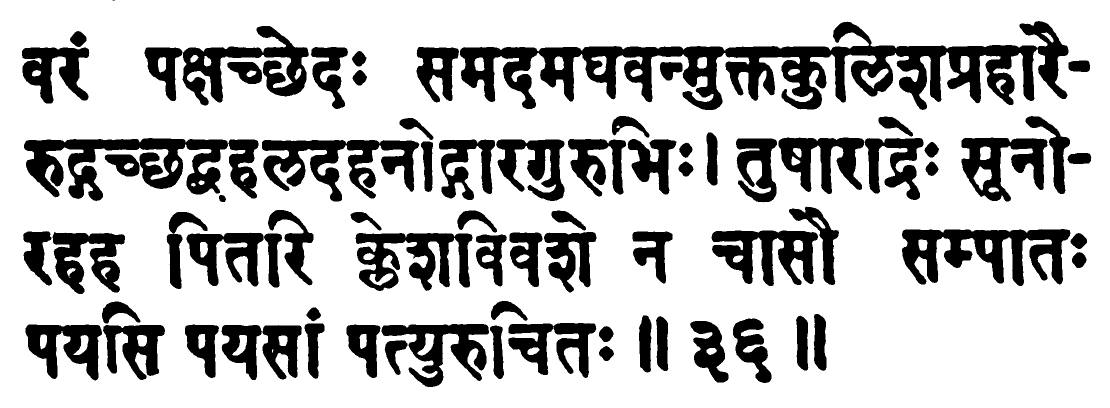
वरं पक्षच्छेदः समदमघवन्मुक्तकुलिशप्रहारै-
रुद्गच्छद्बहलदहनोद्गारगुरुभिः । तुषाराद्रेः सूनो-
रहह पितरि क्लेशविवशे न चासौ सम्पातः
पयसि पयसां पत्युरुचितः ॥ ३६ ॥
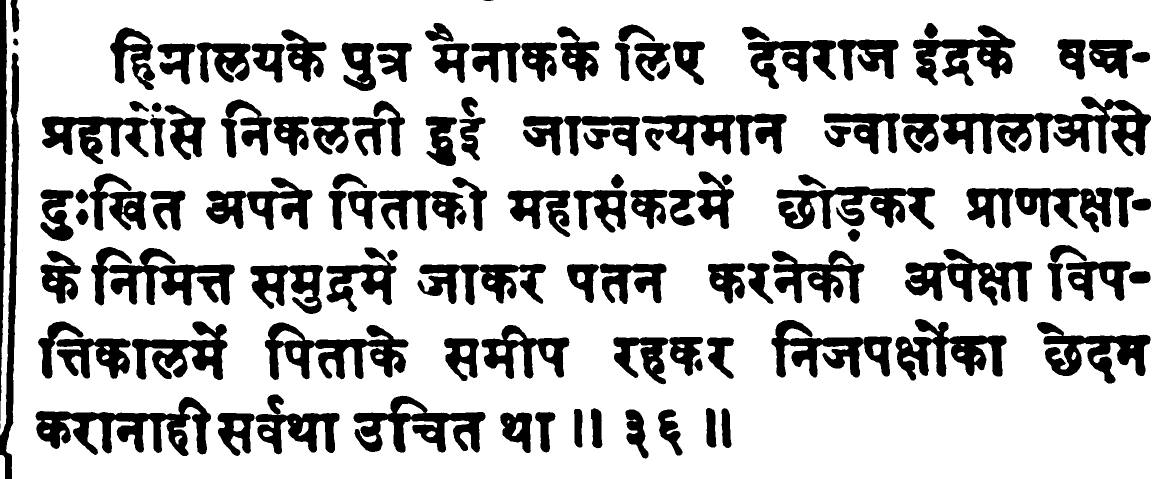
हिमालयके पुत्र मैनाकके लिए देवराज इंद्रके वज्रप्रहारोंसे निकलती हुई जाज्वल्यमान ज्वालमालाओंसे दुःखित अपने पिताको महासंकटमें छोड़कर प्राणरक्षाके निमित्त समुद्रमें जाकर पतन करनेकी अपेक्षा विपत्तिकालमें पिताके समीप रहकर निजपक्षोंका छेदन करानाही सर्वथा उचित था ॥ ३६ ॥
Footnote
Cf.—(a) “ क्रौंचं विमुच्य पुत्रं च पितरं च हिमालयम् । प्रविश्य जलधिं पक्षौ रक्षताऽनेन किं कृतम् ॥ ” (मुरारिकृतानर्घराघवे).


Kosambi
all
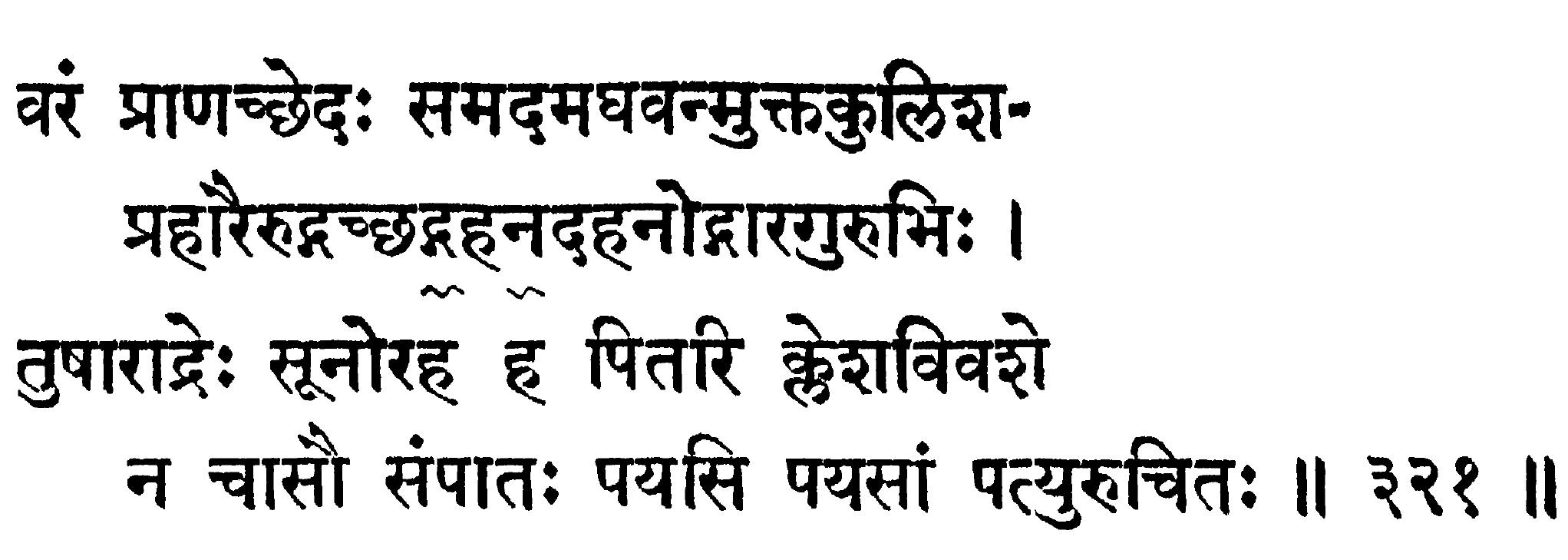
वरं प्राणच्छेदः समदमघवन्मुक्तकुलिश
प्रहारैरुद्गच्छद्गहनदहनोद्गारगुरुभिः ।
तुषाराद्रे : सूनोरह ह पितरि क्लेशविवशे
न चासौ संपातः पयसि पयसां पत्युरुचितः ॥ ३२१ ॥
Footnote
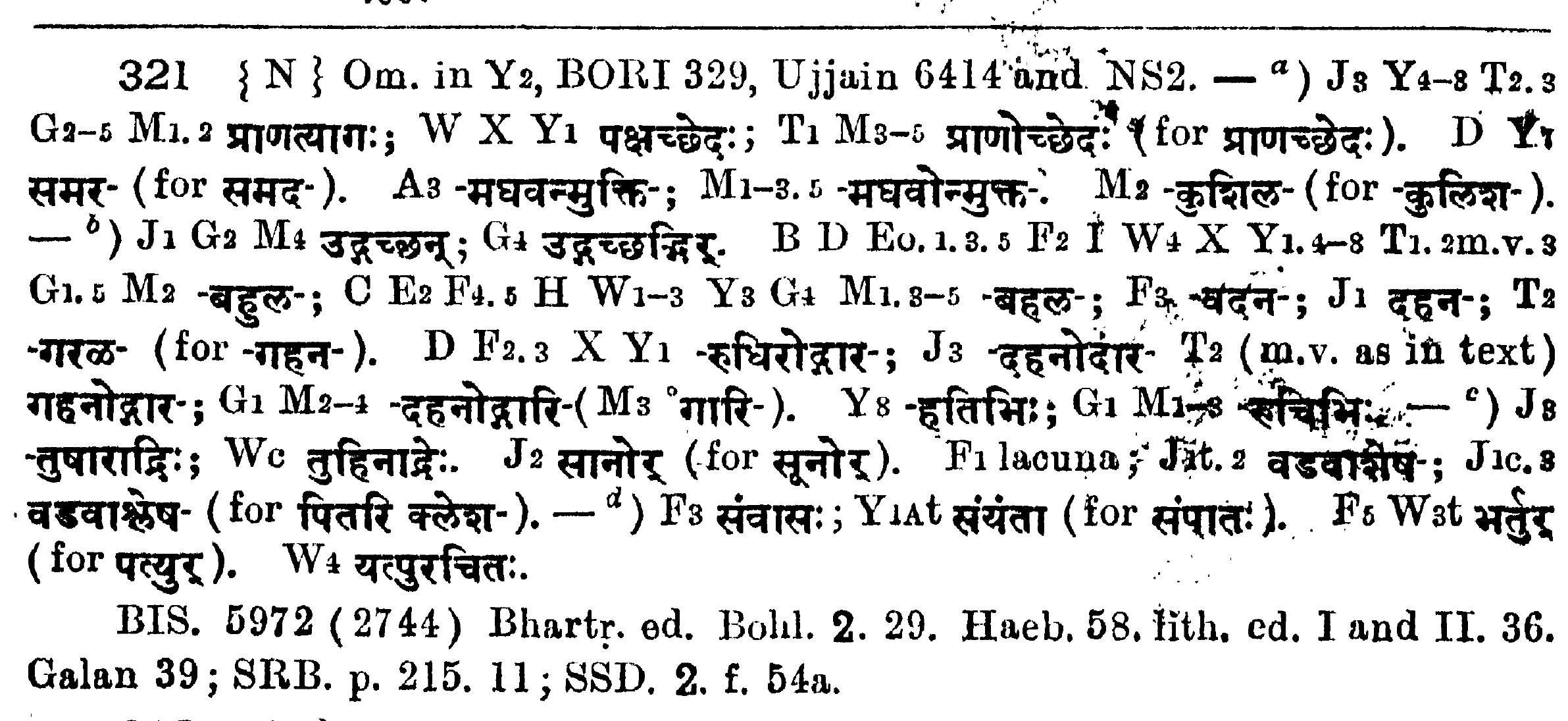
321 { N } Om . in Y2 , BORI 329 , Ujjain 6414and NS2 . — “ @ ) J3 Y4-4 T2.3
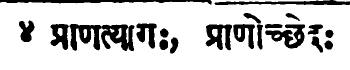
G2 - 5 M. 1. 2 प्राणत्यागः ; W X Y1 पक्षच्छेदः ; T1 M3 - 5 प्राणोच्छेदः ( for प्राणच्छेदः ) . D th
समर- ( for समद ) . A3 मघवन्मुक्ति ; M1-3.5 मघवोन्मुक्त : M2 कुशिल - ( for कुलिश ) .
– 6 ) J1 G2 M4 उद्भच्छन् ; G उद्गच्छद्भिर् BD E0 1 3 5 F2f W X Y1.44 T1.2m.v.3
G 1.5 M 2 बहुल ; C_E2 F 4 5 H®W 1 - 3 Y3 G4 M1 . 8 - 5 - बहल ; Ps -वदन- ; J1 दहन ; Ta
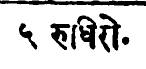
-गरळ - ( for -गहन - ) . DF 2. 3 X Y1 रुधिरोद्वार ; J3 दहनोदार- T2 ( m.v. as in text )
गहनोद्गार ; G1 M2- दहनोद्गारि- ( M3 गारि - ) . Y 8 हतिभिः ; G1 M18 रुचिभिः- ( ) Jg
-तुषाराद्वि ; We तुहिनाद्वे : J2 सानोर् ( for सूनोर् ) . Filacuna ; ' Jit . 2 वडवाशेष ; Jic.s
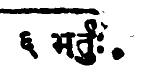
. वडवाश्लेष- ( for पितरि क्लेश- ) . – ( ) F3 संवास :; XIAt संयंता ( for संपात : ) . Fs Wst भर्तुर्
( for पत्युर् ) . W½ यत्पुरचितः .
BIS . 5972 ( 2744 ) Bhartr . ed . Bohl . 2. 29. Haeb 58 Fith ed . I and II . 36 .
G & lan 39 ; SRB p . 215 11 ; SSD . 2. f . 54 .
Commentary