Mādhavānanda
ब्रह्मेन्द्रादिमरुद्गणांस्तृणकणान्यत्र स्थितो मन्यते
यत्स्वादाद्विरसा भवन्ति विभवास्त्रैलोक्यराज्यादय: ।
भोग: कोऽपि स एक एव परमो नित्योदितो जृम्भते
भो साधो क्षणभंगुरे तदितरे भोगे रतिं मा कृथा: ।।४०।।
40. There is one Enjoyment and one alone, lasting, immutable, and supreme, of which the taste renders tasteless the greatest possessions, such as the sovereignty of the three worlds, and established in which a Brahmā, Indra, or the gods (i.e., their positions) appear like particles of grass. Do not, oh sādhu, set your heart on any ephemeral enjoyment other than that.
Kale
all
Introduction
सर्वथा भोग एव इष्यते चेत्क्षुद्रभोगान्विहाय निरतिशयेऽनिर्वाच्ये ब्रह्मानन्दभोगे रतिं कुरु इत्युपदिशति—

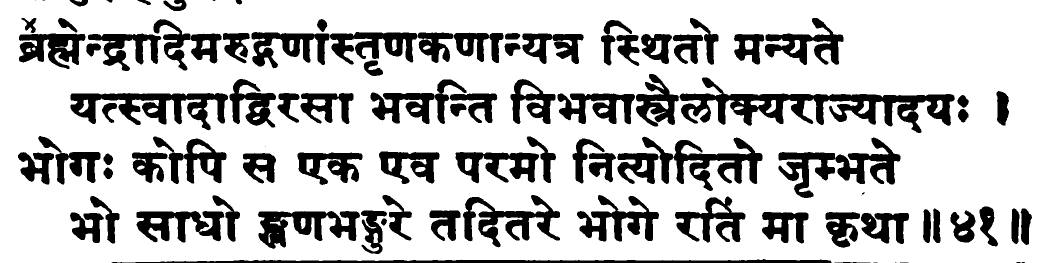
ब्रह्मेन्द्रादिमरुद्गणांस्तृणकणान्यत्र स्थितो मन्यते
यत्स्वादाद्विरसा भवन्ति विभवास्त्रैलोक्यराज्यादयः ।
भोगः कोपि स एक एव परमो नित्योदितो जृम्भते
भो साधो क्षणभङ्गुरे तदितरे भोगे रतिं मा कृथा ॥४१॥
Translation
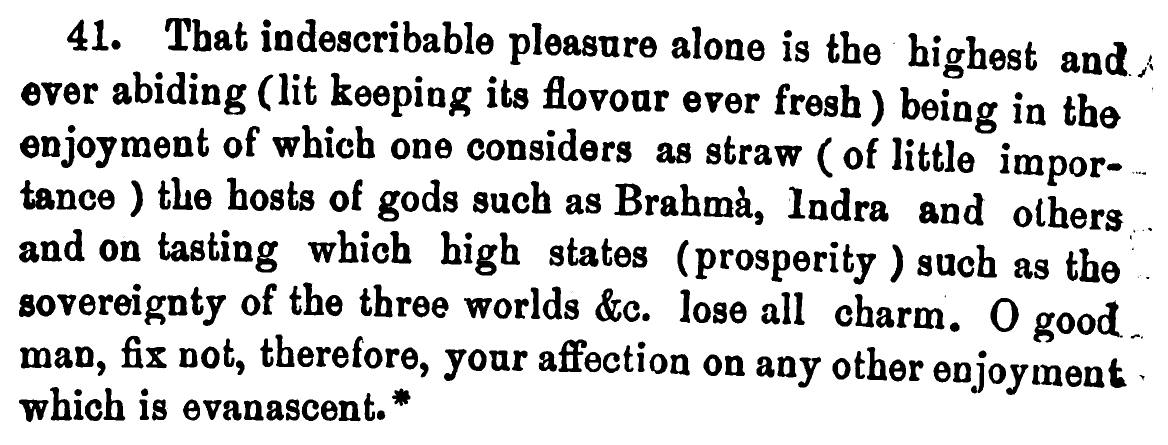
41. That indescribable pleasure alone is the highest and ever abiding (lit keeping its flovour ever fresh) being in the enjoyment of which one considers as straw ( of little importance ) the hosts of gods such as Brahmà, Indra and others and on tasting which high states (prosperity ) such as the sovereignty of the three worlds &c. lose all charm. O good man, fix not, therefore, your affection on any other enjoyment which is evanascent.
Notes
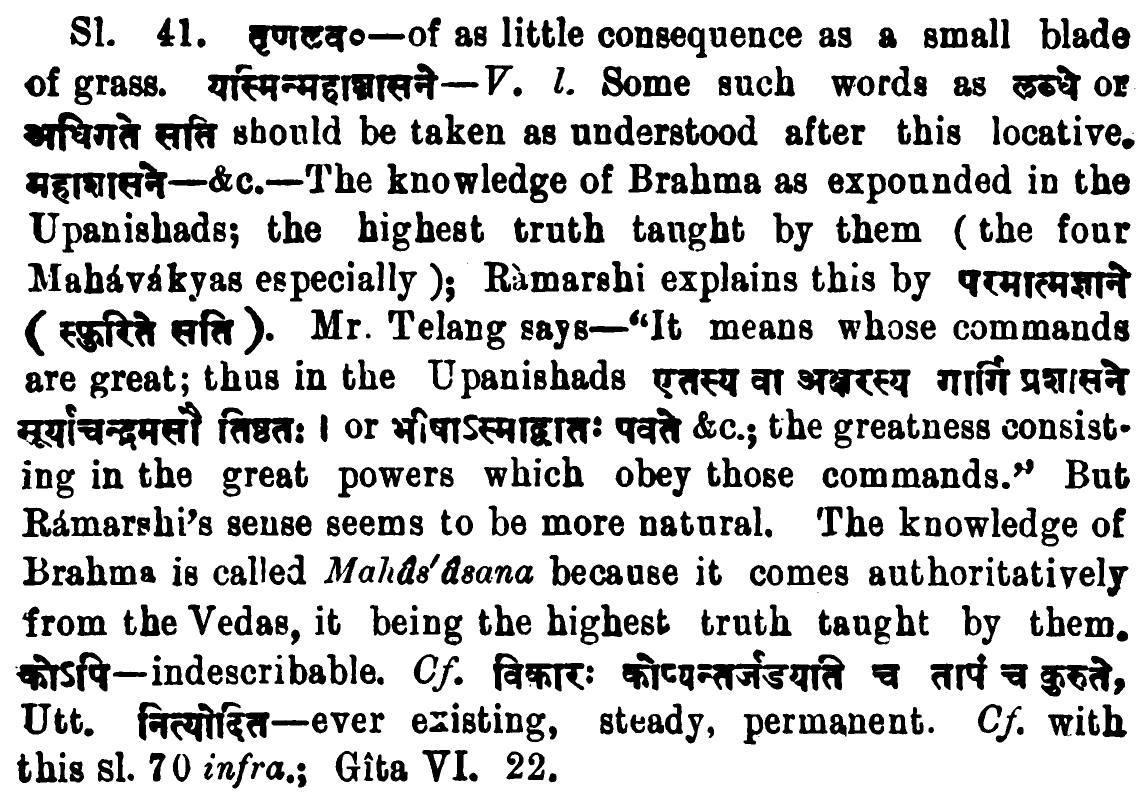
Sl. 41. तृणत्व०—of as little consequence as a small blade of grass. यस्मिन्महाशासने—V. l. Some such words as लब्धे or अधिगते सति should be taken as understood after this locative. महाशासने—&c.—The knowledge of Brahma as expounded in the Upanishads; the highest truth taught by them ( the four Mahávákyas especially ); Ràmarshi explains this by परमात्मज्ञाने ( स्फुरिते सति ). Mr. Telang says—“It means whose commands are great; thus in the Upanishads एतस्य वा अक्षरस्य गार्गि प्रशासने सूर्याचन्द्रमसौ तिष्ठतः । or भीषाऽस्माद्वातः पवते &c.; the greatness consisting in the great powers which obey those commands.” But Rámarshi’s sense seems to be more natural. The knowledge of Brahma is called Mahâs'âsana because it comes authoritatively from the Vedas, it being the highest truth taught by them. कोऽपि—indescribable. Cf. विकारः कोप्यन्तर्जडयति च तापं च कुरुते, Utt. नित्योदित—ever existing, steady, permanent. Cf. with this sl. 70 infra.; Gîta VI. 22.
Footnote
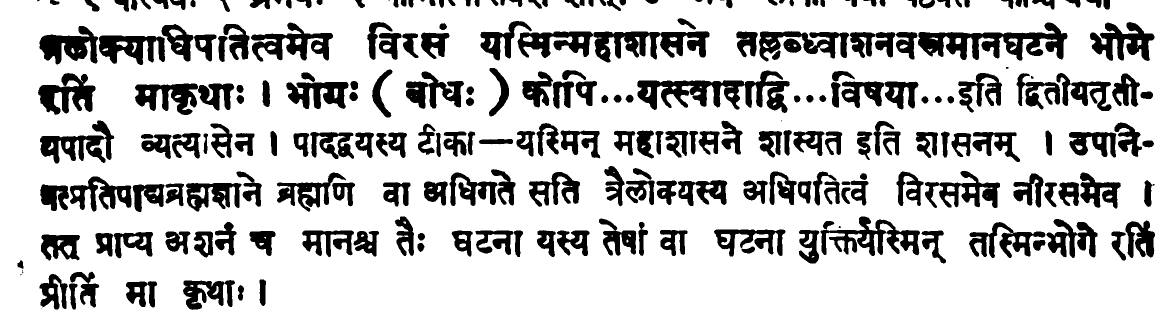
४ अयं श्लोकोन्यथा पठ्यते कैश्चिद्यथा— त्रैलोक्याधिपतित्वमेव विरसं यस्मिन्महाशासने तल्लब्ध्वाशनवस्त्रमानघटने भोगे रतिं मा कृथाः । भोगः ( बोधः ) कोपि...यत्स्वादाद्वि...विषया...इति द्वितीयतृतीयपादौ व्यत्यासेन । पादद्वयस्य टीका—यस्मिन् महाशासने शास्यत इति शासनम् । उपनिषत्प्रतिपाद्यब्रह्मज्ञाने ब्रह्मणि वा अधिगते सति त्रैलोक्यस्य अधिपतित्वं विरसमेव नीरसमेव । तत् प्राप्य अशनं च मानश्च तैः घटना यस्य तेषां वा घटना युक्तिर्यस्मिन् तस्मिन्भोगे रतिं प्रीतिं मा कृथाः ।

Kosambi
all
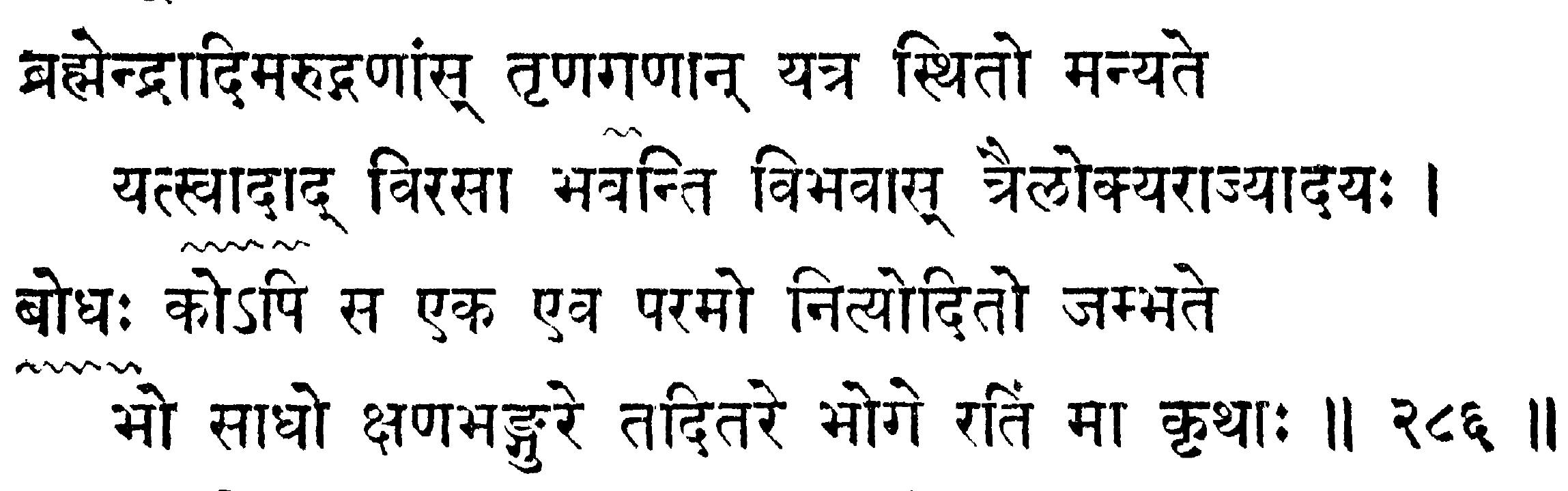
ब्रह्मेन्द्रादिमरुद्गणांसू तृणगणान् यत्र स्थितो मन्यते
यत्स्वादाद् विरसा भवन्ति विभवासू त्रैलोक्यराज्यादयः ।
बोधः कोऽपि स एक एव परमो नित्योदितो जम्भते
भो साधो क्षणभङ्गुरे तदितरे भोगे रतिं मा कृथाः ॥ २८६ ॥
Footnote
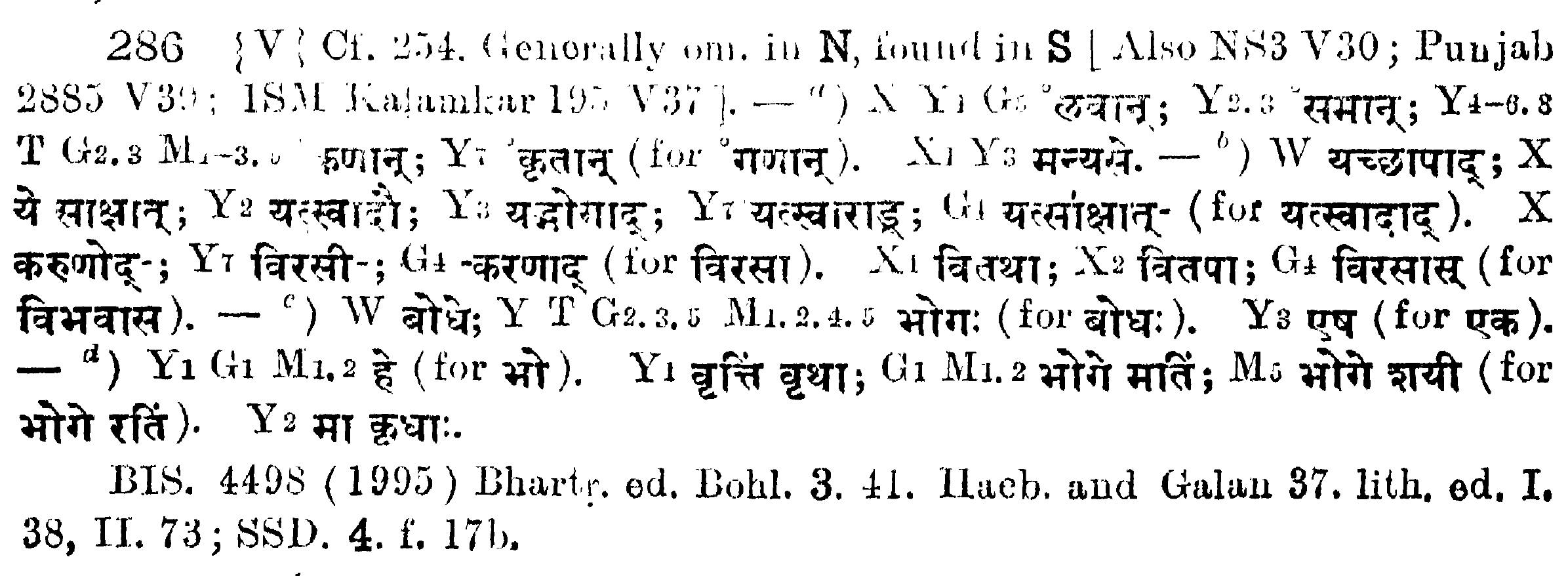
286 { V | Ci . 254 Genorally om . in N , iound in S [ Also NS3 V30 ; Punjab
2883 V39 ; 1SM Kajamkar 195 V37 ] — " " ) ) X X G G ° लवान् ; Y०.३ समान् ; Y 1 - 6.8
TG2.3 M. 3 - 3 . हणानू ; Y : ' कृतान् ( for ' गणान् ) . XIY Y : मन्यसे . – ' ) ) W W यच्छापादू ; X
ये साक्षात् ; Y० 2 यत्स्वादौ ; Y : योगा ; Y यत्स्वारा ; G ) यत्सांक्षात् ( for यत्स्वादादू ) . x
करुणोद् ; IT विरसी- ; G + -करणाद् ( for विरसा ) . Xi वितथा ; X 2 वितपा ; G + विरसास् ( for
विभवास ) . c ) W बोधे ; Y TG2.35 M12.45 भोगः ( for बोध : ) . Y3 एष ( for एक ) .
– d ) Y1 G1 M12 हे ( for भो ) . Y1 वृत्तिं वृथा ; G1 M1 . 2 भोगे मातें ; Mo भोगे शयी ( for
भोगे रतिं ) . Y2 मा कृधाः .
BIS . 4498 ( 1995 ) Bhartr . ed . Bohl . 3. 41. Ilaeb . and Galan 37. lith , ed . I.
38 , II . 73 ; SSD . 4. f . 17 ) .
Commentary