Ryder
JOYOUS TREASURES
How hard a thing it is that they achieve
Whose hearts the thought of God keeps pure and bright,
Who for His sake earth's joyous treasures leave
Without a pang at losing such delight!
Those joyous treasures I could never get;
I cannot get them now; I am not sure
That I shall ever win to them; and yet
I cannot flout the thought, the hope, the lure.
Tawney
Those who distinguish that which is from fleeting outward shows,
Do well to give up wealth and joys to gain secure repose;
What therefore must be said of us who cannot bear to part
From that which never can be ours, on which we've set our heart?
Mādhavānanda
ब्रह्मज्ञानविवेकनिर्मलधिय: कुर्वन्त्यहो दुष्करं
यन्मुञ्चन्त्युपभोगभाञ्ज्यपि धनान्येकान्ततो नि:स्पृहा: ।
संप्राप्तान्न पुरा न संप्रति न च प्राप्तौ दृढप्रत्यया-
न्वाञ्छामात्रपरिग्रहानपि परं त्यक्तुं न शक्ता वयम् ।।१३।।
13. Ah! It must be indeed a difficult feat which persons, with their minds purified by the discrimination arising from the knowledge of Brahman, accomplish, in that, free from desire, they wholly discard that wealth which has been actually bringing them enjoyment; whereas we fail to renounce enjoyments which are reaped by us as mere longings and which we never did realize in the past, nor do we realize now, nor can we count upon as lasting when obtained (in future).
Telang
all
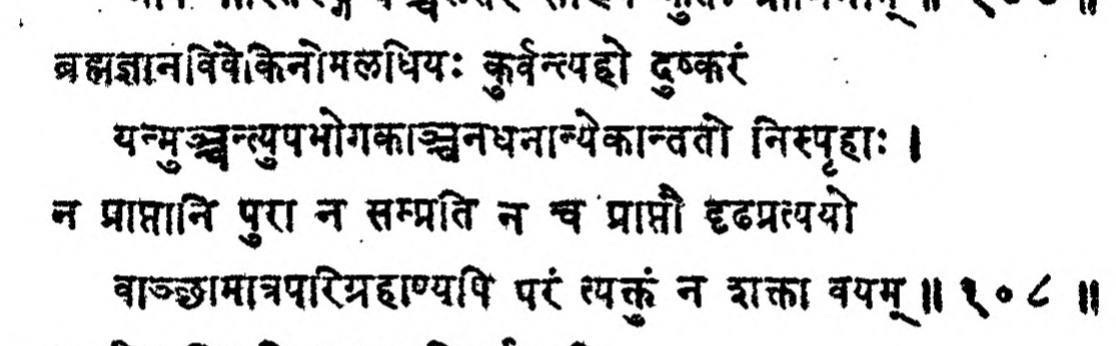
ब्रह्मज्ञानविवेकिनोमलधियः कुर्वन्त्यहो दुष्करं
यन्मुञ्चन्त्युपभोगकाञ्चनधनान्येकान्ततो निस्पृहाः ।
न प्राप्तानि पुरा न सम्प्रति न च प्राप्तौ दृढप्रत्ययो
वाञ्छामात्रपरिग्रहाण्यपि परं त्यक्तुं न शक्ता वयम् ॥ १०८ ॥
Notes
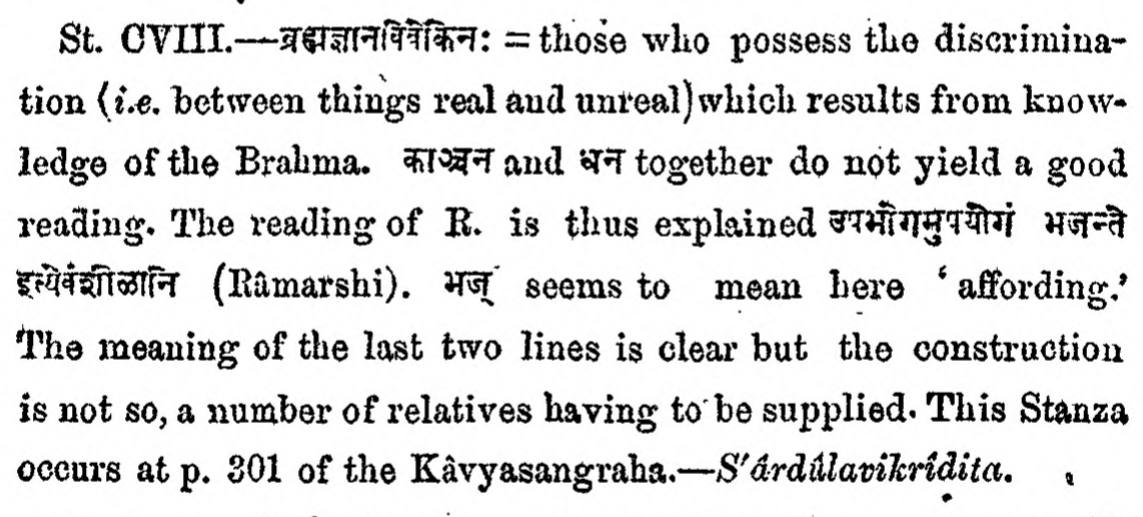
St. CVIII.—ब्रह्मज्ञानविवेकिनः = those who possess the discrimination (i.e. between things real and unreal) which results from knowledge of the Brahma. काञ्चन and धन together do not yield a good reading. The reading of R. is thus explained उपभोगमुपयोगं भजन्ते इत्येवंशीलानि (Râmarshi). भज् seems to mean here ‘affording.’ The meaning of the last two lines is clear but the construction is not so, a number of relatives having to be supplied. This Stanza occurs at p. 301 of the Kâvyasangraha.—S'ârdûlavikrîḍita.

Kale
all

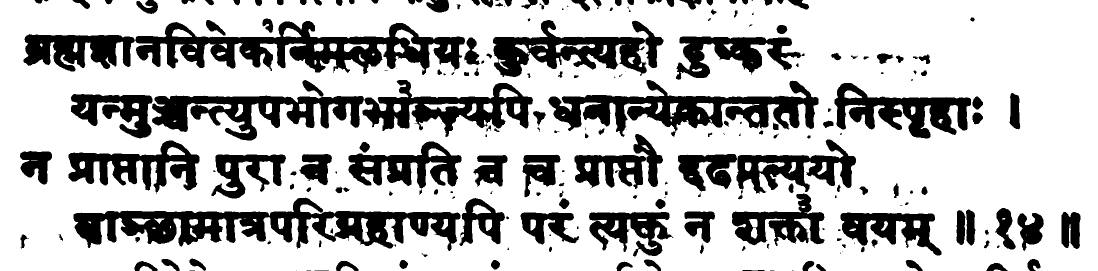
ब्रह्मज्ञानविवेकनिर्मलधियः कुर्वन्त्यहो दुष्करं
यन्मुञ्चन्त्युपभोगभाञ्जयपि धनान्येकान्ततो निस्पृहाः ।
न प्राप्तानि पुरा न संप्रति न च प्राप्तौ दृढप्रत्ययो
वाञ्छामात्रपरिग्रहाण्यपि परं त्यक्तुं न शक्ता वयम् ॥१४॥
Translation
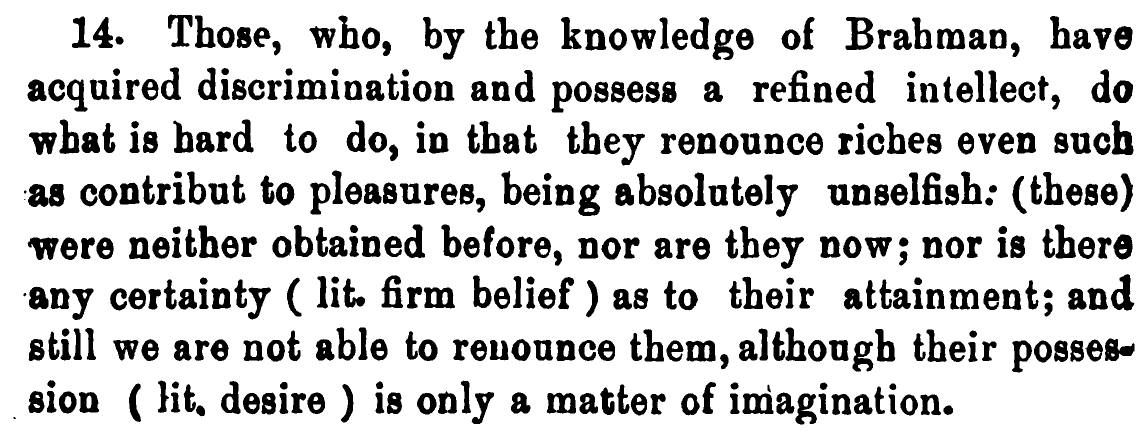
14. Those, who, by the knowledge of Brahman, have acquired discrimination and possess a refined intellect, do what is hard to do, in that they renounce riches even such as contribut to pleasures, being absolutely unselfish: (these) were neither obtained before, nor are they now; nor is there any certainty ( lit. firm belief ) as to their attainment; and still we are not able to renounce them, although their possession ( lit. desire ) is only a matter of imagination.
Notes
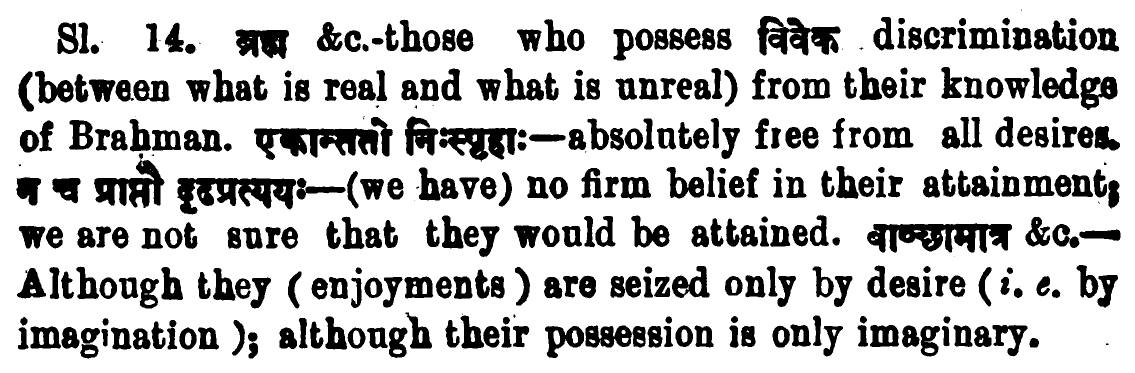
Sl. 14. ब्रह्म &c.-those who possess विवेक discrimination (between what is real and what is unreal) from their knowledge of Brahman. एकान्ततो निःस्पृहाः—absolutely free from all desires. न च प्राप्तौ दृढप्रत्ययः—(we have) no firm belief in their attainment; we are not sure that they would be attained. वाञ्छामात्र &c.— Although they ( enjoyments ) are seized only by desire ( i. e. by imagination ); although their possession is only imaginary.



Gopinath1914
all
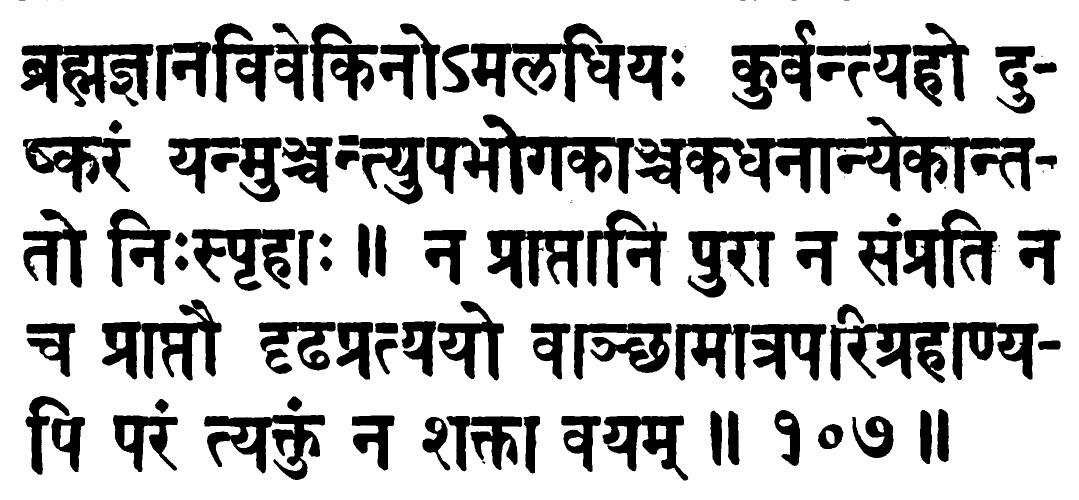
ब्रह्मज्ञानविवेकिनोऽमलधियः कुर्वन्त्यहो दु-
ष्करं यन्मुञ्चन्त्युपभोगकाञ्चकधनान्येकान्त-
तो निःस्पृहाः ॥ न प्राप्तानि पुरा न संप्रति न
च प्राप्तौ दृढप्रत्ययो वाञ्छामात्रपरिग्रहाण्य-
पि परं त्यक्तुं न शक्ता वयम् ॥ १०७ ॥
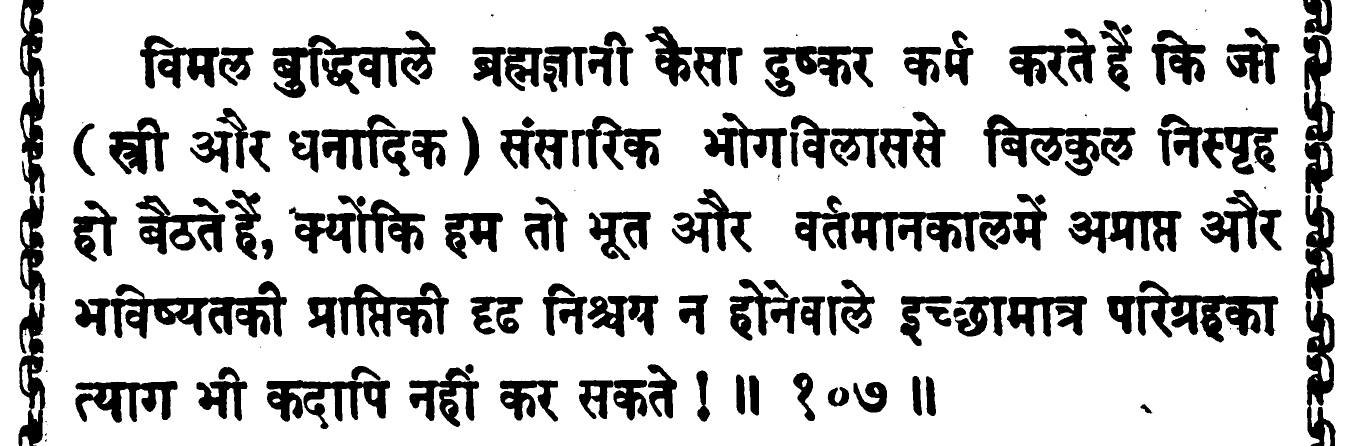
विमल बुद्धिवाले ब्रह्मज्ञानी कैसा दुष्कर कर्म करते हैं कि जो ( स्त्री और धनादिक) संसारिक भोगविलाससे बिलकुल निस्पृह हो बैठते हैं, क्योंकि हम तो भूत और वर्तमानकालमें अप्राप्त और भविष्यतकी प्राप्तिकी दृढ निश्चय न होनेवाले इच्छामात्र परिग्रहका त्याग भी कदापि नहीं कर सकते ! ॥ १०७ ॥
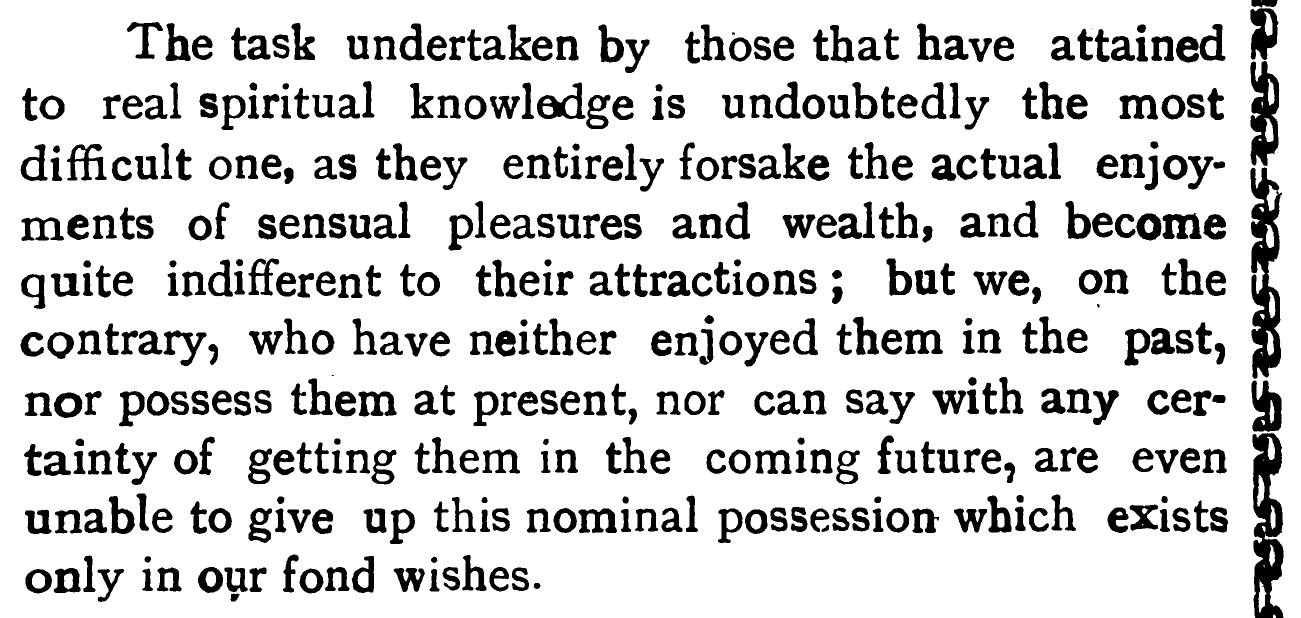
The task undertaken by those that have attained to real spiritual knowledge is undoubtedly the most difficult one, as they entirely forsake the actual enjoyments of sensual pleasures and wealth, and become quite indifferent to their attractions; but we, on the contrary, who have neither enjoyed them in the past, nor possess them at present, nor can say with any certainty of getting them in the coming future, are even unable to give up this nominal possession which exists only in our fond wishes.


Gopinath1896
all
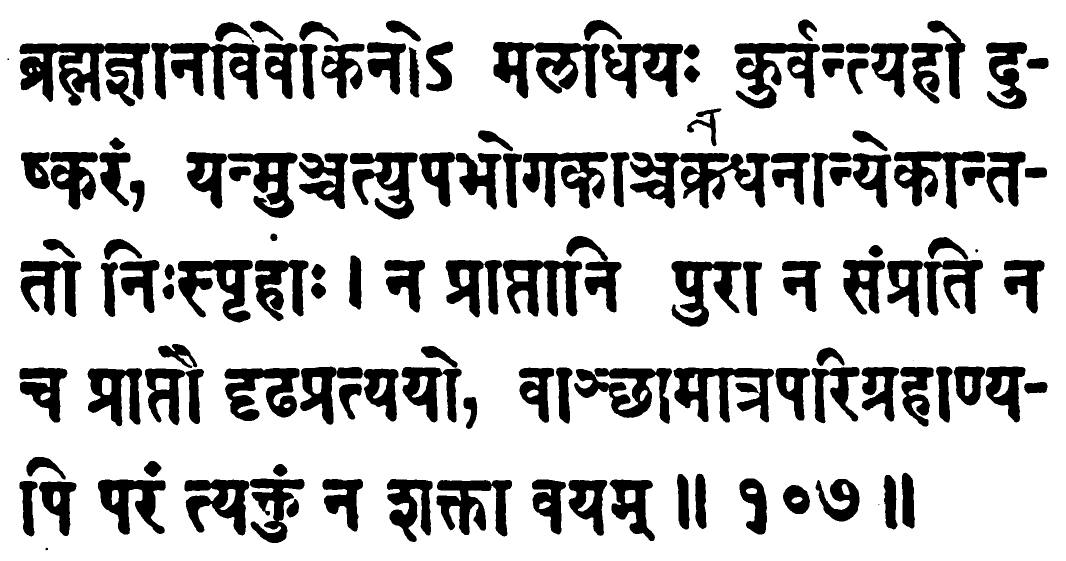
ब्रह्मज्ञानविवेकिनोऽमलधियः कुर्वन्त्यहो दु-
न
ष्करं, यन्मुञ्चत्युपभोगकाञ्चक्रेधनान्येकान्त-
तो निःस्पृहाः । न प्राप्तानि पुरा न संप्रति न
च प्राप्तौ दृढप्रत्ययो , वाञ्छामात्र परिग्रहाण्य-
पि परं त्यक्तुं न शक्ता वयम् ॥ १०७ ॥
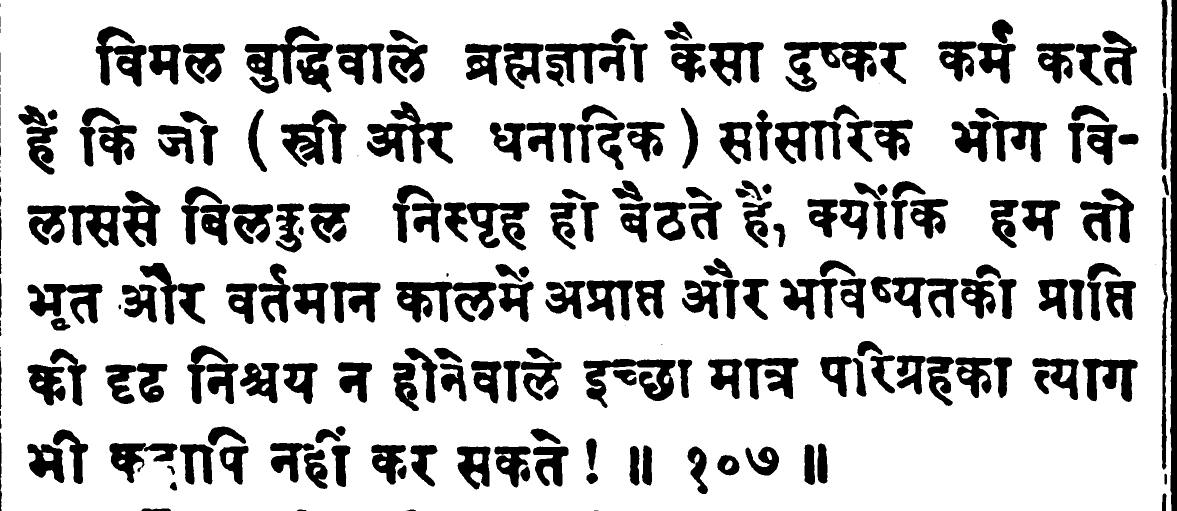
विमल बुद्धिवाले ब्रह्मज्ञानी कैसा दुष्कर कर्म करते हैं कि जो (स्त्री और धनादिक) सांसारिक भोग विलास से बिलकुल निस्पृह हो बैठते हैं, क्योंकि हम तो भूत और वर्तमान काल में अप्राप्त और भविष्यतकी प्राप्ति की दृढ निश्चय न होनेवाले इच्छा मात्र परिग्रहका त्याग भी कदापि नहीं कर सकते ! ॥ १०७ ॥
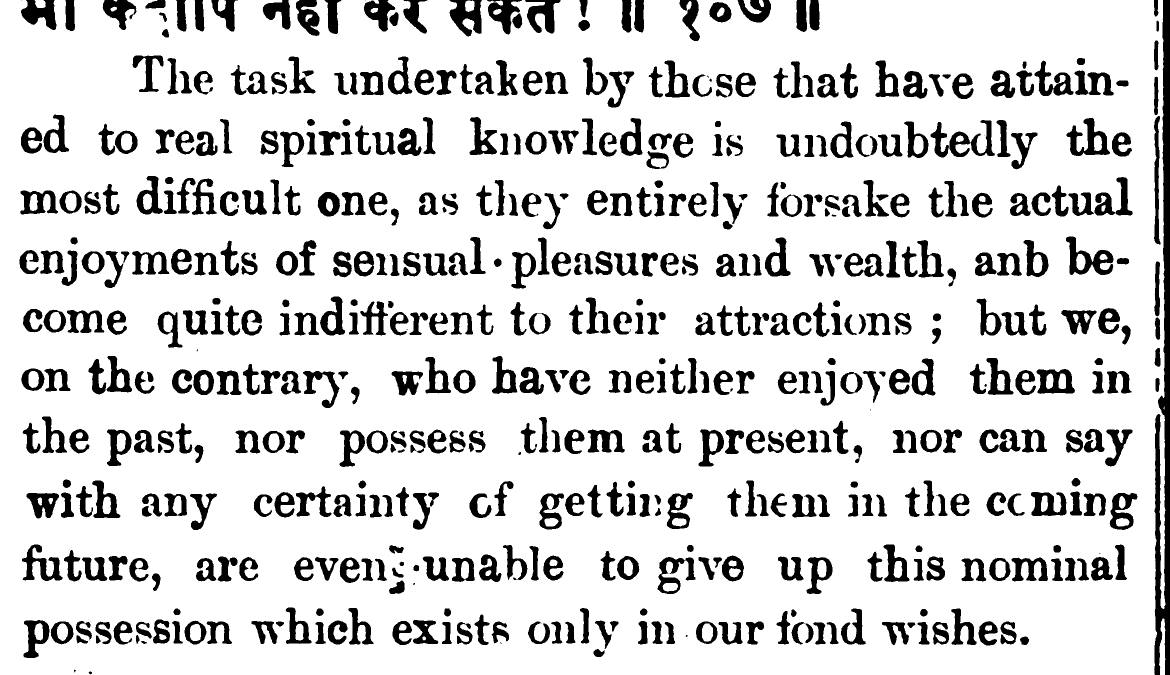
The task undertaken by those that have attained to real spiritual knowledge is undoubtedly the most difficult one, as they entirely forsake the actual enjoyments of sensual • pleasures and wealth, anb be, come quite indifferent to their attractions; but we on the contrary, who have neither enjoyed them in the past, nor possess them at present, nor can say with any certainty of getting them in the coming future, are even unable to give up this nominal possession which exists only in our fond wishes.


Kosambi
all
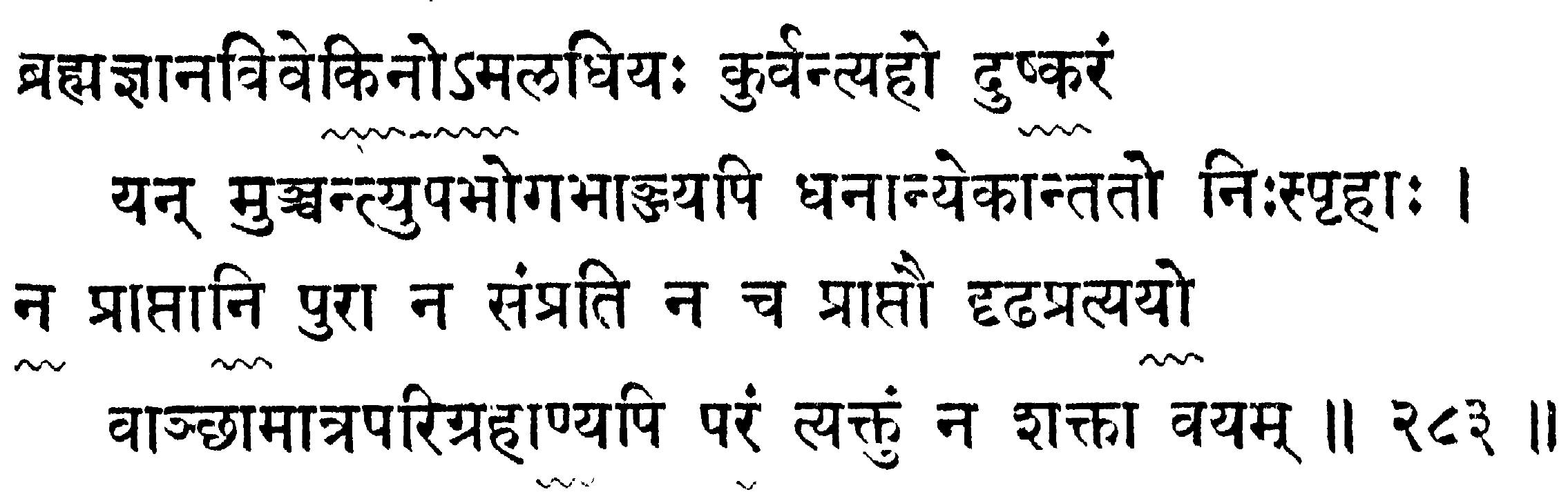
ब्रह्मज्ञानविवेकिनोऽमलधियः कुर्वन्त्यो दुष्करं
यन् मुञ्चन्त्युपभोगभाञ्जयपि धनान्येकान्ततो निःस्पृहाः ।
न प्राप्तानि पुरा न संप्रति न च प्राप्तौ दृढप्रत्ययो
वाञ्छामात्रपरिग्रहाण्यपि परं त्यक्तुं न शक्ता वयम् ॥ २८३ ॥
Footnote
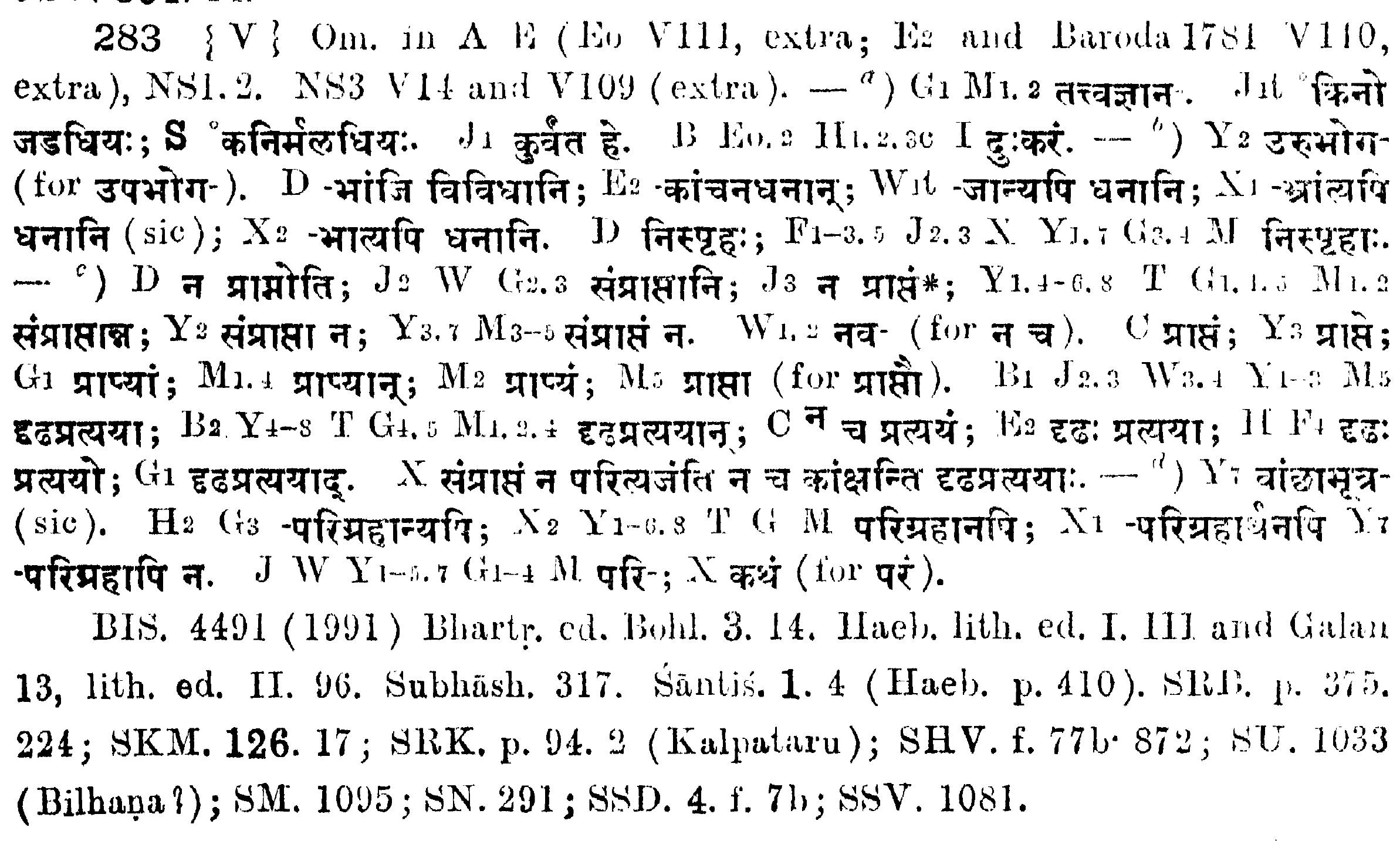
283 { V } Om . in A B ( Eo V111 , extra ; We and Baroda 1781 V110 ,
extra ) , N $ 1.2 . NS3 V14 and VI09 ( extra ) . – 4 ) ( G1 M 1. 2 तत्वज्ञान . किनो
जडधिय :; S ' कनिर्मलधिय : 11 कुर्वत हे . BEo H1.2.30 Hi23 I I दुःकरं . -- ' ) ) Y2 उरुभोग
( for उपभोग - ) . D- भांजि विविधानि ; : कांचनधनान् ; Wit जान्यपि धनानि ; XI प्रत्यपि
धनानि ( sic ) ; X 2 - भात्यपि धनानि . 1 ) निस्पृहः ; F1 - 3.5 J2 3 X X11 G3.1M निस्टहाः .
९ ) ) ID न प्राप्नोति ; J2 V G2.3 संप्राप्तानि ; 13 न प्राप्तं * ; Y17-68 T G1.1 Mha
संप्राप्तान ; X 2 संप्राप्ता न ; Y37 M3-5 संप्राप्तं न . W1 . : नव- ( for न च ) . C प्राप्तं ; X 3 प्राप्ते ;
G1 प्राध्यां ; M1.1 प्राप्यान् ; M2 प्राप्यं ; M5 ग्राप्ता ( for प्राप्तौ ) . B1 J2.3 W3.1 Yre MS
हढप्रत्यया ; B2 Y 4-4 + T G + M12 + दृढप्रत्ययान् ; C नच च प्रत्ययं ; 52 दृढः प्रत्यया ; 11 + दृढः
प्रत्ययो ; G 1 दृढप्रत्ययाद् . X संप्राप्तं न परित्यजंति न च कांक्षन्ति दृढप्रत्ययाः . - " ) Y : वांछाभृत्र
( sic ) . H2 ( 3 - परिमहान्यपि ; X 2 X1 - 6.3T ( GM परिग्रहानपि ; X1 - परिग्रहार्थनपि 17
-परिप्रहापि न . J JWY W Y 167G1-1 M परि ; X कथं ( for परं ) .
BIS 4401 ( 1991 ) Bhartr . cd . Bohl . 3. 14. Hael ) lith ed . I. III and Galan
13 , lith ed . II . 96. Subhāsh 317. Santis 1. 4 ( Hael ) . p . 410 ) . SRE . p . 375 .
224 ; SKM . 126 17 ; SRK . p . 94 · 2 ( Kalpataru ) ; SHV . f . 776 872 ; SU . 1033
( Bilhapa 1 ) ; SM . 1095 ; SN . 291 ; SSD 4. f 7D ; SSV . 1081 .
Commentary