Tawney
Does not the tortoise feel the load he bears without complaint?
Is not the flaming lord of day with ceaseless wandering faint?
Are not good men though sore distressed ashamed their troth to break?
Great spirits love to carry through whate'er they undertake.
Telang
all
किं कूर्मस्य भरव्यथा न वपुषि क्ष्मां न क्षिपत्येष यत्
किं वा नास्ति परिश्रमो दिनपतेरास्ते न यन्निश्चलः ।
किंचाङ्गीकृतमुत्सृजन्न मनसा श्लाघ्यो जनो लज्जते
निर्वाहः प्रतिपन्नवस्तुषु सतामेतद्धि गोत्रव्रतम् ॥ ७ ॥


Notes
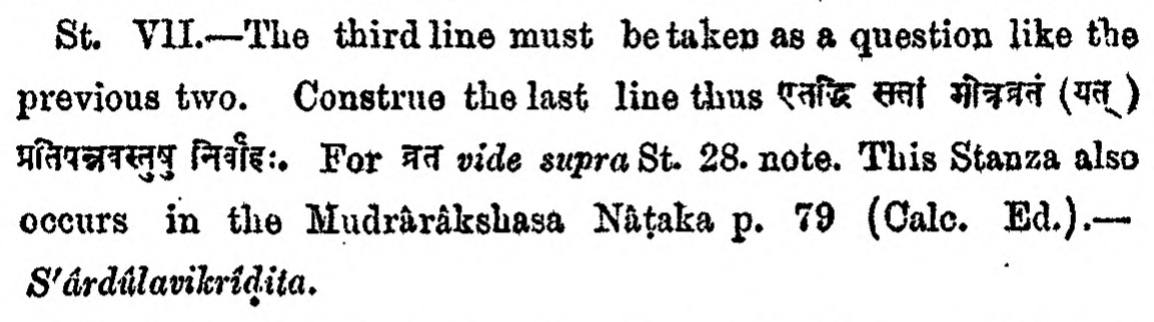
St. VII.—The third line must be taken as a question like the previous two. Construe the last line thus एतद्धि सतां मीत्रव्रतं (यत्) प्रतिपन्नवस्तुषु निर्वाहः. For व्रत vide supra St. 28. note. This Stanza also occurs in the Mudrârâkshasa Nâṭaka p. 79 (Calc. Ed.).—S'ârdûlavikrîḍita.


Kale
all
किं कूर्मस्य भरव्यथा न वपुषि क्ष्मां न क्षिपत्येष यत्
किंवा नास्ति परिश्रमो दिनपतेरास्ते न यन्निश्चलः ।
किंत्वङ्गीकृतमुत्सृजन्स्वमनसा श्लाघ्यो जनो लज्जते
निर्वाहः प्रतिपन्नवस्तुषु सतामेतद्धि गोत्रव्रतम् ॥ १३ ॥


Translation
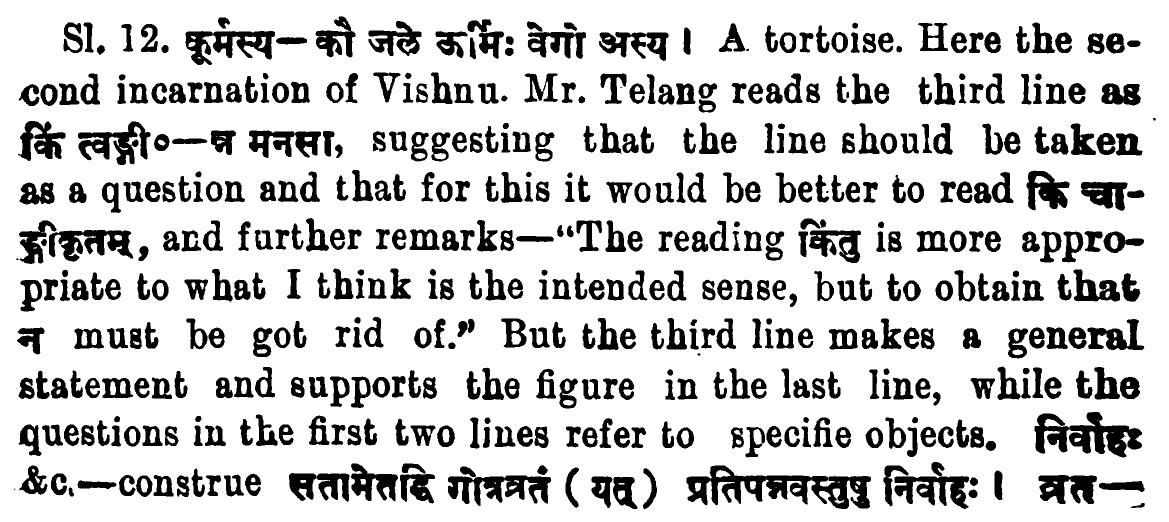
13. Does not the Tortoise feel pain in his body on account of his burden, that he does not throw off the earth, or does not the lord of the day feel fatigue, in that be never remains motionless ? ( Yes they do ). But a worthy man, when going to give up his undertaking, feels shame inwardly; for carrying to their completion things ( once ) undertaken is the hereditary vow of the good.
Notes
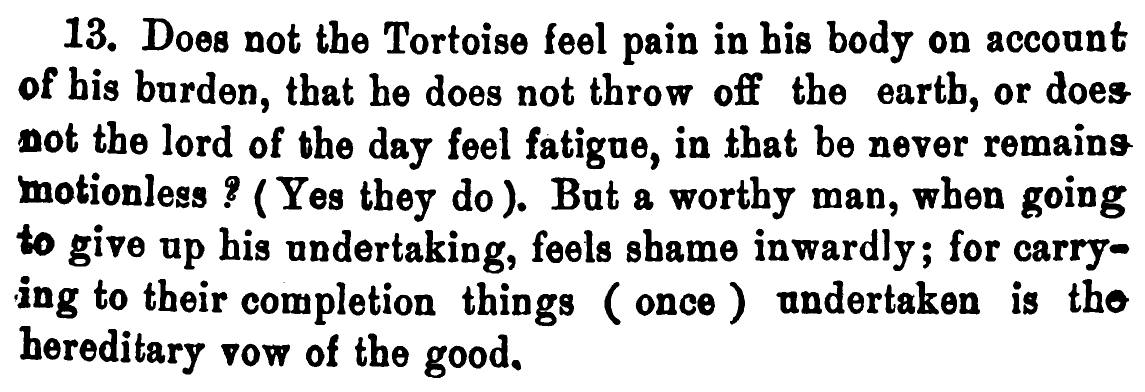
Sl. 12. कूर्मस्य—कौ जले ऊर्मिः वेगो अस्य । A tortoise. Here the second incarnation of Vishnu. Mr. Telang reads the third line as किं त्वङ्गी०—न्न मनसा, suggesting that the line should be taken as a question and that for this it would be better to read किं चाङ्गीकृतम्, and further remarks—“The reading किंतु is more appropriate to what I think is the intended sense, but to obtain that न must be got rid of.” But the third line makes a general statement and supports the figure in the last line, while the questions in the first two lines refer to specifie objects. निर्वाहः &c.—construe सतामेतद्धि गोत्रव्रतं ( यत् ) प्रतिपन्नवस्तुषु निर्वाहः । व्रत— An observance that is binding. The sloka occurs in Mud. II. The fig. is अर्थान्तरन्यास.

Kosambi
all
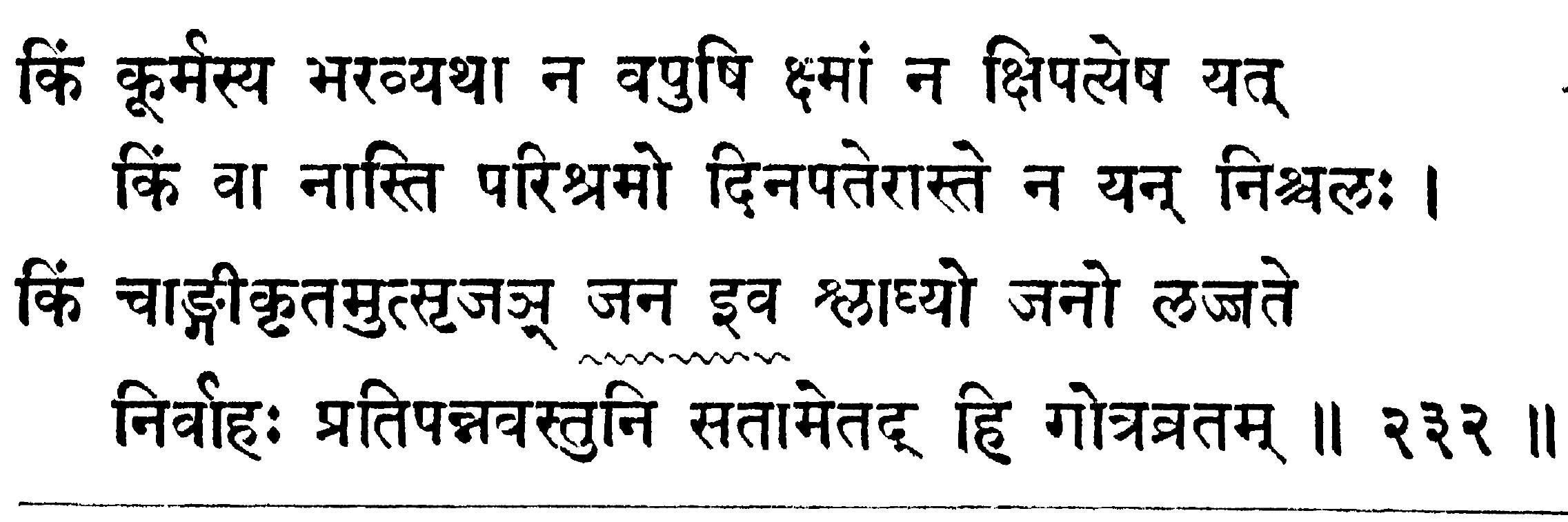
किं कूर्मस्य भरव्यथा न वपुषि क्ष्मां न क्षिपत्येष यत्
किं वा नास्ति परिश्रमो दिनपतेरास्ते न यन् निश्चलः ।
किं चाङ्गीकृतमुत्सृजञ् जन इव श्लाघ्यो जनो लज्जते
निर्वाह : प्रतिपन्नवस्तुनि सतामेतद् हि गोत्रव्रतम् ॥ २३२ ॥
Footnote
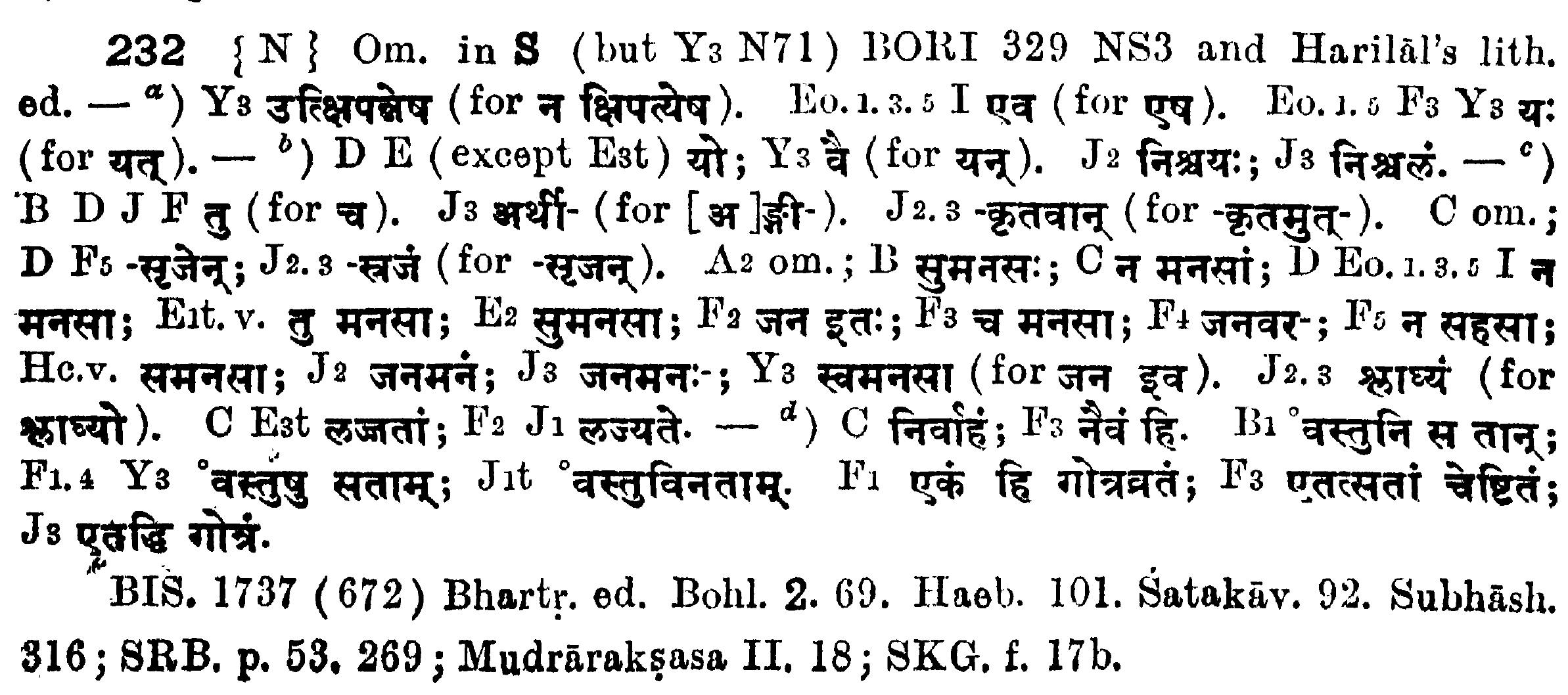
232 { N } Om in S ( but Y3 N71 ) BORI 329 NS3 and Harilāl's lith .
ed . – a ) Y3 उत्क्षिपद्वेष ( for न क्षिपत्येष ) . Eo.1.3.5 I एव ( for एष ) . Fo.1.6 F3 Y3 यः
( for यत् ) . – 0 ) D E ( except Est ) यो ; X 3 वै ( for यन् ) . J2 निश्चयः ; J3 निश्चलं . — ° )
B D J F तु ( for च ) . J3 अर्थी - ( for [ अ ] ङ्गी- ) . J2.3 कृतवान् ( for कृतमुत्- ) . Com . ;
D F5 - सृजेन् ; J2 . 3 स्रजं ( for - सृजन् ) . 42om .; B सुमनसः ; C न मनसां ; D Eo . 1. 3.0 I न
मनसा ; Eit.v. तु मनसा ; 52 सुमनसा ; F2 जन इतः ; F3 P3 च मनसा ; F + जनवर ; F5 न सहसा ;
Hc.v. समनसा ; J2 J2 जनमनं जनमनं ; ; J3 जनमन : - ; Y3 स्वमनसा ( for जन इव ) . J2.3 श्लाघ्यं ( for
लाग्यो ) . C Est लज्जतां ; F2 J1 लज्यते . d ) C निर्वाहं ; F3 नैवं हि . B1 वस्तुनि स तान् ;
F1.4 Y3 वस्तुषु सताम् ; Jit ' वस्तुविनताम् . F1 एकं हि गोत्रव्रतं ; 3 एतत्सतां चेष्टितं ;
Js एतद्धि गोत्रं .
BIS . 1737 ( 672 ) Bhartr . ed . Bohl . 2. 69. Haeb . 101. Satakäv . 92. Subhāsh .
316 ; SRB . p . 53. 269 ; Mudrārakşasa II 18 ; SKG . f . 17b .
Commentary