Ryder
PEACE
I would not call a friend or foe mine own,
A gem or clod, a bed of flowers or stone,
A serpent or a string of precious pearls,
A bunch of grasses or a bunch of girls,
So might I see with calm, unwavering eye
My peaceful days move softly gliding by,
The while I murmured in a pious grove
To Shiva, Shiva, Shiva, all my love.
Tawney
Night, day, friend, foe, dross, gems, are all the same to me,
'Twixt stones and rose-strewn beds no difference I see;
In some lone hermitage I let the hours glide by,
And loud on Siva call with thrice-repeated cry.
Telang
all
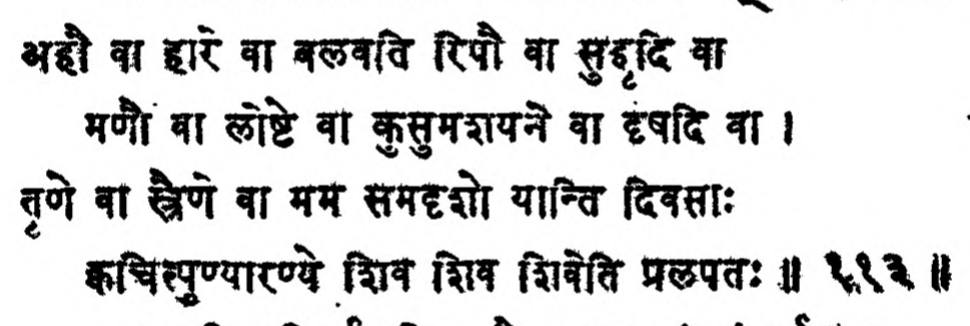
अहौ वा हारे वा बलवति रिपौ वा सुहृदि वा
मणौ वा लोष्टे वा कुसुमशयने वा दृषदि वा ।
तृणे वा स्त्रैणे वा मम समदृशो यान्ति दिवसाः
क्वचित्पुण्यारण्ये शिव शिव शिवेति प्रलपतः ॥ ११३ ॥
Notes
St. CXIII.—स्त्रैण = collection of women. See Siddh. Kaum. I., 491 and comp. Uttararâmacharita p. 114. यान्तु perhaps is a better reading than यान्ति.—S'ikhariṇî.


Kale
all
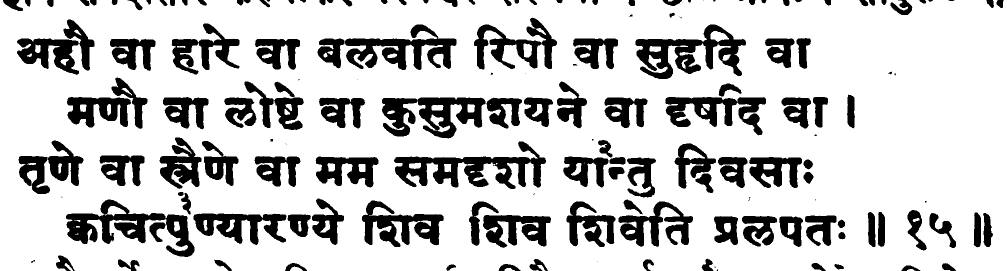
अहौ वा हारे वा बलवति रिपौ वा सुहृदि वा
मणौ वा लोष्टे वा कुसुमशयने वा दृषदि वा ।
तृणे वा स्त्रैणे वा मम समदृशो यान्तु दिवसाः
क्वचित्पुण्यारण्ये शिव शिव शिवेति प्रलपतः ॥ १५ ॥
Translation
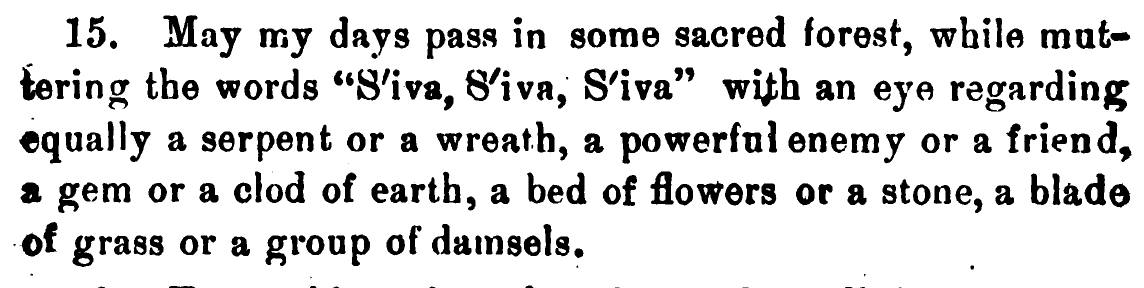
15. May my days pass in some sacred forest, while muttering the words “S'iva, S'iva, S'iva” with an eye regarding equally a serpent or a wreath, a powerful enemy or a friend, a gem or a clod of earth, a bed of flowers or a stone, a blade of grass or a group of damsels.
Notes
Sl. 15. बलवति-breaks the symmetry as this is the only noun having an adj. to quilify it. तृणे वा स्त्रैणे वा—स्त्रैण is used here more for the sake of alliteration than as being the recognised opposite of तृण as the other parts above are. स्त्रैणं—स्त्रीणां समूहः स्त्रैणम् from स्त्री + नञ् (न) a collection of women. समदृशः—of one that looks upon all things as equal, having an equal regard for all things.


Gopinath1914
all
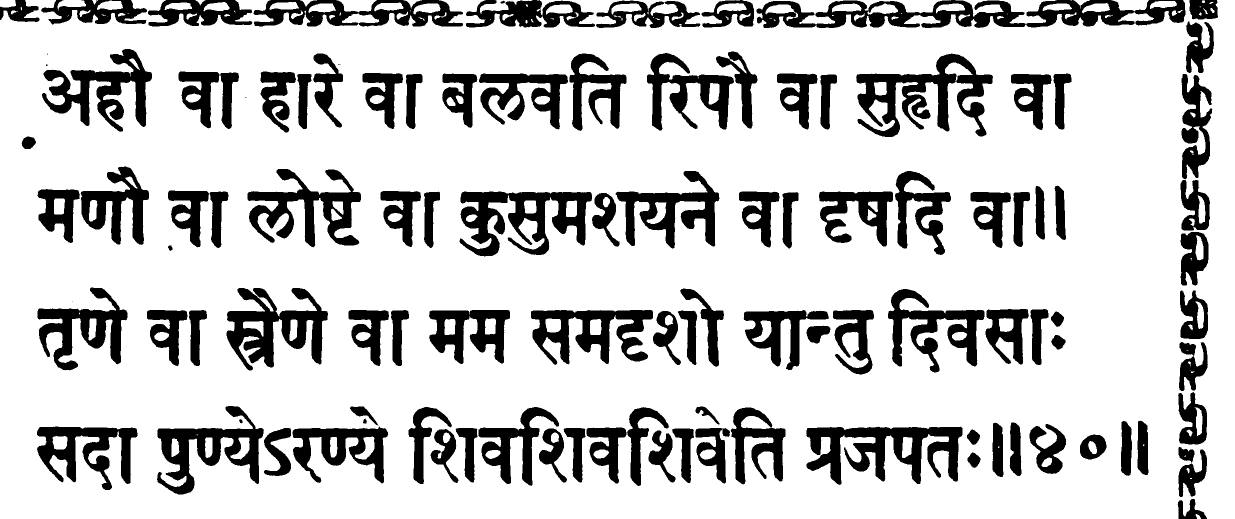
अहौ वा हारे वा बलवति रिपौवा सुहृदि वा
मणौ वा लोष्टे वा कुसुमशयने वा दृषदि वा ॥
तृणे वा स्त्रैणे वा मम समदृशो यान्तु दिवसाः
सदा पुण्येऽरण्ये शिवशिवशिवेति प्रजपतः ॥४०॥
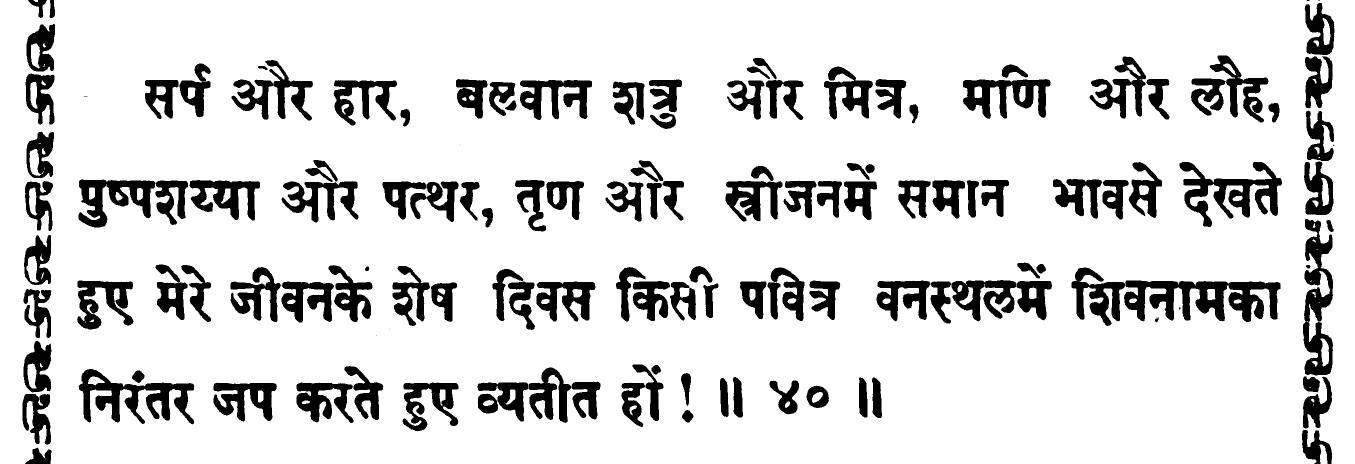
सर्प और हार, बलवान शत्रु और मित्र, मणि और लौह, पुष्पशय्या और पत्थर, तृण और स्त्रीजनमें समान भावसे देखते हुए मेरे जीवन के शेष दिवस किसी पवित्र वनस्थलमें शिवनामका निरंतर जप करते हुए व्यतीत हों ! ॥ ४० ॥
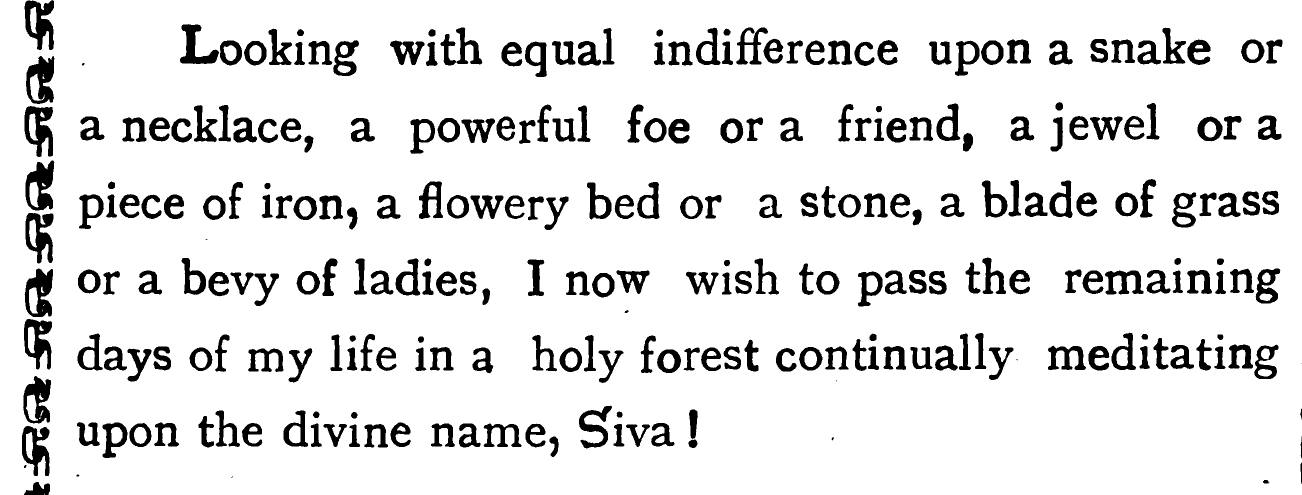
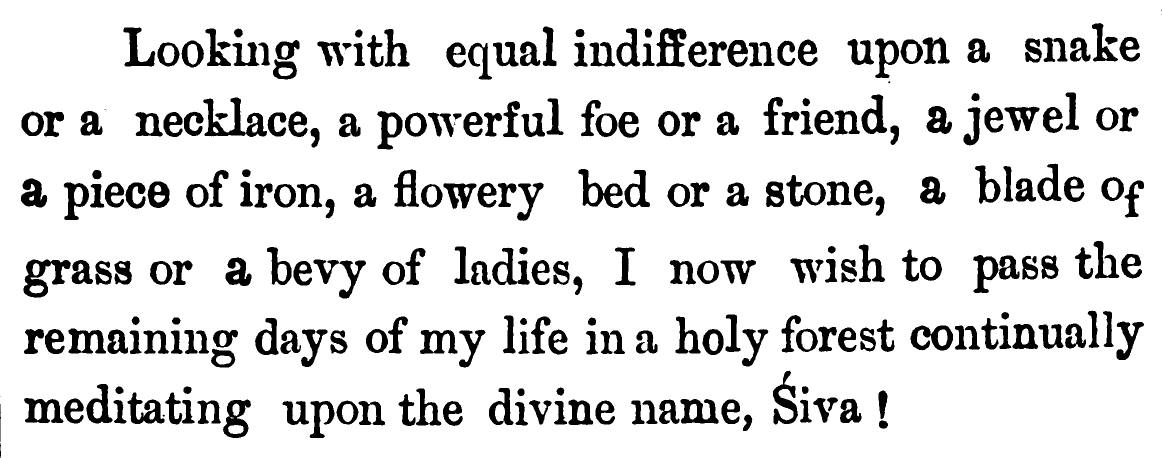
Looking with equal indifference upon a snake or a necklace, a powerful foe or a friend, a jewel or a piece of iron, a flowery bed or a stone, a blade of grass or a bevy of ladies, I now wish to pass the remaining days of my life in a holy forest continually meditating upon the divine name, Siva!
Footnote
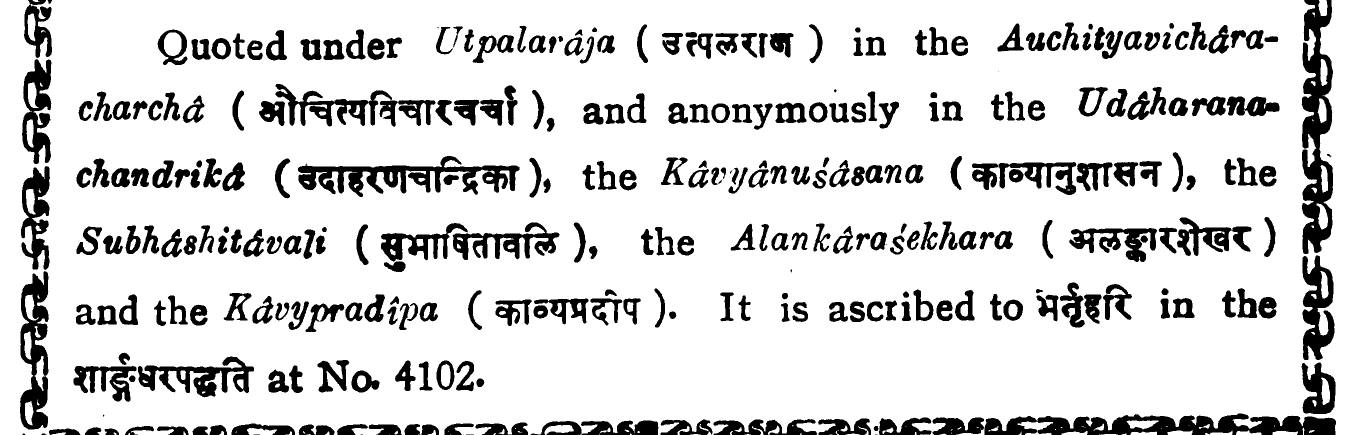
Quoted under Utpalaraja ( उत्पलराज ) in the Auchityavicharacharchá ( औचित्यविचार चर्चा ), and anonymously in the Uddharanachandrika (उदाहरणचन्द्रिका), the Kavyanuśasana ( काव्यानुशासन ), the Subhashitavali ( सुभाषितावलि), the Alankaraśekhara ( अलङ्कारशेखर ) and the Kávypradipa ( काव्यप्रदीप ). It is ascribed to भर्तृहरि in the शार्ङ्गधरपद्धति at No. 4102.
Gopinath1896
all
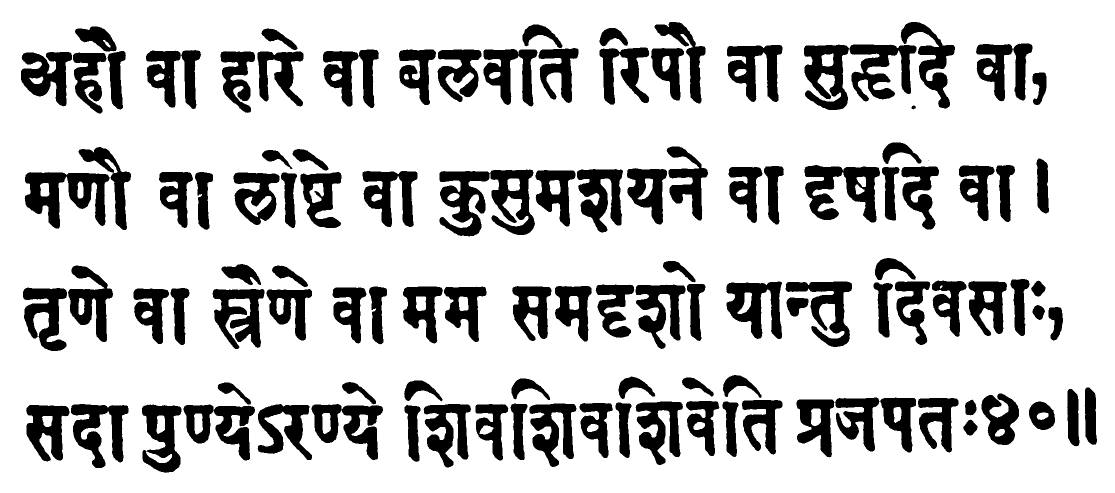
अहो वा हारे वा बलवति रिपौ वा सुहृदि वा,
मणौ वा लोष्टे वा कुसुमशयने वा दृषदि वा ।
तृणे वा स्त्रैणे वा मम समदृशो यान्तु दिवसाः,
सदा पुण्येऽरण्ये शिवशिवशिवेति प्रजपतः४० ॥
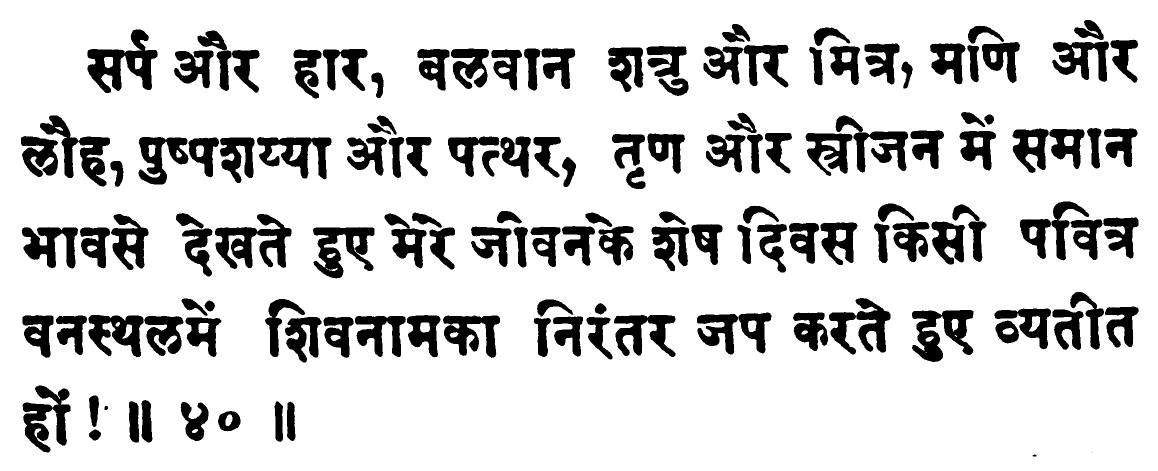
सर्प और हार, बलवान शत्रु और मित्र, मणि और लौह, पुष्पशय्या और पत्थर, तृण और स्त्रीजन में समान भावसे देखते हुए मेरे जीवन के शेष दिवस किसी पवित्र वनस्थलमें शिवनामका निरंतर जप करते हुए व्यतीत हों ! 1180 11
Kosambi
all
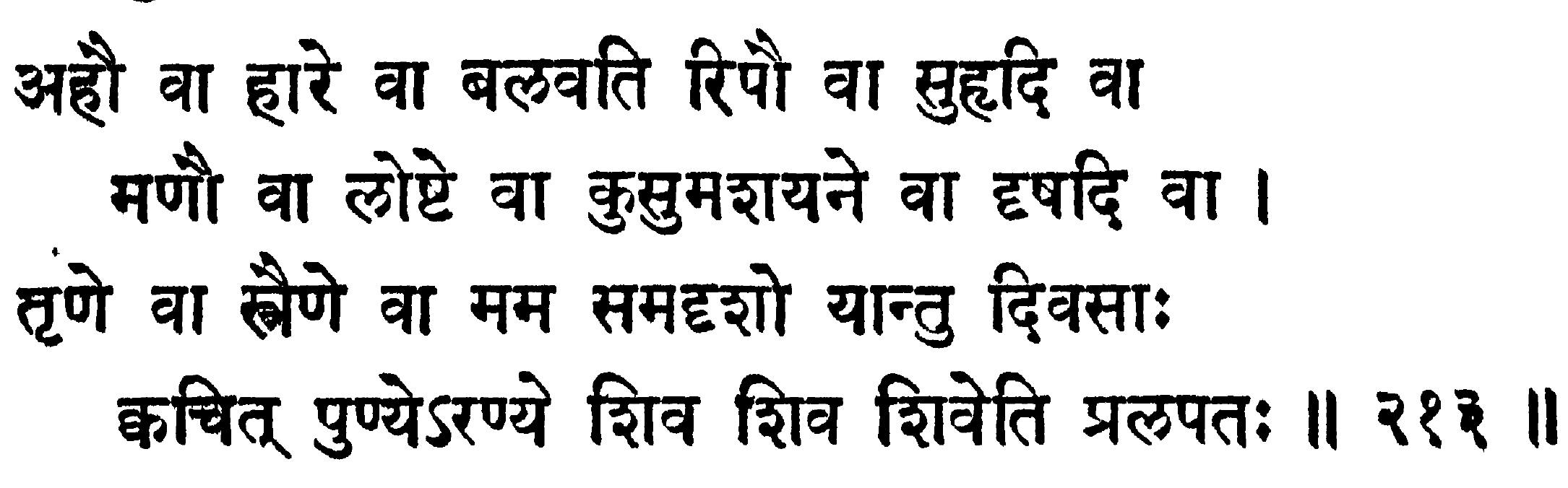
अहौ वा हारे वा बलवति रिपौ वा सुहृदि वा
मणौ वा लोष्टे वा कुसुमशयने वा दृषदि वा ।
तृणे वा स्त्रैणे वा मम समदृशो यान्तु दिवसा :
कचित् पुण्येऽरण्ये शिव शिव शिवेति प्रलपतः ॥ २१३ ॥
Footnote
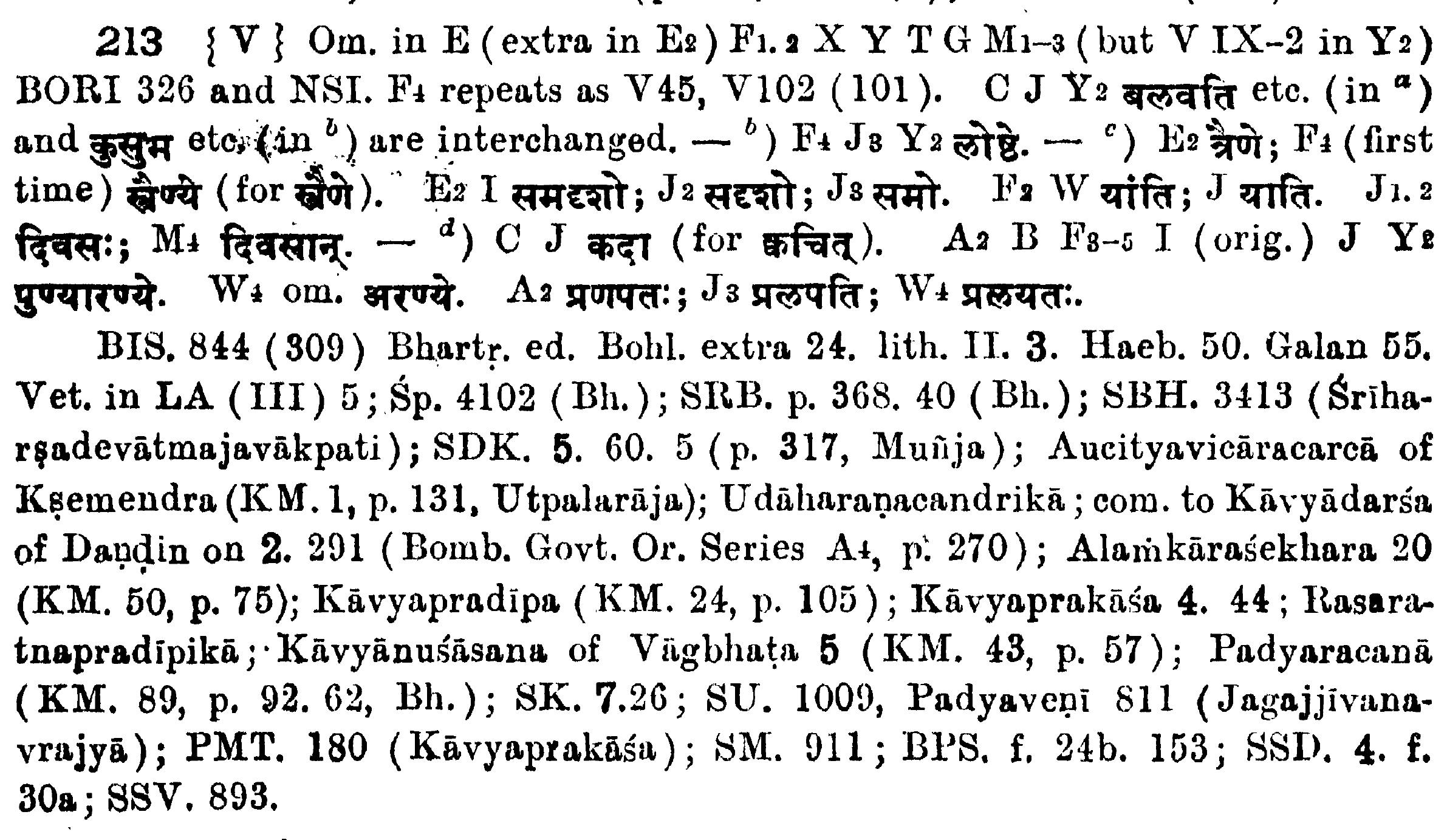
213 { V } Om in E ( extra in E2 ) F 1 2 X Y T G M1-3 ( but V IX - 2 in Y2 )
BORI 326 and NSI . F1 repeats as V45 , V102 ( 101 ) . C J Y 2 बलवति etc. ( in )
and कुसुम etortin ' ) are interchanged . — 4 ) F + J8 Y2 लोष्ठे . c ) E2 त्रैणे ; ; F1 ( first
time ) खैण्ये ( for लेणे ) . 62 1 समदृशो ; J2 सदृशो ; Js समो . F2 W यांति ; J याति . J1.2
दिवस :; M + दिवसानू – 4 ) C J कदा ( for क्वचित् ) . A2 B F 4 -5 I ( orig . ) J Ye
पुण्यारण्ये . W + om . अरण्ये . 42 प्रणपतः ; J3 प्रलपति ; W + प्रलयतः .
BIS . 844 ( 309 ) Bhartr . ed Bohl . extra 24. lith . II . 3. Haeb . 50. Galan 55 .
Vet . in LA ( III ) 5 ; Śp . 4102 ( Bh . ) ; SR.B. p . 368.40 ( Bh . ) ; SBH 3413 ( Sriha -
rşadevātmajavākpati ) ; SDK . 5. 60. 5 ( p . 317 , Muñja ) ; Aucityavicăracarcã of
Kṣemendra ( KM . 1 , p . 131 , Utpalarāja ) ; Udāharaṇacandrikā ; com . to Kāvyādarśa
of Dandin on 2. 291 ( Bomb Govt . Or . Series At , p . 270 ) ; Alamkāraśekhara 20
( KM . 50 , p . 75 ) ; Kāvyapradīpa ( KM . 24 , p . 105 ) ; Kāvyaprakāśa 4. 44 ; Rasara
tnapradipikå ; · Kāvyānusāsana of Vāgbhata 5 ( KM . 43 , p . 57 ) ; Padyaracanā
( KM . 89 , p . 92. 62 , Bh . ) ; SK . 7.26 ; SU . 1009 , Padyaveni 811 ( Jagajjivana
vrajyā ) ; PMT . 180 ( Kāvyaprakāśa ) ; SM . 911 ; BPS f , 24b 153 ; SSD . 4. f .
30 & ; SSV . 893 .
Commentary