Ryder
BEASTS
Men void of learning, character, and worth,
Religion, kindness, wisdom, piety,
Are but a mortal burden on the earth;
Such men are beasts allowed to wander free.
Tawney
Those slaves who neither fast nor give,
Unjust, unthinking, idle live,
Are beasts, though men by right of birth,
Unwieldy burdens, cumbering earth.
Telang
all
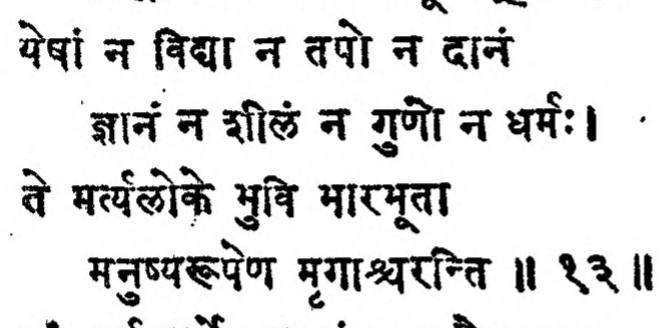
येषां न विद्या न तपो न दानं
ज्ञानं न शीलं न गुणो न धर्मः ।
ते मर्त्यलोके भुवि भारभूता
मनुष्यरूपेण मृगाश्चरन्ति ॥ १३ ॥
Notes
St. XIII.—मर्त्यलोके must be construed with चरन्ति and भुवि with भारभूताः. The commentary is not quite explicit.—Upajâti.


Kale
all
येषां न विद्या न तपो न दानं ज्ञानं न शीलं न गुणो न धर्मः ।
ते मर्त्यलोके भुवि भारभूता मनुष्यरूपेण मृगाश्चरन्ति ॥ १३ ॥

Translation
13. Those who do not possess learning, or practise penance or give gifts, or have knowledge, character, virtue or religious merit, roam in the mortal world as beasts in a human form, a mere burden to the earth.

Notes
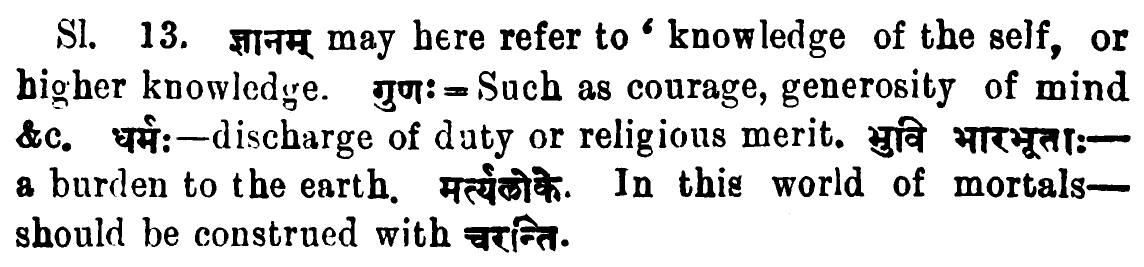
Sl. 13. ज्ञानम् may here refer to ‘ knowledge of the self, or higher knowledge. गुणः=Such as courage, generosity of mind &c. धर्मः—discharge of duty or religious merit. भुवि भारभूताः— a burden to the earth. मर्त्यलोके. In this world of mortals— should be construed with चरन्ति. मनुष्यरूपेण &c—The fig. here is Apahnuti. प्रकृतं यन्निषिध्यान्यत्स्थाप्यते सात्वपह्नुतिः’ where the real thing ( the matter in hand, the उपमेय ) is denied and some thing unreal ( the उपमान ) is affirmed in its place, that is Apahnuti. cf. विद्याविहीनः पशुः Sl. 20.

Gopinath1914
all
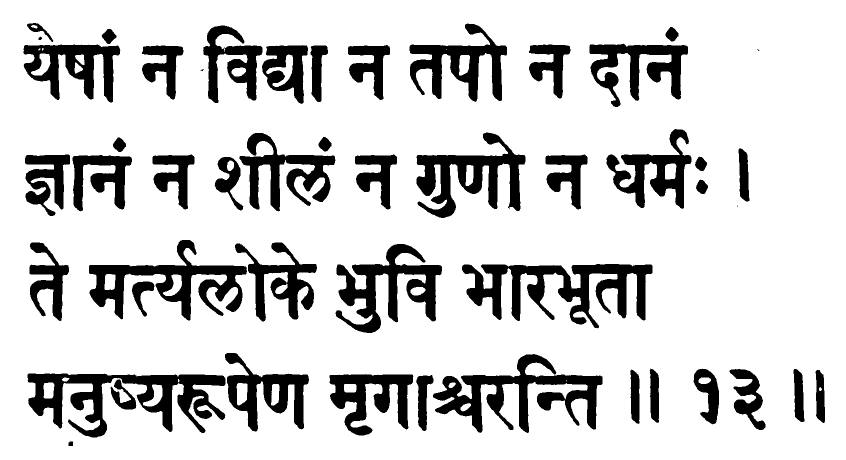
येषां न विद्या न तपो न दानं
ज्ञानं न शीलं न गुणो न धर्मः ।
ते मर्त्यलोके भुवि भारभूता
मनुष्यरूपेण मृगाश्चरन्ति ॥ १३ ॥
जिन मनुष्योंने न तो विद्याध्ययनही कियाहै, न तपश्चरणही किया है, न दानही दिया है, न ज्ञानही संपादन किया है, न सुशीलहीका आचरण किया है, न गुणोपार्जनही किया है और न धर्मानुष्ठानही किया है, वह इस मर्त्यलोकमें केवल आकृतिमात्रसे मनुष्य कहलाते हैं; परंतु वास्तवमें वह साधारण मृगोंकी भांति पृथ्वीमाताके वृथाभाररूप हैं ॥ १३ ॥
Those who have neither learning, nor devotion, nor charity, nor spiritual knowledge, nor good conduct, nor morality, nor religious faith are nothing less than mere useless burdens to mother earth, wandering over this mortal world like the wild deer in a human form.
Footnote
IlliadProf. See Tawney Tawney's cites Two a Centuries striking parallel of Bhartriharito this stanza p. 6. from the



Gopinath1896
all
येषां न विद्या न तपो न दानं
ज्ञानं न शीलं न गुणो न धर्मः ।
ते मर्त्यलोके भुवि भारभूता
मनुष्यरूपेण मृगाश्चरन्ति ॥ १३ ॥
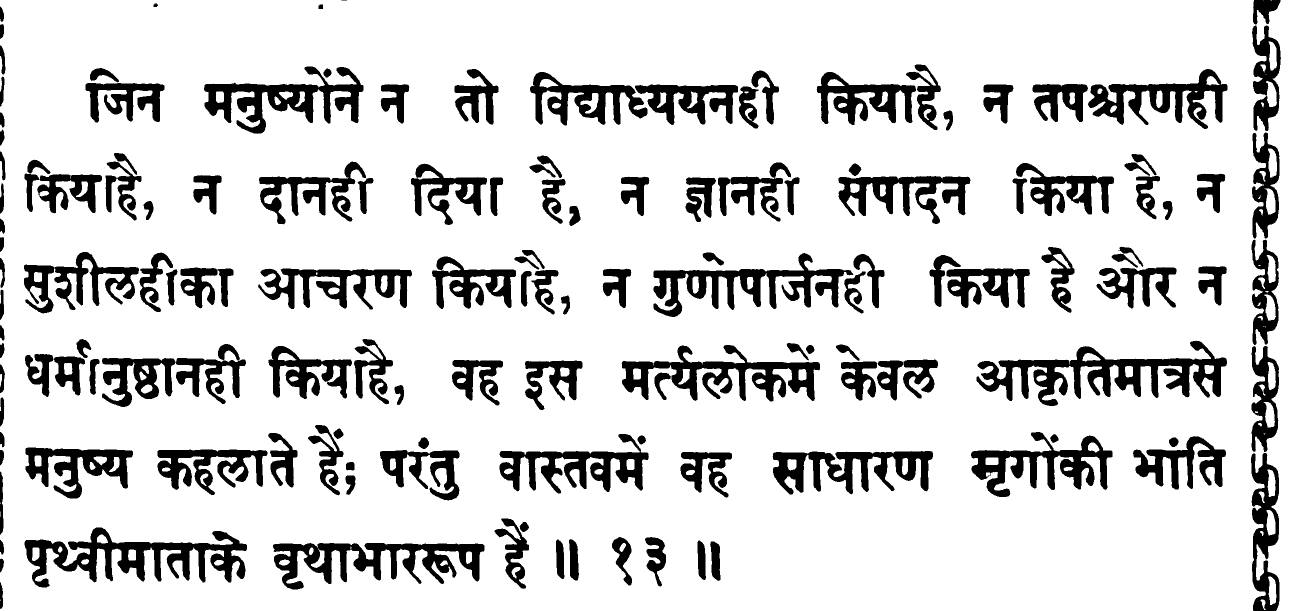
जिन मनुष्यों ने न तो विद्याध्ययनही किया है, न तपश्चरणही किया है, न दानही दिया है, न ज्ञानही • संपादन किया है, न सुशीलहीका आचरण किया है, न गुणोपार्जनही किया है और न धर्मानुष्ठानही किया है, वह इस मर्त्यलोक में केवल आकृतिमात्रसे मनुष्य कहलाते हैं; परंतु वास्तवमें वह साधारण मृगोंकी भांति पृथ्वीमाताके वृथाभाररूप हैं ॥ १३ ॥
Those who have neither learning, nor devotion, nor charity, nor spiritual knowledge, nor good conduct, nor morality, nor religious faith are nothing less than mere useless burdens to mother earth, wandering over this mortal world like the wild deer in a human form.
Footnote
Prof. Tawney cites a striking parallel to this stanza from the Illiad. See Tawney's Two Centuries of Bhartrihari, p. 6.



Commentary