Tawney
O for those days when I shall dwell alone
Among the snowy hills by Ganga's stream,
In stony torpor stiffened on a stone,
Inly conversing with the One Supreme,
Rapt in devotion, dead to all beside,
And deer shall fray their horns against my senseless hide.
Mādhavānanda
गङ्गातीरे हिमगिरिशिलाबद्धपद्मासनस्य
ब्रह्मध्यानाभ्यसनविधिना योगनिद्रां गतस्य ।
किं तैर्भाव्यं मम सुदिवसैर्यत्र ते निविर्शङ्का:
कण्डूयन्ते जरठहरिणा: स्वाङ्गमङ्गे मदीये ।।९८।।
98. Will those happy days come to me when on the bank of the Gaṅgā, sitting in the lotus-posture on a piece of stone in the Himalayas, I shall fall into the yoga-nidrā (i.e., lose all consciousness in samādhi or perfect concentration) resulting from a regular practice of the contemplation of Brahman, and when old antelopes having nothing to fear, will rub their limbs against my body!
[पद्मासनम्— lit. lotus-seat; sitting cross-legged so that the soles of the feet protrude above along the thighs.]
Telang
all
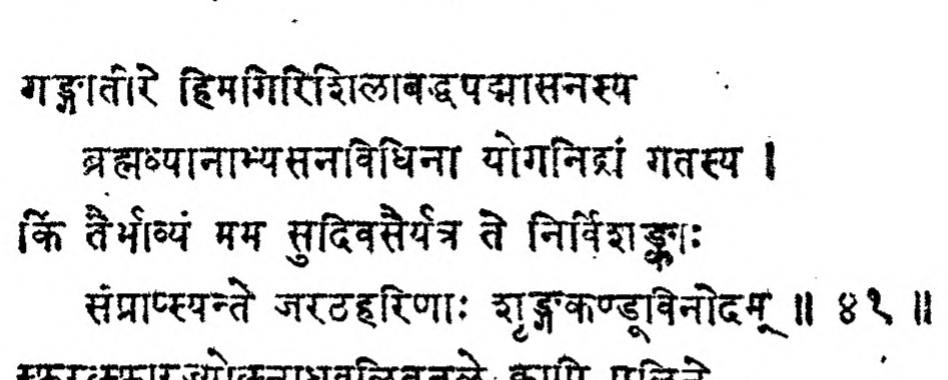
गङ्गातीरे हिमगिरिशिलाबद्धपद्मासनस्य
ब्रह्मध्यानाभ्यसनविधिना योगनिद्रां गतस्य ।
किं तैर्भाव्यं मम सुदिवसैर्यत्र ते निर्विशङ्काः
संप्राप्स्यन्ते जरठहरिणाः शृङ्गकण्डूविनोदम् ॥ ४१ ॥
Notes
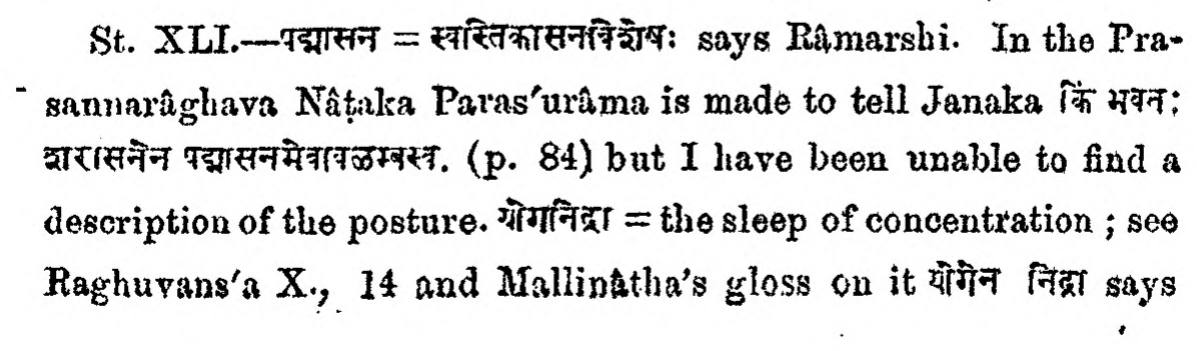
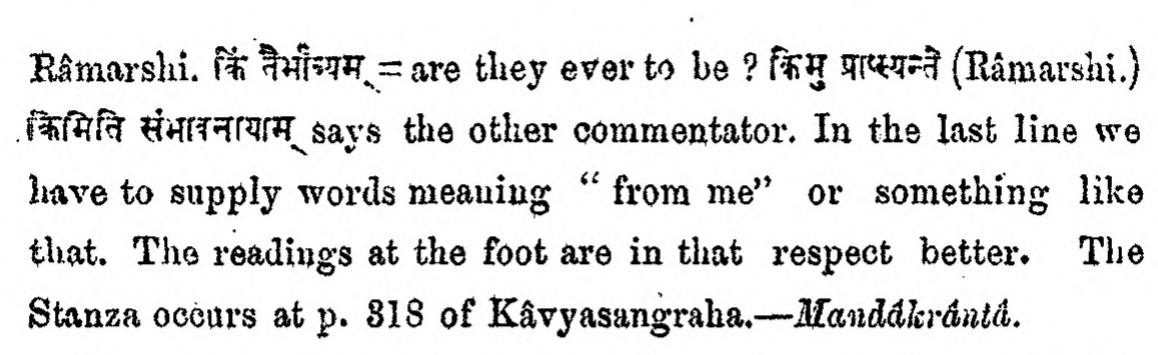
St. XLI.—पद्मासन = स्वस्तिकासनविशेषः says Râmarshi. In the Prasannarâghava Nâṭaka Paras'urâma is made to tell Janaka किं भवतः शरासनेन पद्मासनमेवावलम्बस्व. (p. 84) but I have been unable to find a description of the posture. योगनिद्रा = the sleep of concentration; see Raghuvans'a X., 14 and Mallinâtha's gloss on it योगेन निद्रा says Râmarshi. किं तैर्भाव्यम् = are they ever to be ? किमु प्राप्स्यन्ते (Râmarshi.) किमिति संभावनायाम् says the other commentator. In the last line we have to supply words meaning “from me” or something like that. The readings at the foot are in that respect better. The Stanza occurs at p. 318 of Kâvyasangraha.—Mandâkrântâ.

Kale
all

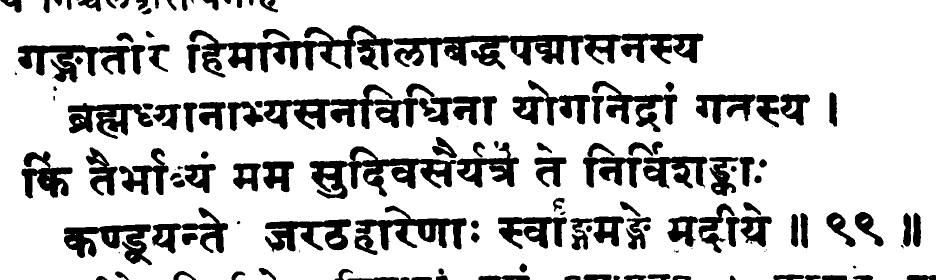
गङ्गातीरे हिमगिरिशिलाबद्धपद्मासनस्य
ब्रह्मध्यानाभ्यसनविधिना योगनिद्रां गतस्य ।
किं तैर्भाव्यं मम सुदिवसैर्यत्र ते निर्विशङ्काः
कण्डूयन्ते जरठहरिणाः स्वाङ्गमङ्गे मदीये ॥ ९९ ॥
Translation
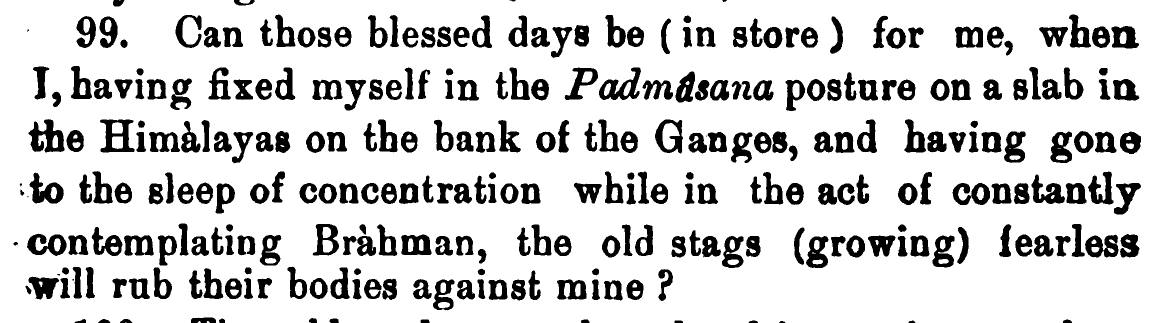
99. Can those blessed days be ( in store ) for me, when I, having fixed myself in the Padmâsana posture on a slab in the Himàlayas on the bank of the Ganges, and having gone to the sleep of concentration while in the act of constantly contemplating Bràhman, the old stags (growing) fearless will rub their bodies against mine ?
Notes
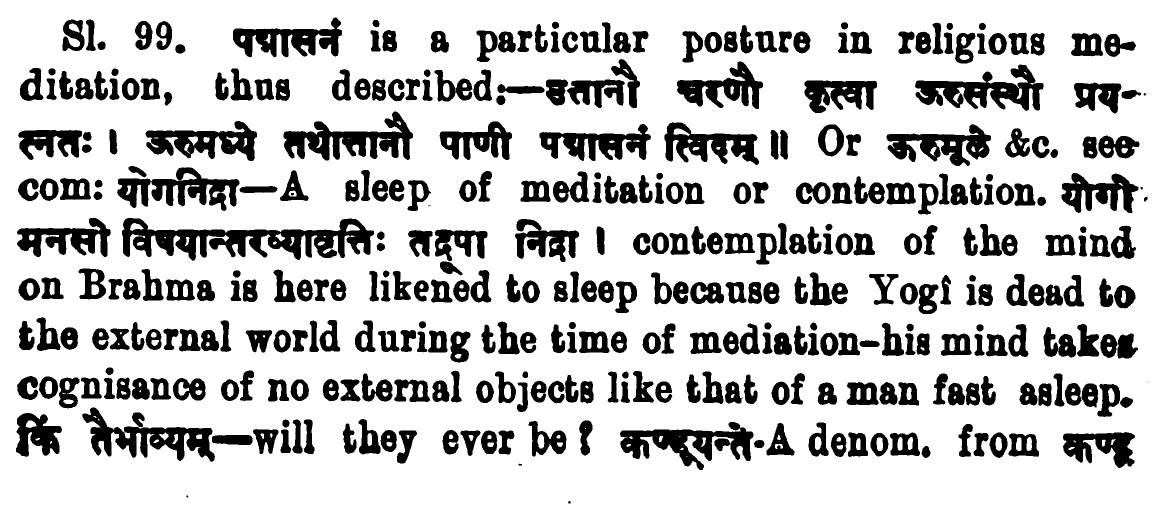
Sl. 99. पद्मासनं is a particular posture in religious meditation, thus described:—उत्तानौ चरणौ कृत्वा ऊरुसंस्थौ प्रयत्नतः । ऊरुमध्ये तथोत्तानौ पाणी पद्मासनं त्विदम् ॥ Or ऊरुमूले &c. see com: योगनिद्रा—A sleep of meditation or contemplation. योगी मनसो विषयान्तरव्यावृत्तिः तद्रूपा निद्रा । contemplation of the mind on Brahma is here likened to sleep because the Yogî is dead to the external world during the time of mediation–his mind takes cognisance of no external objects like that of a man fast asleep. किं तैर्भाव्यम्—will they ever be ? कण्डूयन्ते-A denom. from कण्डू ( कण्डूञ् अङ्गविघर्षणे ). The reading संपत्स्यन्ते &c. adopted by Mr. Telang ( see foot-note ) is more poetical but requires some such expression as ‘ from me ’ to be supplied.


Gopinath1914
all
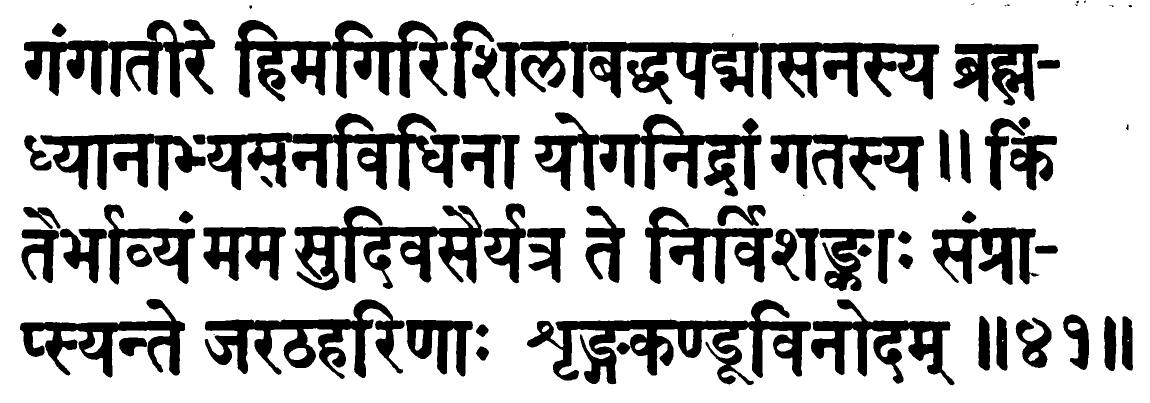
गंगातीरे हिमगिरिशिलाबद्धपद्मासनस्य ब्रह्म-
ध्यानाभ्यसनविधिना योगनिद्रां गतस्य ॥ किं
तैर्भाव्यं मम सुदिवसैर्यत्र ते निर्विशङ्काः संप्रा-
प्स्यन्ते जरठहरिणाः शृङ्गकण्डूविनोदम् ॥४१॥
श्रीगंगाजीके तीरवती हिमालयकी शिलापर पद्मासन लगाए हुए उन उत्तम दिवसोंका मुझको कब दर्शन होगा कि जब विधिपूर्वक ब्रह्मध्यानके अभ्यास से योगनिद्रा में सोते हुए मेरे शरीरको वृद्ध हरिण अपने शृंगाग्रभाग से निःशंक होकर खुजाने लगेंगे ! ४१ ॥
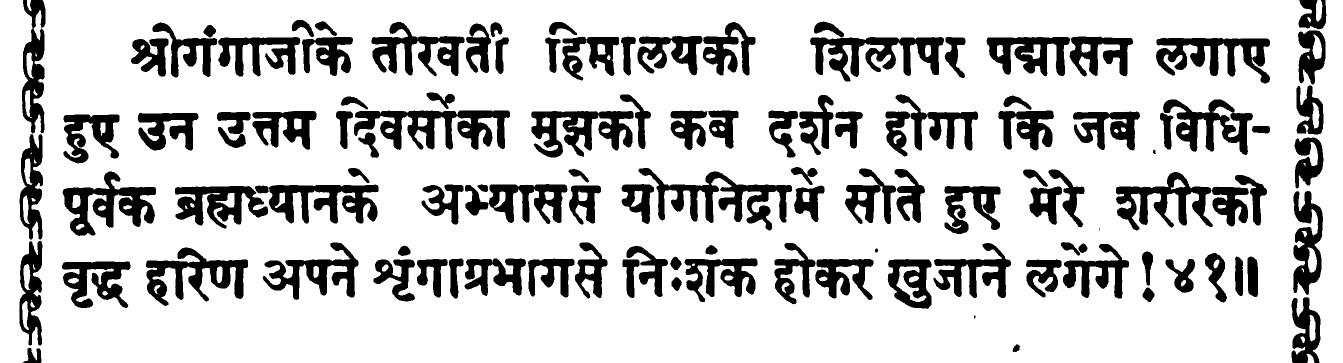
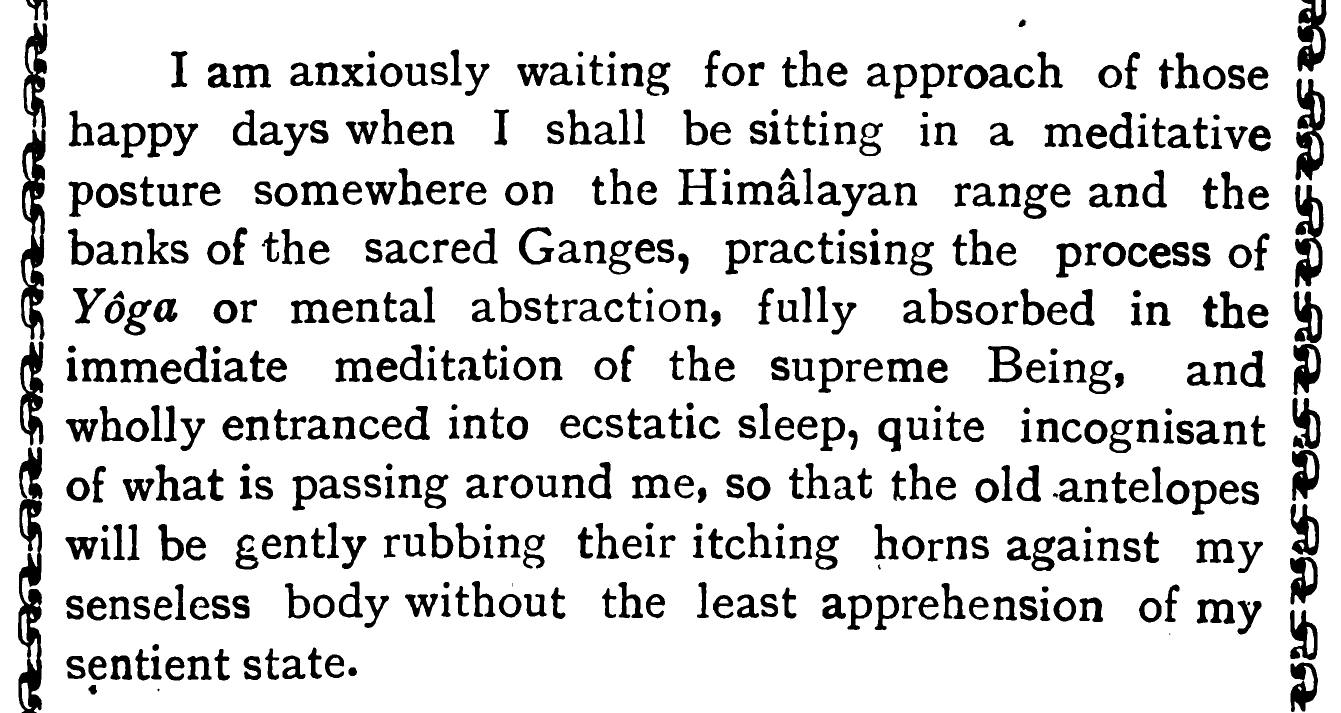
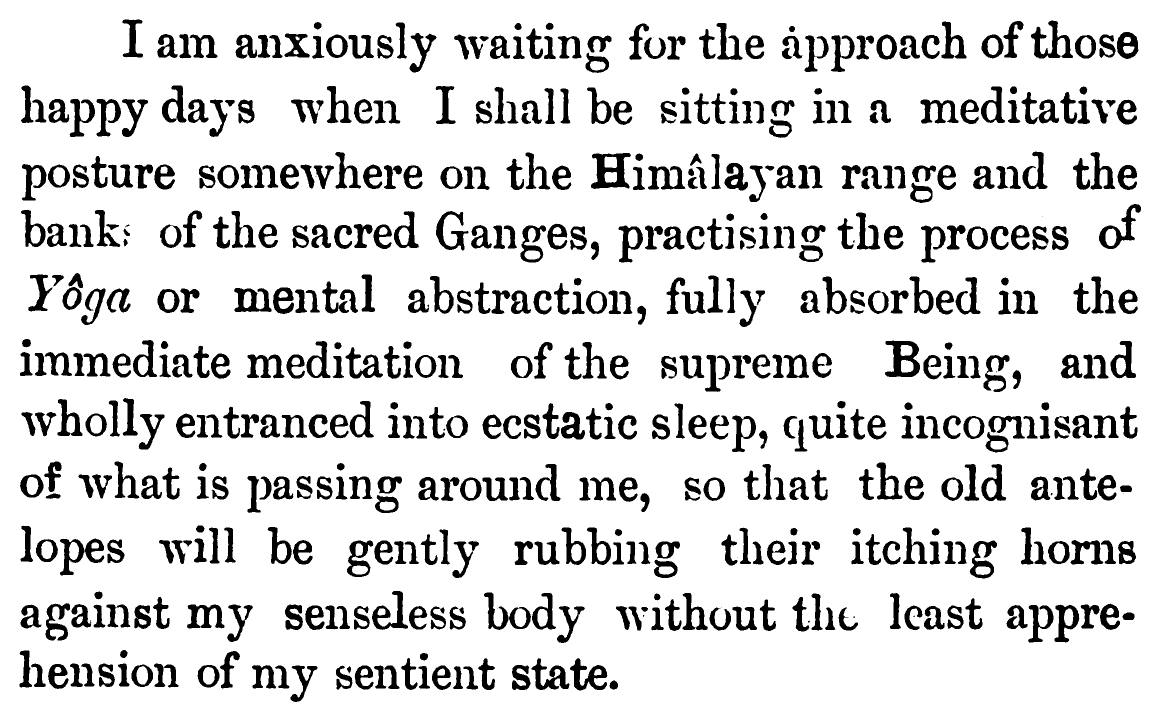
I am anxiously waiting for the approach of those happy days when I shall be sitting in a meditative posture somewhere on the Himâlayan range and the banks of the sacred Ganges, practising the process of Yoga or mental abstraction, fully absorbed in the immediate meditation of the supreme Being, and wholly entranced into ecstatic sleep, quite incognisant of what is passing around me, so that the old antelopes will be gently rubbing their itching horns against my senseless body without the least apprehension of my sentient state.
Gopinath1896
all
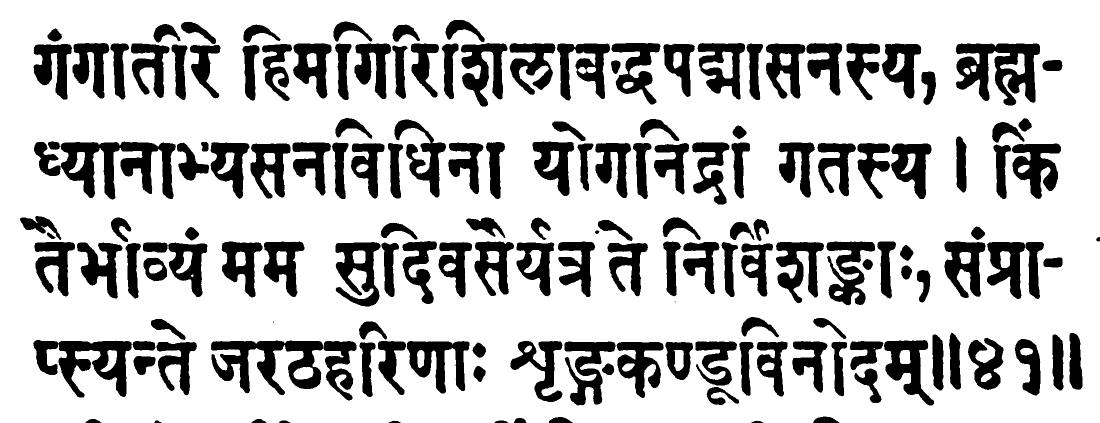
गंगातीरे हिमगिरिशिलाबद्धपद्मासनस्य, ब्रह्म-
ध्यानाभ्यसनविधिना योगनिद्रां गतस्य । किं
तैर्भाव्यं मम सुदिवसैर्यत्र ते निर्विशङ्काः, संप्रा-
प्स्यन्ते जरठहरिणाः शृङ्गकण्डूविनोदम् ॥४१॥
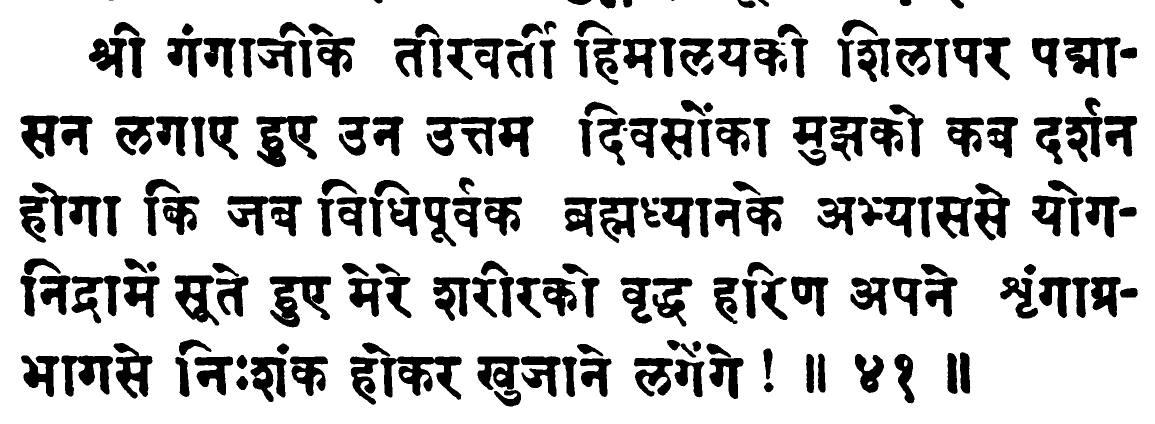
श्री गंगाजीके तीरवर्ती हिमालयकी शिलापर पद्मासन लगाए हुए उन उत्तम दिवसोंका मुझको कब दर्शन होगा कि जब विधिपूर्वक ब्रह्मध्यानके अभ्यास से योगनिद्रामें सूते हुए मेरे शरीरको वृद्ध हरिण अपने शृंगामभागसे निःशंक होकर खुजाने लगेंगे ! ॥ ४१ ॥
I am anxiously waiting for the approach of those happy days when I shall be sitting in a meditative posture somewhere on the Himalayan range and the banks of the sacred Ganges, practising the process of Yoga or mental abstraction, fully absorbed in the immediate meditation of the supreme Being, and wholly entranced into ecstatic sleep, quite incognisant of what is passing around me, so that the old antelopes will be gently rubbing their itching horns against my senseless body without the least apprehension of my sentient state.
Footnote
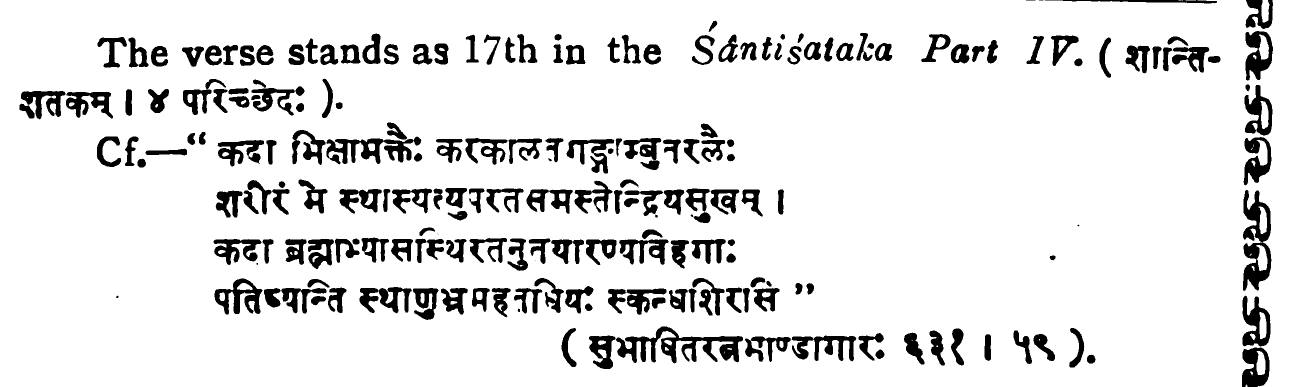
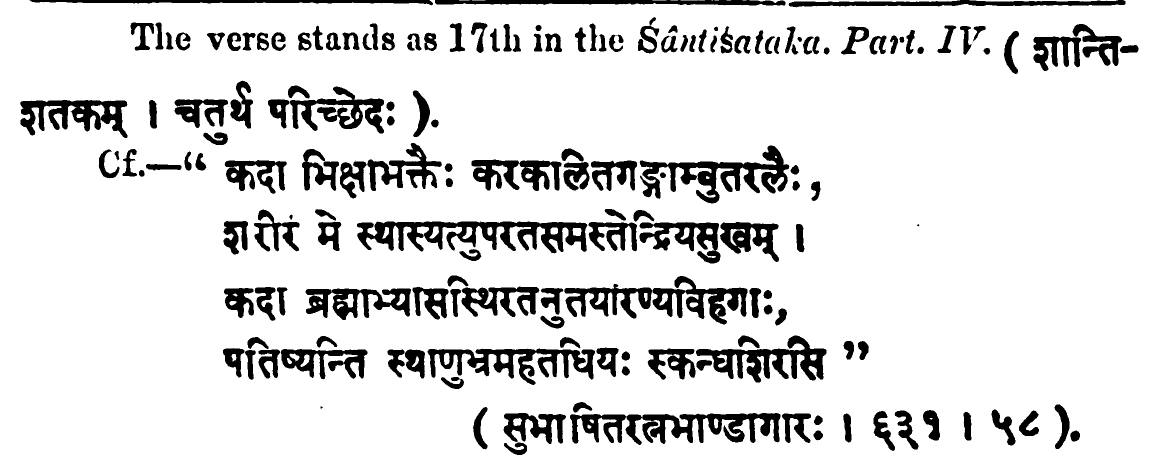
The verse stands as 17th in the śāntisataka. Part. IV. ( शान्तिशतकम् । चतुर्थ परिच्छेदः ). CE. - " कदा भिक्षाभक्तैः करकलितगङ्गाम्बुतरलैः, शरीरं मे स्थास्यत्युपरत समस्तेन्द्रियसुखम् । कदा ब्रह्माभ्यासस्थिरतनुतयारण्यविहगाः, पतिष्यन्ति स्थाणुभ्र महतधियः स्कन्धशिरसि " ( सुभाषितरत्नभाण्डागारः । ६३१ । ५८ ).
Kosambi
all
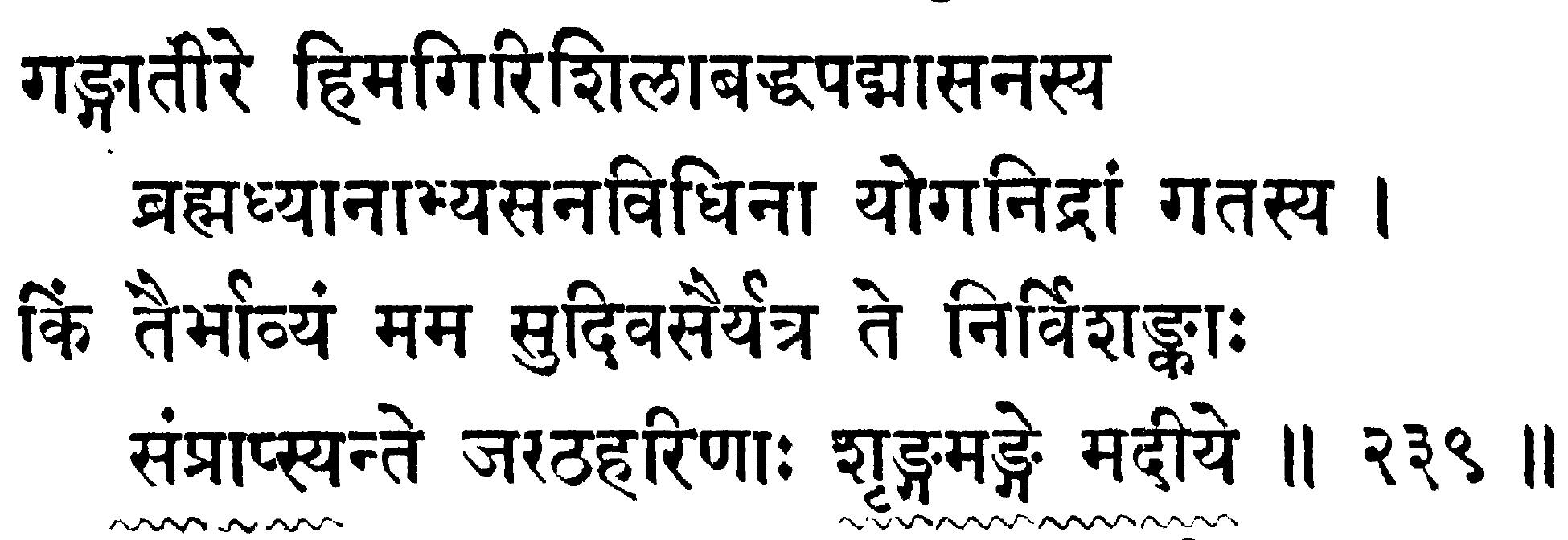
गङ्गातीरे हिमगिरिशिलाबद्धपद्मासनस्य
ब्रह्मध्यानाभ्यसनविधिना योगनिद्रां गतस्य ।
किं तैर्भाव्यं मम सुदिवसैर्यत्र ते निर्विशङ्काः
संप्राप्स्यन्ते जरठहरिणाः शृङ्गमङ्गे मदीये || २३ ९ ॥
Footnote
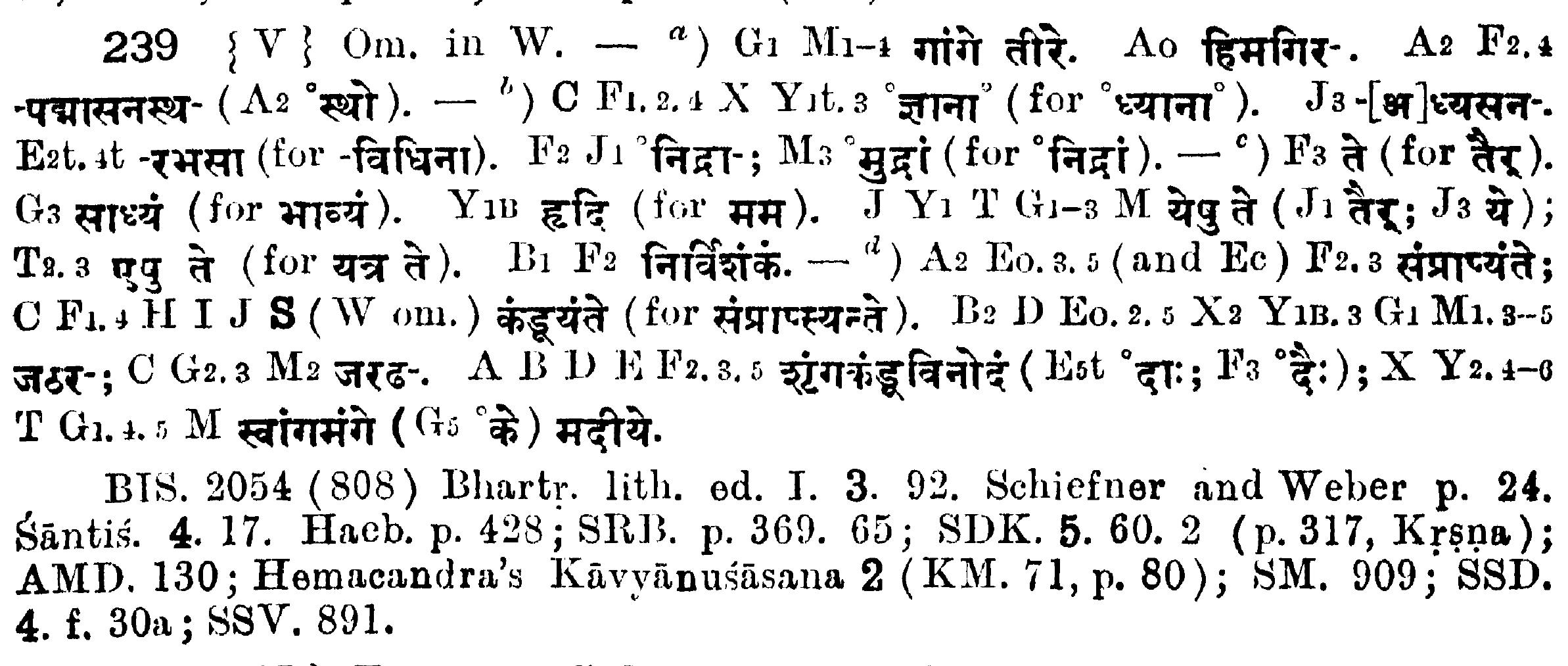
239 { V } Om . in W. a ) G1 M1 - 1 गांगे तीरे . 40 हिमगिर- A2 F2.4
- पद्मासनस्थ - ( 12 स्थो ) – 4 ) CF1 2 • 4 X Yat . 3 ' ज्ञाना ' ( for ' ध्याना ' ) . J3 - [ अ ] ध्यसन .
E2t . 4t - रभसा ( for -विधिना ) . F2 J1 ' निद्रा ; Ms ' मुद्रां ( for ' निद्रां ) . – . ° ) F3 ते ( for तैर् ) .
G3 साध्यं ( for भाव्यं ) . Y1u हृदि ( for मम ) . J Y1 T G1 - 3M येषु ते ( J1 तैर् ; J3 ये ) ;
T2 . 3 एषु ते ( for यत्र ते ) . B1 F2 निर्विशंकं . 2 ) A2 Eo . 3. 5 ( and Ec ) F 2. 3 संप्राप्यंते ;
C_F1 , 4 H_I_J_S ( W om . ) कंडूयंते ( for संप्राप्स्यन्ते ) . B2 D Eo . 2.5 X 2 Y1B 3 G1 M1 . 3-- 5
जठर- ; C G2.3 M2 जरढ- ABD E F2.35 शृंगकंडू विनोदं ( Est ° दाः ; F3 ° दैः ) ; X Y 21-0
T G1 . ± 5 M स्वांगमंगे ( के ) मदीये .
BIS . 2054 ( 808 ) Bhartr . lith . od . I. 3. 92. Schiefner and Weber p . 24 .
Santis . 4. 17. Hacb . p . 428 ; SRB . p . 369. 65 ; SDK 5.60.2 ( p . 317 , Krsna ) ;
AMD . 130 ; Hemacandra's Kāvyānuśāsana 2 ( KM . 71 , p . 80 ) ; SM . 909 ; SSD .
4. f . 30a ; SSV . 891 .
Commentary